Archives for Reference Question:
February 6th, 2016 Brian Herzog
 I've said this before and I'll say it again, but I know that sometimes, some things are funny only to me. One day this week, a patron walks up to the desk and says,
Patron: Can you help me find a book? The title is, The [szuunnttz] of Murder.
Me: I'm sorry, what was that first word - "sounds" or "silence?"
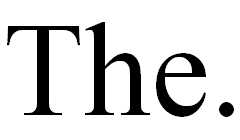
Patron: "The."
Me: Um...
And then she set her phone down on the desk and spun it around so I could see the title: The silence of murder, by Dandi Daley Mackall.
Ha. I blame our cataloger for constantly drilling into me to ignore the leading article in a title when typing it into a library catalog. Unfortunately, I can apparently no longer tell the difference between typing a title into a computer and asking a real live patron what the title is. Oh well.
Th good news is that the book was in the catalog, and I showed the patron how to place a request for it, so everyone was happy. Even the patron, who perhaps now thinks I'm an idiot. Oh well. It also made me wonder if patrons have blogs where they share all their stories of crazy interactions with librarians - now that would be interesting.
Posted under Uncategorized | 3 Comments »
January 23rd, 2016 Brian Herzog
 After I published the post on Wednesday about the likelihood of this blog changing due to my new position, I forgot to mention that until we hire a new Head of Reference (which will probably take a few weeks), I'm keeping my normal desk schedule - and so should be able to keep up with Reference Questions of the Week.
Wednesday is my 1-9pm shift, and I published that post from home that morning. I decided that when I got to work that day, the very first reference question I got would be this week's post. Usually I just take notes whenever something comes up that is interesting or funny, but I thought a random "slice of reference life" might be appropriate this week.
So, here it is: I sat down at the desk and the phone rings...
Me: Chelmsford Library, can I help you?
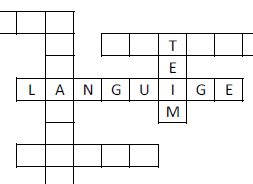
Patron: Can you tell me how to spell "language?"
Me: Oh sure, it's-
Patron: Does it have an "i" in it?
Me: No, it's spelled l-a-n-g-u-a-
Patron: Is it u-i-g-e?
Me: ... [waiting to make sure the patron has finished talking] It's l-a-n-g-u-a-g-e.
Patron: Oh, so an "a" and not an "i?"
Me: Yes, l-a-n-g-u-a-g-e.
Patron: Okay, thank you.
Me: You're welcome, good-bye.
This is one of our regular phone patrons, and most of her calls are like this. We suspect she works crossword puzzles.
Not every reference interaction is funny or interesting, but it's true that any of them can be.
Posted under Uncategorized | 2 Comments »
January 16th, 2016 Brian Herzog
 My library subscribes to OCLC's QuestionPoint service, which is a 24/7 chat reference resource our patrons can use anytime. We've had this for years, and it's been great - not only being able to offer patrons 24-hour assistance, but also the quality of the answers they get is just as good or better than they would have gotten from our staff.
Every month I total up our database usage stats, and also read the transcripts of the chat questions asked. Sometimes though, when the chat librarian can't answer the question for whatever reason, the chat librarian flags it as "followup by local library" and I'm notified by email that a patron needs more help.
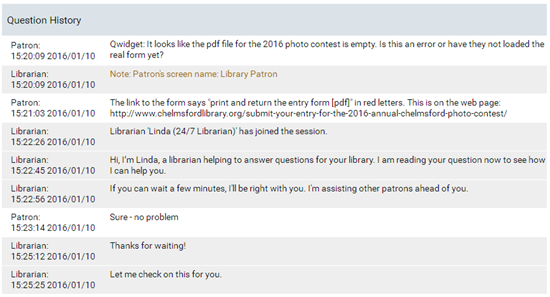
One of these followup notification emails was waiting for me when I got to the library this past Monday morning, after a chat session on Sunday. I logged into QuestionPoint to see what the question was, and found,
I had just put up the blog post in question the previous week, with the link to the contest application. I didn't have an electronic copy of the application, so I had to scan one of the print forms and make my own PDF.
So I was surprised to read the patron say it didn't work, because I remember opening it to double-check the margins of the scan looked okay.
Knowing that it worked, and thinking the patron must just be doing something wrong, I kept reading the chat transcript - confident that the chat librarian would have my back and set the patron right. But then this happened...
What? Well, maybe something was actually wrong, if the chat librarian was seeing a blank page too.
So of course, I immediately go to the blog post and try the link again - and sure enough, it works just fine. So, I create a new PDF of the form, and email it directly to the patron (email is included in the chat transcript), apologizing for the problem and asking him to let me know if this one doesn't work.
The patron emailed back to say thanks, and a little more. After getting my message saying that it worked for me, the patron kept experimenting with the PDF link, and explained what he found:
Hi Brian.
OK - here's the scoop in case you get any others with this issue. This looks like a Google Chrome browser issue, and it may be unique to my computer, perhaps a settings problem. The PDF document opens fine in IE, Firefox, and Edge. It even opens fine in Chrome if I save the file first. But when I try to link to the file via the web it opens but with blank content. [...]
Thanks again for your follow up. I hope I haven't wasted too much of your time.
Wasted my time? You just did my job for me!
I'm glad it worked for him, but I was curious to see if this issue was just this one patron, or a Chrome thing. A quick search for Chrome blank PDF turned up a lot of relevant results, including some on Google forums. It seems like this is indeed a Chrome problem. And not exactly a new one at that, so I'm surprised that this is the first I was encountering it.
It also explains why the chat librarian had the same issue, while everything worked fine for me in Firefox.
It's not very often that I outsource my job, but in this one instance, I outsourced it twice - first to the chat librarian, and second to the patron.
Tags: blank, chat reference, chrome, libraries, Library, oclc, pdf, public, questionpoint, Reference Question, Service, Technology
Posted under Uncategorized | Comments Off on Reference Question of the Week – 1/10/16
January 9th, 2016 Brian Herzog
 Maybe it's not the best way to start off a new year by having someone question the very fabric of your everyday life.
This week, the first full week after the New Year's holiday, someone did just that - and for a few seconds, what he said made enough sense that I doubted that what I thought I knew was true, and underwent an instantaneous reevaluation of my career as a librarian. But luckily, it passed.
In my library, the non-fiction stacks start right next to the Reference Desk - so on the first shelf closest to us are the 000-152s. This, of course, includes the computer books, which is good because this is a section we get asked about a lot.
Such was the case this Wednesday night. A patron walked up and asked where the programming books were, and without a second thought I walked with him the few steps to the first shelf.
As I was giving my normal spiel about, "here are the programming books, and next come applications and then web stuff," the patron interrupted me by saying,
These books are out of order.
Oh. Well, that's actually not uncommon in the computer books - partly because it's a frequently-used collection, and partly, I think, because we have so many books with the exact same Dewey number that people don't always get them in the right order by Cutter.
I started to apologize to the patron and say something to this effect, when he stepped up to the shelf, took a book off, moved it over a couple books and replaced it on the shelf, then took a step back and said,
It's a common mistake, that's a silent "D."
I looked more closely at the book he moved and saw,
He said it so matter-of-factly that it was at this point that I wondered if I missed a day in library school and have subsequently been shelving books incorrectly my entire career. What other words have common silent letters? Should books about Czars be in the "Zs?" And wherever should we be shelving phone books?
However, rather than get into it with him, I went back to the desk and left him to browse the books. I saw him leave a few minutes later with three or four, so that was great.
And after he left I went back over to look at the books, and sure enough, these were still like that. I'd recovered my own confidence by this point, and reshelved the books so that they were correct again. Take that, patron of anarchy!
Posted under Uncategorized | 8 Comments »
January 2nd, 2016 Brian Herzog
 If you're a reference librarian long enough, eventually you might hear every possible question - even those you'd never think someone would ask.
Due to traveling for Christmas and how New Year's Eve fell this year, this past week was a short one for me. However, that didn't stop one patron from sneaking in this phone question on Wednesday evening:
Me: Chelmsford Library, can I help you?
Patron: Hi, my husband and I were watching a show last night which we liked, and then I found out it was a series, and we'd like to watch all the earlier episodes to get caught up, so I thought I'd get them from the library, so can you help me with this, I mean find those old shows for me, I don't know how many there are...
Me: [glance at the timer on the phone and see that 30 seconds has already elapsed on this call without the patron giving me the information I need to actually start helping her, so even though I hate interrupting people, I have to break in with] Oh sure, what's the name of the show?
Patron: "Keeping up with the Kardashians."
Me: Oh, okay.
I mean, how do you respond to that? I've never seen this show, but the things I'm thinking are,
- Ugh.
- I feel like this show was on a long time ago
- Most libraries don't collect reality show DVDs
I don't like being snobby, but I really am surprised someone would go out of their way to track down old episodes of this show. Being timely and current was, I thought, part of the appeal, but I suppose if you get sucked into the personalities, it doesn't matter.
Of course I don't say any of this to the patron, and instead just quickly and quietly search our consortium catalog, but that came up empty. The next step for us is to search Massachusetts' statewide Commonwealth catalog - which, very surprisingly, has seasons 1-3.
Now that is impressive - to me. The patron, however, is a little disappointed there aren't more, although neither of us know how many seasons there were (another surprise for me: this show started in 2007 and is currently in it's 11th season).
So there you go. I requested the available DVDs to get the patron started, and asked her to check back after she got caught up. Perhaps by then there will be more in the system, or we can ILL from outside the state, or I'll be able to find episodes somewhere online, or she will have found a marathon or something on television.
I'm sure there are all kinds of crazy things I check out of the library that other people would never think someone would want, so yay for a public library coming through with what a patron was looking for.
Posted under Uncategorized | 2 Comments »
December 19th, 2015 Brian Herzog
One slow evening, a patron walked up to the desk and asked if anyone had turned in a pair of glasses.
In my library, we have two lost-and-founds - one on each floor. I try to keep the downstairs one, at the Reference Desk, limited to valuable and personally-identifiable things only, and bring things like glasses, coats, dolls, etc., up to the main lost-and-found by the Circ Desk by the front door.
However, since this doesn't always work, I checked the Reference Desk lost-and-found to see if there were any glasses, and there were:
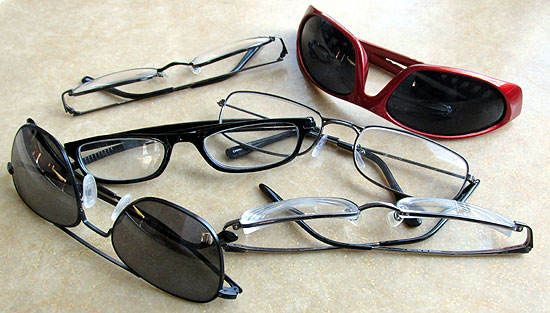
Far more than I would have expected. I asked the patron what his looked like, and he said,
They were gray, with big frames.
I didn't see any in the pile that I would describe that way, so I spread them all out on the desk for him to look through, just in case. Sometimes with lost-and-found requests, I get the feeling people think I'm lying to them, and that their item actually is right in front of me but I'm choosing not to give it to them. I don't really understand that, but it happens all the time.
So the patron starts looking through them, and then things get odd. There is one pair with gray frames, but definitely not "big frames." He picks up this pair and says,
Patron: Mine kind of looked like this, but were bigger. Do you think these are mine?
Me: [Having no idea what his glasses look like, and being surprised he'd ask that] Oh, I don't know - do they look like your glasses?
Patron: Kind of. [Continues to turn them over and over looking at them]
Me: [Stares at patron staring at glasses, wondering if he can't tell if they're his or not because his eyesight is so bad without glasses that everything just looks fuzzy.]
Patron: [Eventually puts glasses on.] These work pretty good. I can see. But they're bifocals, and mine weren't bifocals.
Me: Oh, then maybe those aren't yours after all. I'm sorry yours don't seem to be here.
Patron: [Still wearing the glasses, looking around the room.]
Me: [Watching patron look around the room.]
Patron: [Tilts head up and down, to alternately look through and look over bifocals.]
Me: [Still watching patron, but now starting to compose this blog post in my head.]
Patron: Maybe these aren't mine. But I can see well with them, so it seems like my prescription. I don't know who else would have my prescription.
Me: I think...
Patron: Maybe I need bifocals after all. Maybe I had them and didn't realize it. At least, these will let me drive home tonight and be able to see.
Me: Okay.
Patron: Do you think these are my glasses?
Me: I don't know, but if you think they're yours, you're welcome to them.
Patron: Thanks for finding my glasses.
With that, the patron turns and walks away. He sits back down at his computer for awhile, and then maybe a half an hour later packs up and leaves.
This whole exchange was strange, but primarily due to the idea of someone "stealing" someone else's item out of the lost-and-found. But really, I have no idea if that happened here - I don't know whose glasses those were, and they very well may have been that patron's.
Lost-and-found in the library has always kind of bothered me. On the one hand, I really like the idea of making sure a lost item get back to the right person. In many cases, this is easily possible - cell phones, lost flash drives (that, 99% of the time, have a resume with the person's name, phone, and email on it), purses, wallets, photocopies of important documents, etc - anything with ID or a person's name is usually returnable, and we make the effort to notify the person and hold the item until they pick it up.
Other things though - glasses, keys, coin purses, cell phone chargers, favorite pens, jewelry, hats, coats - that don't have any kind of identification, are just lost items. In general, we hold those at the desk until the end of the day (or until the end of the next day), and then take them up to the main lost-and-found by the Circ Desk. This one is just a basket in a public area, which anyone can look through to find their stuff.
This has the sense of "well anyone could just take anything," but at the same time, I really don't like the idea of library staff being responsible for lost items. Valuable or personally-identifiable things don't get put in the public lost-and-found basket, but everything else should.
Otherwise, we might have gotten into the situation of me, since I suspected these glasses may not have actually belonged to that patron, forcing him to prove to me that they were his, otherwise I wouldn't have let him take them. That is impossible and not a position library staff should be in.
Plus, I was kind of interested in the fact that this patron really seemed to think that eye care happens serendipitously - when the universe decided he needed bifocals, it gave him a pair. If nothing else, him driving home safely is a good thing.
Posted under Uncategorized | 2 Comments »