Archives for Service:
October 16th, 2008 Brian Herzog
 I hope everyone enjoyed Work Like a Patron Day, and found a way to make using the library easier for your patrons.
I didn't get to spend as much time as I had hoped, but I did notice a few things:
- We need more scrap paper at the workstations
- We need to clean up the litter and leaves and sticks and other debris around the front steps
- We should rename our wireless network from "CPL-g" to something an uninitiated patron will recognize and feel safe with
- It turns out that staff congregating and chatting at service desks is every bit as distracting as patrons on cell phones
But what struck me the most wasn't what I noticed, but what kinds of things I noticed. I mean, I already know that the patron catalog interface needs improvement, and that not everyone understands how to log on to a computer or where the photocopier is.
Everything I noticed yesterday were little things. Even though I'm among the public computers every day, and we replenish them with scrap paper when we see them empty, if you're a patron sitting there and there is no paper, it doesn't help that staff put some there that morning. It's not there now. And the junk around the front door is easy to miss when you've got on the blinders of familiarity - it's always there, so I stopped noticing it. But when you do notice it, it looks kind of bad.
So in addition to the original list, I'm also going to make a point of looking for the subtle things, like:
- Is there a glare on computers by the windows at certain parts of the day?
- Is it too hot/cold in here?
- Does it stink in here?
- How easy is the phone menu system to navigate?
Even if I can't change them, staff being aware of them is a good thing, because I'm sure our patrons are.
So thank you to everyone who supported and participated in the day. I got lots of emails and saw many posts and comments about it, which is great. In fact, I only saw one negative comment about it. It astounds me that someone who writes for Library Journal would criticize the idea of making the library a better place, but there you go.
Be sure to remember this day next year, too. More information is available on
http://www.libsuccess.org/index.php?title=Work_Like_A_Patron_Day and http://www.flickr.com/groups/worklikeapatronday.
Posted under Uncategorized | 1 Comment »
October 11th, 2008 Brian Herzog
 This week's question is actually one with me as the patron (well, in this case, customer). I was so impressed with the person who helped me, and how she helped me, that I thought I'd share. However, to keep her from getting into trouble, I'm going to change a few facts to protect her identity.
On the weekends lately I've been working on a project building boardwalks through a swampy park in Chelmsford (hey, librarians need fresh air too). I needed to rent a cordless circular saw, and in the process of calling around to local places that rent tools, I called a Lowe's Home Improvement store. After I explained what I needed, the customer service associate I spoke with said:
I'm sorry, but that is not a tool we rent. Furthermore, it is against Lowe's store policy for associates to suggest places like Taylor Rental at 555-555-5555, so I'm very sorry I can't help you.
I was laughing so hard I could barely say thank you and good-bye, and I think she appreciated it. I know I did - no rules were broken, and the customer service was friendly, informative, useful, and very memorable.
Because of this good experience, I'll definitely be shopping at that Lowe's in the future, despite their unhelpful official store policy. Just an example of why good customer service, and caring and helpful employees, is so important.
Posted under Uncategorized | 1 Comment »
October 4th, 2008 Brian Herzog
 Sometimes, an innocent reference question has the potential to turn into a multi-million dollar industry.
Late one evening, a man in his early-forties came up to the desk:
Patron: I'm looking for someone to drive my kids.
Me: Um... where to?
Patron: My kids get home from school about 3 o'clock, but wife and I don't get home from work until about 6 o'clock. Most of the activities they want to do (sports, dance lessons, piano lessons, etc.) are after school, but they can't do them because I can't drive them there. I'm looking for someone who can drive my kids to their activities and then bring them home afterwards. Can you give me the number of the group in town that does that?
Me: I don't know of any group that does that specifically. I think most people use nannies or babysitters, or carpools or relatives or neighbors. But I'll check around and email you what I find.
After a little more talking, I learned that he and his family had immigrated here from India a little over a year ago, and so didn't have family in the area and hadn't met many people yet. They couldn't afford to pay a babysitter, especially since the kids were old enough to be home alone, but just not old enough to drive.
I first checked with our Childrens Librarian, as the Childrens Desk usually knows about kid- or mom- or family-related resources in the area. And I was right. She told me that the middle schools in town have buses that move kids between the various schools to get them to school-related after-school activities. Also, she said that high school kids volunteer around town after school, and that perhaps he could find one of them that could drive his children around.
I next checked our Community Information database, which is a listing of social services and non-profit organizations in the area. Most of what I found were child services for low income families or at-risk kids, but there was also a listing for the Chelmsford Mother's Club.
This club is kind of like a support group for new and expectant mothers, so I didn't think it would help him directly. But I linked to the Mother's Club website from CommInfo, and found that they had put together a great resources page. I couldn't tell if any of them could help the patron, but it was a good list to start with.
I emailed these three options to the patron, but haven't yet heard back.
And after thinking about this question for a few days, this really does sound like a business that could make a fortune.
Tags: activities, after-school, children, drive, driving, kids, libraires, Library, public, Reference Question, ride, Service
Posted under Uncategorized | 1 Comment »
July 29th, 2008 Brian Herzog
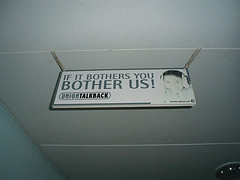 At the Simmons Tech Summit, we talked about more than just tech stuff - we had a good discussion on customer service in libraries, too.
A few of the attendees visit lots of libraries, and so witness different levels of customer service in action. Since good customer service is absolutely fundamental to libraries, we talked about a new trend that is a bit alarming.
We dubbed it "reverse justification," but what it boiled down to was libraries claiming "customer service" as the reason for continuing to do something "the way it's always been done" - regardless of whether or not patrons benefit from it. Examples:
- We only allow patrons to use the internet for 30 minutes a day ... because it's good customer service
- Bathroom doors are always to remain locked ... because it's good customer service
- Patrons cannot use flash drives, only floppy disks ... because it's good customer service
I'm not saying there aren't legitimate reasons for rules like these - technological limitations, staff shortages, etc. - but "customer service" is not it. Customer service is very important, so some serious critical thinking should always be applied when customer service is cited as a justification for something. Are the patrons really being served, or it is that policy/rule/situation just easiest for the library?
Tags: Conferences, customer service, gslis, libraries, Library, public, reverse justification, Service, simmons, simmons tech summit, unconference
Posted under Uncategorized | 4 Comments »
June 26th, 2008 Brian Herzog
 This isn't a new issue, but it's happen three times this week, so I thought I'd mention it: people using the library for storage.
I don't mean the library collection. I mean patrons using the friendly and easy-going atmosphere of the library as a safe place to either leave things, store things, or transfer things to someone else.
So far this week, I have been involved in the following situations:
- A patron who routinely leaves her notebook and text books at the library. She knows we clean up each night and hold things like this at the lost-and-found at the desk, in case someone comes to claim them. She said she knows they are safe, and it's easier than her lugging it all home each night
- A patron who emailed me important files from his home computer, because he was sending it out for service and didn't want to lose them (I won't even try to explain that he could have emailed them to himself instead of me, not to mention backing up to disk)
- A patron who uses the library as a drop-off point: for instance, if she needs to get some documents to someone else, and they can't meet personally, she'll leave them at the desk with that person's name on them and tell the other person to pick them up at the library
It says a lot that people not only trust the library like this, but also think of us in these situations. That's being an important part of the community.
But it's also annoying, you know? The library cannot take responsibility for these items, so it worries me that people rely on good natures and good fortunes. I could understand if we had public lockers for these purposes, but we don't (then there are the stories of library lockers being used for drug deals and who knows what all).
All of these exchanges involve staff time, which is another concern. A few times a month is no big deal, but if more people routinely use the library to store their personal property, or to pass along items to other people - or worse, as daycare until their child can be picked up by someone else - this kind of thing could easily get overwhelming.
Or am I wrong? Should libraries do whatever patrons ask of us, and make it part of our mission to offer this kind of service? I fully support the idea of library as community center, so perhaps. It just seems something like this needs to be decided deliberately, and not just be some patrons getting special treatment on the sly.
Tags: drop-off, libraries, Library, Personal, pick-up, private, public, Service, storage, transfer, use
Posted under Uncategorized | 7 Comments »
April 22nd, 2008 Brian Herzog
 This is a long story, so I'm going to try to summarize as much as possible. It's a good story, though, so stick with me.
A few months ago, an incident at my library finally brought a long-smoldering issue to the surface. My library doesn't charge overdue fines, and we rely on patron integrity to get things back on time. So far, this policy works very well, and I know the staff enjoys not dealing with fines.
That being said, our system is abused from time to time. The culture in this library is to put customer service first, to give patrons a good library experience, with "getting to yes" as our unwritten rule. But since we had no written policy to that affect, and what rules we do have are considerably flexible, different staff would enforce overdue items in different ways (some would allow patrons to check out new items, some wouldn't).
But worst of all, this situation allowed some patrons to "shop around" amongst desk staff until they got the answer they wanted, and this is what finally caused a blow up.
We (the department heads) decided we needed to ensure that patrons received consistent service, no matter who helped them. We rewrote a portion of our circulation policy, with the goal of making it clear and fair, while making sure it allowed for the highest degree of service but still punished those who flagrantly abused the system.
It took some time, and as Reference Librarian I was only marginally involved. But I was so impressed with what our Circulation and Childrens Librarians came up with that I wanted to share. The beginning of the new policy contains this preamble:
This library makes certain assumptions when dealing with the public:
- The staff of this library works to “get to yes” with patrons
- The vast majority of patrons are honest; therefore, we take patrons at their word
- Patrons appreciate courtesy and understanding. Gentle reminders, along with compassion toward extenuating circumstances, are used to prompt people to return overdue items
It goes on from there into the technical nitty-gritty for enforcing the policy, and in general staff was very satisfied with the result. The goal is still serving patrons, but the more black-and-white desk staff now have an up-to-date policy in writing to guide them.
And since this policy has been in place, the number of abuses and difficult situations seems to have gone down.
I'm generally a rules-based person, but serving patrons as well as possible should always come first. It's a fine line between completely meeting one patron's needs and also serving the next patron in line equally and fully, but having a written yes-based policy goes a long way towards making everyone happy.
Tags: customer service, get to yes, libraries, Library, patrons, Policies, policy, positive now, public, saying yes, Service, yes, yes-based
Posted under Uncategorized | 5 Comments »