October 17th, 2012 Brian Herzog
 I spent the first part of this week at the New England Library Association 2012 annual conference, which I found I enjoyed more than others in recent memory. Partly it was due to talking with way more people than I usually do, but the guys from ByWater Solutions, Koha developers, also picked up my lunch tab one day, which is awesome - thanks Nate.
Anyway, I mostly stuck to the technology track this time, which seemed like it was all ebooks all the time. Often, that turned into Overdrive-bashing (for past practices), but there was also a lot of looking to the future of what-could-be. Here are a few notes I wrote down from the various sessions over the three days:
- Followup on Kirtsaeng v. John Wiley & Sons, Inc.
Last week I posted about this case now before the Supreme Court, and mentioned that Alan Wexelblat of Copyfight would be speaking at NELA. This was probably the hands-down absolute best session I attended, and if you ever get the chance to see Alan speak, jump at it.
He offered more insight on the speculating I did last week - for one thing, this case will be limited to items imported from overseas, and only items that have (or can be) copyrighted. So, things like iPhones (which are patented, not copyrighted) and clothes (which are not copyrighted at all) will not be affected (so no "Garage Sale Police: SVU" any time soon).
Alan also said he expected the Supreme Court to rule in Wiley's favor, albeit with a very narrow ruling. Arguments between October 29th, so keep an eye on it.
- The (not so bright) future of ereaders
In more than one session, I heard people say that 2012 was the peak for dedicated ereaders. They will start to decline in 2013, and from here on out, ebooks will be read on smartphones and tablets, because ebooks will cease to be something special or unusual and just part of peoples' normal lives. As people get more and more used to doing everything on one device, dedicated devices - like ereaders - will be left behind.
Dedicated ereaders have the advantage with cheaper prices and better eink displays, but hardware prices are always falling, and the more people use smartphones and tablets, the more they become accustomed to those displays. Besides, Betamax was better quality than VHS, and it still lost out.
Except maybe in libraries, since the libraries that circulate hardware will only want patrons using them for ebooks. But the death of ereaders was still an interesting observation (and again, a widely-held one, it seemed).
- But if you are buying ereaders...
A few speakers gave kind of best-practices reviews of ereader lending programs in their libraries. One recommendation was that, if you are buying ereaders to lend to patrons, definitely get the extended warranty.
Another model for ereader/ebook lending was to give patrons a gift card in addition to loaning them an ereader. That way, patrons do your ebook collection development for you. And, since the books are being purchased, patrons aren't limited to just what is available through Overdrive, and instead they get to read whatever bestseller they want, right now. A couple libraries in Massachusetts are doing this, and they have not had any problems - the gift card is tied to the library's Amazon account, and patrons are told not to buy more than three ebooks.
However, again, there was the recommendation to buy tablets, not dedicated ereaders at all - they will have a longer useful life.
- The (ever brightening) future of ebooks
Another common opinion was that ebooks really are a major revolution in publishing, whether we like it or not. And by revolution, we're really talking evolution along the lines of cave walls > clay tablets > papyrus scrolls > bound books > ebooks. However, ebooks won't necessarily totally supersede print in our lifetime - more likely, they will be viewed as different experiences, not as mutually-exclusive.
A great example of this was keynote speaker T. Scott Plutchak's story of reading picture books to his granddaughter. She has one favorite book, which they have both in print and on his iPad. She always wants him to read it to her, but sometimes she wants the interactive play of the iPad, and sometimes she wants the traditional page-turning of the print book. I like the view that it's not all or nothing - print and ebooks can coexist. And kids don't see them as competitors, just different. I think I've said this before, but I still use both pencils and pens, and I also still listen to the radio every day. Pencils and the radio are good for certain applications, pens and keyboards and television and internet good for others.
Another analogy I liked was that ebooks are a total revolution in technology, along the lines of sheet music > phonograph recordings. Before Edison, music was distributed as sheet music - people bought it and then played the piano themselves in their own parlors. But after the phonograph, people could buy and listen to a recording. This is a fundamental change in how people interacted with music - it removed the personal experience of playing it, and standardized what version of the song people heard. This isn't a direct ebook correlation, but the basic "this is a fundamental shift in how people interact with stories" is worth considering.
However, one of the funniest lines at the conference came up when a speaker was trying to make the point that new technology does often replace old technology: "yes, people still raise horses, but how many of you rode a horse here today?" Ha.
- DRM is the problem.
Universally, the cause of all ebook-related problems right now is DRM. Not copyright, not technology, not piracy - just DRM. So, the recommendations were always: buy DRM-free ebooks - publishers like TOR and HumbleBundle are leading the way and need to be supported.
- Create your own electronic content
For libraries in Massachusetts, contact the Boston Public Library to get on board with BPL's local resource digitization program. For free, libraries, historical societies, town offices, etc. can have their annual reports, yearbooks, special collections, whatevers digitized by BPL and Internet Archive staff. The items will become part of the Digital Commonwealth and Internet Archive collections, and will be freely available online. This is definitely worth checking out - send a message to [email protected] for more information.
Good quotes relating to this were, "copyright is like a speed limit - it's flexible, so going a little over is okay." And, "copyright is often a gray area - and to us, gray means GO!"
- Training - it's what we do
Lastly, lots of talk about training and tech support - library staff training patrons to use ebooks, the reference desk evolving into a community technology help desk, etc. These ideas are not new, but they bear repeating, because I do think this is the future for libraries.
I did hear one new idea though: one speaker found he was having trouble training senior citizens to use their brand new ereaders, because they had no computer experience whatsoever. No matter how patient and repetitive he was, he could just not communicate with them in the way they needed. So, he got the idea to train one of their peers - a senior woman who volunteered at the library - and then had her show other seniors how to use technology. He said results were instant and fantastic, because she, being from their generation, was naturally more attuned to speaking at their level. Great idea, up until he told us what he called it: "The Old Lady Support Group."
In all, it was a great conference. My only complaint is that I couldn't get to all the sessions I wanted to see. Presentations are being posted online, so please check them out for more information.
Posted under Uncategorized | 2 Comments »
October 13th, 2012 Brian Herzog
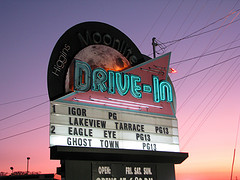 This was funny. A patron walked up to the desk and asked,
Do you have any information on the drive-in theater that used to be in Chelmsford?
I've been here for about seven years, but had no idea there had been a Chelmsford drive-in. I told the patron this, and he relayed his story:
I've just moved to town, so I was online checking out the area and seeing what was around. I like drive-ins, so I went to this website to see if there were any nearby. I put in "Chelmsford" and it found one listed for Chelmsford. But the weird thing was that when I looked at the address, it was the same address as where I live! My condo complex was build in the early 1990's, and it turns out they tore down the drive-in to build the condos. Do you have any other information on the drive-in?
Now that's bizarre - but also the kind of thing you hear in libraries.
Unfortunately, the 1990's are the doughnut hole era when it comes to historical research. Not old enough for most archives and books, but still too far back to be in online databases. Luckily, there is always hope.
A new book on Chelmsford history was published this year, History of Chelmsford : 1910-1970, and we have a copy right at the desk in our Ready Reference collection. Even though it's supposed to only go to 1970, the editor wisely included an appendix with lots of more recent information (wisely, because he wasn't sure when the next history book would be written). In that appendix was a paragraph on the drive-in, which said it was built in 1957, torn down for the condos in 1994, and gave a little more information. But no photos.
I also suggested this patron contact the Chelmsford Historical Society, which has an extensive photo archive of the area. I gave the patron their contact information, and he was excited to get in touch with them. There are some photos on the drive-in website, but he wanted more.
And when talking about property questions, there's always the Town's tax records. I suggested that to the patron as well, but since we already knew the date range of the drive-in, we didn't think the tax records would offer much.
So, although I didn't actually help this patron very much, this is one of my favorite questions so far this year - this only happened Wednesday, and already I've told this story about ten times. Yay, libraries!
Tags: chelmsford, drive, drive-in, drive-ins, history, in, ins, libraries, Library, public, Reference Question, theater
Posted under Uncategorized | 1 Comment »
October 10th, 2012 Brian Herzog
 I like it when issues are so relevant to me that I couldn't miss them if I tried.
Early last week, I was coordinating with a speaker for the upcoming NELA conference, when he mentioned the Supreme Court Case of Kirtsaeng v. John Wiley & Sons, Inc.. It sounded vaguely familiar, but since I knew I could hear him talk about it next week, I didn't really pursue it.
A few days later, the same case showed up on BoingBoing, , nicely summarized:
Writing in MarketWatch, Jennifer Waters explains the implications of a Supreme Court case, Kirtsaeng v. John Wiley & Sons, which turns on the question of whether you have the right to re-sell things you buy out of the country, or whether the copyrights embodied by your phones, clothes, gadgets, books, music, DVDs, and other possessions mean that you can't sell your stuff without permission from the original manufacturer.
Following Wiley's theory, you don't really own most of your possessions. You share ownership in your goods with the companies that made the goods you "bought" from them, and they get a veto over your disposal of them, and can also demand a cut of the proceeds.
It seems like something this ridiculous-sounding couldn't possibly come to pass, but remember this is also the Court that said corporations are people, sometimes.
And more significantly, a major publisher is involved. Here's where things started:
Wiley & Sons, a U.S. based textbook publisher with foreign affiliates, originally filed suit in the Southern District Court of New York against a Thai individual studying in the United States who obtained cheaper foreign-made editions of Wiley textbooks, printed by Wiley Asia, that he then resold on eBay in the U.S. for a profit. The District Court held that the first sale doctrine applies only to works manufactured in the United States.
We've already kissed the First Sale Doctrine goodbye with ebooks, and now it looks like applying it to physical items is threatened too. It seems like this would mean, at the very least, libraries would need to check all our books for "Printed in the USA" before we could resell them at a booksale, or else we risk breaking the law. But taken to the ridiculous extreme, it also sounds like individuals would have difficulty reselling almost anything made overseas - cell phones, cars, clothes, DVDs, etc.
The FBI will have to create a new task force, which could be dubbed "The Garage Sale Police," to enforce this if it becomes new copyright law. And in my opinion, anything that sounds like a reality show has got to be a bad idea.
But seriously, this is definitely something to pay attention to. Read more on MarketWatch and the Harvard Journal of Law & Technology Digest.
Posted under Uncategorized | 8 Comments »
October 6th, 2012 Brian Herzog
 This might be one of the strangest questions I've ever been asked.
A patron called to ask what information we could find out about the business her husband worked for in Chelmsford in the 1990's. She gave me the name and address of their office from that time, and just said that she had recently been contacted by the IRS concerning his pay and benefits from his time there.
Whew. I told her it might take me some time to research it, and she gave me her name and phone number to contact her when I found something. Interestingly (to me), the phone number she gave me had a California area code.
So anyway, the first step was just to search online for "Financial Applications Consulting Services, Inc." (the name of the company, which unfortunately is also a common description of this type of business) to see if they were still around. I also checked local phone directories and ReferenceUSA, but from what I could tell, they were no longer in business. If that's the case, I'm not sure what I could possibly find to offer this woman, but now it became a personal challenge to find anything at all.
I thought the Town Clerk would have information on businesses in town, when they filed for permits or paid taxes or whatever. However, when I called over there, the Clerk said they had no record of this business - which, she said, isn't unusual, because only certain kinds of businesses need to be on record with them.
Next, since I had the business' old address, I thought I'd try to track down the owner of that building (since it was sort of a strip mall of office suites). I hoped the business would have left some kind of forwarding address when they moved, or at least I'd get the date they closed. I called the current tenants of the same address and explained that I was looking for the building owner to find a previous tenant, and they were happy to give me his name and number. However, they also cautioned that he's difficult to get a hold of because he travels a lot.
So I noted this to pass on the patron, but didn't try contact him myself.
Instead, I went back to web searching, looking more for information about the company than the company itself. This turned up an interesting history:
From Bizjournals.com:
...Financial Applications Consulting Services Inc., which does business under the name Fastech. It is based in Livonia, Mich. ...
From Businesswire.com:
...On July 25, 2003, FASTECH filed for Chapter 11 bankruptcy protection in the U.S. Bankruptcy Court. On Nov. 18, 2003, the court ordered the granting of FASTECH's motion to sell certain assets, including its customer base, to Kronos....
Kronos happens to be one of the larger companies based in Chelmsford*, but I don't know if it's a coincidence that a Michigan-based company had a small office here, or if there had been some connection to Kronos all along.
Regardless, I think this gave me the information I was looking for - since Kronos was involved with taking ownership of the company the patron where the patron's husband worked, their legal or human resources department is probably the best resource to answer her questions regarding whatever questions the IRS is asking her.
So I gathered contact information for Kronos, Fastech, the building landlord, and also the URLs for the articles I had found online, and called the patron back. No answer - bummer. I left a message, saying that I had made some progress and asked her to call me back.
A couple days later, the patron's daughter called. She explained that after her father retired, her parents left Chelmsford and moved to California. Recently, her father had died, and in the course of finalizing his estate, the IRS contacted them about outstanding benefits from the time he was employed at this company in Chelmsford. She didn't know what it was about, but really appreciated the information I was able to provide.
That's great, and I was happy to help - but this is one of those questions that still feels opened-ended, because I have no idea how it was ultimately resolved. Of course, it's not about me - I hope the family was able to accomplish whatever they needed to do.
*Kronos has been extremely generous to the Chelmsford Library, donating laptops and other equipment - thank you very much!
Posted under Uncategorized | Comments Off on Reference Question of the Week – 9/20/12
October 3rd, 2012 Brian Herzog
 I think I'm a little behind the curve on this, but since there were so many great comments on how to improve the Overdrive interface, I thought this would be worth talking about.
It looks like the new Overdrive interface really is coming, scheduled to hit libraries during the holidays - perhaps the worst time for staff to be learning a new interface, but if it's progress, it's worth it.
I haven't seen Overdrive's Webinar on the new interface, but I do plan to watch it as soon as I find a spare 60 minutes.
However, other librarians in my consortium have watched it, and it looks like there's some good stuff in there. Most interesting to me is the "one-click download" requiring no software installation or activation. That's huge. Apparently that component isn't quite ready yet, but should make our patrons lives (and therefore our lives) much, much, much easier.
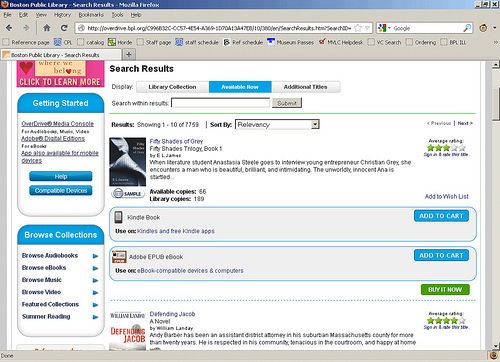
But one of the new features did bother me. The new interface apparently includes a "Buy It Now" button, which will be located directly under the "Add to Cart" button. The Boston Public Library has been demo'ing the new interface for most of this year, and here's what it looks like (click for bigger):
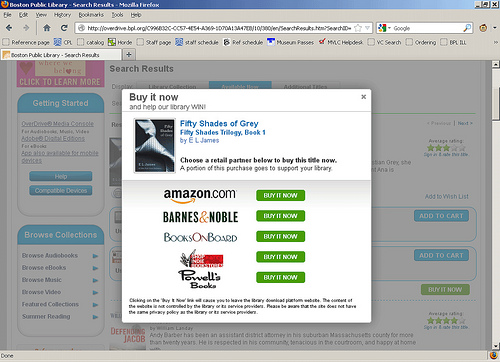
When someone clicks that green "Buy It Now," a windows pops up with a list of stores (click for bigger):
Pardon my French, but I fucking hate this. There's been conflicting reports about whether this "Buy It Now" button is optional or not, but I sincerely hope it can be turned off.
Certainly there's an argument to be made for it: if publishers know libraries are going to directly be driving customers to them, they might be more inclined to actually deal with libraries. There's also the convenience to the patrons who don't want to wait for the library's copy to be returned, and can afford to just go buy it themselves.
This seems wrong to me. It makes libraries Overdrive's bitches, because now we're drumming up retail business by preying on immediate gratification. Which is absolutely idiotic, because technologically there is no reason anyone should ever have to wait for an ebook. Implementing this feature just encourages the backward-thinking currently gripping the ebook world as they try to cling to past revenue models.
What would be awesome is if the patrons were given the option of buying a copy for the library. They get it first, then they can donate it to the library for others to use, if they want.
There's also the line that libraries will be getting a kickback from such sales, in the form of Overdrive credit. This is a complete non-starter for me, so I won't even address the idea of libraries profiting from our shortcomings.
But speaking of revenue streams, it looks like the new Overdrive interface also prominently features banner ads - here's the BPL's advanced search page (click for bigger):
Notice the two "Advertisement" right under the black menu bar? Sigh.
But I don't want to be all doom and gloom. In all fairness, I haven't seen the webinar and don't know a lot of the facts - this is just all from using BPL's site. When I called BPL, they were much more positive than I felt. The "Buy It Now" button was initially a little jarring for them, but they've had no problems or complaints, and do see credits quarterly, which shows patrons have no qualms about using it.
I am also not sure what other new features are included in the new interface, but since Mike Lovett of Overdrive was so encouraging in his comments last time, I'm hopeful the good outweighs the bad (or better yet, all of the "bad" is opt-in).
So, I encourage everyone to check out the Overdrive Next Generation Digital Library webinar. And as always, keep a running list of "how to make this better" to send to Overdrive to incorporate into the next iteration.
And for further reading on ebook topics, here's a few recent things to check out:
Posted under Uncategorized | 9 Comments »
September 29th, 2012 Brian Herzog
Wednesday is my night to close the library, so I work until 9pm. Usually the 8-9pm hour can be slow, allowing me to get off-desk-type work done. However, one particular patron made the last hour of this past Wednesday more interesting than usual.
The phone rings, and when I answer it, she opens with this question:
Do you have that very famous book about Lincoln and World War Two?
I had no idea how to take that. She had a very gravelly voice, and at first I wasn't even sure if was a real call or a prank of some kind.
But to be on the safe side, I said I didn't know the book, and asked if she knew the author. She replied that he was a famous poet, and after a minute or so, came up with Carl Sandburg.
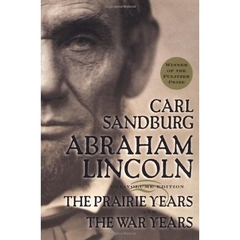 Searching for keyword:Abraham Lincoln author:Carl Sandburg brought up Abraham Lincoln: the prairie years and the war years, and when I read the title to the patron, she said it was the right book. I put it on hold for her and we hung up.
I didn't immediately see the WWII connection, so I did a web search for "Abraham Lincoln" "carl sandburg" +wwii and found an article from the Journal of the Abraham Lincoln Association stating:
Maybe enough time has passed for us to see The Prairie Years and The War Years in historical perspective, to historicize it against the background of American history between the world wars. Sand-burg began writing The Prairie Years in 1922, less than five years after the World War I Armistice, and he completed The War Years in 1939 as the world was sliding inexorably into the holocaust of World War II; the ambiguity of his title did not escape him. Read as a timeless masterpiece, Sandburg's Lincoln does not hold up; read as a timely response to a series of national crises that recalled the Civil War, the book still carries much of its original power.
Okay, I can see why the patron conflated Lincoln and WWII. About two minutes after I found this, the same patron called back and asked:
Can you tell me who designed the Greek army uniforms?
Are you kidding me?
She went on to say she didn't mean the regular uniforms - what she was interested in where the clown uniforms, the ones with balloon pants that they blow air into. Oh, well, then in that case, no problem.
I told her I'd have to research this and I would call her back.
 A quickie search for Greek army uniforms actually lead to a Wikipedia article devoted to them, which was handy. It didn't talk about balloon pants, but one of the images was of some Evzones, whose uniforms, while not including balloon pants, were nonetheless remarkable.
But while I was searching for that, it occurred to me that she might actually mean the Swiss Guard at the Vatican. I looked up their uniform too (and the designer), and their pants are more balloonish than the Greek's leggings.
I called the patron back with what I found, and she was very interested. She agreed that she must have been thinking of the Swiss Guard, but that only slowed her down for a second. She immediately followed-up with,
So then who designed the Beafeaters' uniforms?
A quick web search found two websites talking about uniform origin, which basically date, unchanged, to Tudor times in 1552.
These were all quick and superficial answers. I then searched our catalog to see if we had a book about military uniforms, but none of ours included these types of historical dress uniforms. Other libraries in our consortium appeared to have more historical books, but then the patron changed her mind - she was just curious, so the websites were good enough and she didn't need to read more about it.
So we hung up, and for the rest of the night I kept waiting for her to call back asking for the number of fry cooks on Venus or something - but she never did.
Posted under Uncategorized | 7 Comments »