July 26th, 2007 Brian Herzog
 We recently have been faced with an interesting problem in my library. On the surface it seemed like a pretty simple issue, but the more we thought about it, the more complex it became.
The Situation
A mother came in and said that she had found the movie "Thirteen" (Official Website, IMDb, Wikipedia) in her (thirteen year old) daughter's room. It was overdue, which means that she must have had it for weeks. It also means that we checked out an R-rated movie to an underage child.
The mother was angry that her child could have checked out such a movie, and didn't understand why the library wasn't enforcing the MPAA movie ratings.
One unusual twist in the story is that the woman wasn't directly challenging the movie being in the library's collection (which is usually the case). She understood that it is a movie people in the community might want to see. She was just upset that her daughter was able to check it out, since the mother had seen this movie and felt it was particularly graphic and inappropriate for her young daughter.
As librarians, our collective first response was the party line: we do not censor materials, we don't tell people what they can and can't check out (based on content, anyway), and library staff certainly can't keep track of what every parent in the community allows their particular children to do. Besides, no matter we may do at the desk, kids can use the self check-out machines and we'd never know.
However, none of us felt that this answer was good enough. Yes, all of it is true, but it also felt like a cop-out. We wanted there to be something we could do, rather than just throwing up our hands and telling parents they're on their own. So, we brainstormed what could be done, and came up with options:
1. Regulate Materials Based on Item/Patron Type
We felt that there must be a way within our ILS [?] to make certain types of borrowers unable to check out certain library materials. We use SirsiDynix Horizon 7.3, and we already use Item Type codes to differentiate between feature films, documentaries, kids DVDs, audio books, fiction books, etc. Horizon also allows different borrower types. We thought that we could let parents choose to give their children a "child" card, which would prevent them from checking out anything with the Item Type for R-rated movies.
Unfortunately, after checking with our system administrator, we found that Horizon does not compare these two codes, and so this idea would not work with the Horizon software. There is a "birth date" field, which we have never used, and we're not sure if Horizon can block certain Item Types based on birth date, either.
2. Create a Separate "Adult" Video Collection
Another idea was for us to shelve any R-rated (or unrated) feature film separately from the rest of the films. This way, at least, a parent can tell their children they are not allowed to check out "adult" videos (we called it "adult" for lack of a better word. We thought about "Mature," but then had a hard time calling something like Jackass "mature"), and it would be up to the kids to obey their parents.
The drawback in this situation, apart from the snickers at the library having "adult" videos, is that it makes browsing for movies more difficult for all the other library patrons. Now, instead of having to look in two places for a movie for tonight (regular videos and also in the Children's room), they'd have to look in three places. Plus, there's the inadvertent stigma for people being seen browsing the "Adult" collection. We didn't want a solution to one problem to create new problems for other patrons.
Another issue with separate collections is that, years ago (I'm told), a nearby library was successfully sued by the ACLU for not allowing children into an adult reading room in the library. In that case, the library wanted to keep kids out to give adults a quiet place to read, but the ACLU said that the library could not discriminate based on age in this way (oddly, many libraries have a similar policy to keep adult males without kids out of the Childrens Room, but I don't think any of them have ever been sued over it). So, we couldn't use a method that barred kids from an area of the library.
3. Label Movies Clearly with Ratings Stickers
Since we didn't want to shelve these movies separately, another idea was to keep them all interfiled, but to put rating stickers on the movies. That way, parents can still tell their kids that they can only check out movies with certain stickers on them.
This seemed to be a good option, but it also puts the Library in the position of possibly judging the content of the material. It really isn't up to us to decide what's "mature" or "family" and what's not, because it's a subjective decision and people will disagree on it. MPAA ratings are not exactly definite indicators either, but at least they are a recognized "standard."
Something interesting I learned through all of this that MPAA ratings are just guidelines and not legally-binding in any way. The mother in this case thought that we were breaking the law by letting underage children check out R-rated movies, but there actually is no law that says this. Movie theaters that enforce age limits based on ratings are doing it of their own accord, not because they have to.
In addition to stickers indicating ratings, we also talked about putting stickers on the movies marking them as "comedy," drama," "horror," etc., as we already do for many books. Of course, DVD cases are so small that the stickers necessarily need to be small, too. Also, more than two or three stickers will looked cluttered and hard to read, which would be counter-productive.
Another concern with starting a labeling program, as I see it, is in knowing where to stop. If we do start labeling movies, and parents successfully use this, it's really not much of a leap for them to want us to put rating labels on books, too (because we certainly have some that some parents might not want their kids reading). And from there it's just a short hop to internet filtering, so although well-intended, even this is a slippery slope.
The argument in support of labeling said that DVDs are different than books. When reading a graphic book, your own imagination plays a large part in how disturbing the book can be. Also, reading a book is a solitary event, and the read can put them down at any time. When watching a movie though, very little is left to the imagination - once something very graphic is flashed on the screen, it'll be in your head whether you are ready or not. Also, kids watching naughty movies is usually a group event. So, one kid, even if they know they're uncomfortable and want to stop watching, might not be able to stop because of peer pressure and not wanting to look scared.
4. Start a Viewers Advisory Program
We already have a few Readers/Listeners Advisory stations in the library. These computers are dedicated to this purpose, and so do not go out to the general internet. Instead, patrons can use them to access our catalog, recently-added books (using the Delicious Library software), NoveList, and iTunes (to listen to music before they decide to check out the CD). Also, we create printed reading guides for various subjects and authors that are available in the library, as well as having a Reading Room webpage.
Our thought was to do the same thing with movies. We could add movie review related resources to these stations (such as Common Sense Media, Rotten Tomatoes, Kids-In-Mind, Yahoo's Movie Mom), as well as creating and printing viewing suggestion guides, such as "Family Movies," "Movies for Girls," etc.
Where We Are Now
At the moment, nothing has been finalized. Since this is a pretty big issue, we wanted to make sure whatever we choose will be useful to parents, but won't interfere with other patrons' use of the library. I think we're leaning towards a mix of options 3 and 4, but the exact outcome depends on what is actually available to us, and how much extra work the Technical Services department can handle in the processing of new movies.
The bottom line for us is that we don't want to be making choices for patrons, nor do we have the staff or mandate to enforce parenting decisions on a child-by-child basis. But what we can do, what we can use our librarian expertise to do, is provide parents with tools and information to raise their own children the way they want to.
Of course, knowing how I was as a kid, it probably doesn't matter. If there was something I wanted to do, I'd continually look for a loophole or a way to accomplish it, regardless of what my parents or the library said.
challenge, challenges, children, dvds, libraries, library, material challenge, materials challenges, movies, parents, patron challenge, patron challenges, public libraries, public library, rating, ratings
Tags: challenge, challenges, children, dvds, libraries, Library, material challenge, materials challenges, movies, parents, patron challenge, patron challenges, public libraries, public library, rating, ratings
Posted under Uncategorized | 3 Comments »
July 24th, 2007 Brian Herzog
 I was passing through my library's Technical Services area [?], and the "to be catalogued" shelf caught my eye.
Featured in the photograph here, the titles really struck me as a very accurate cross-section of a modern library's collection. Not only do we have popular/genre fiction (Kilt Dead and Rashi's Daughters), but also represented are the classics (The Odyssey - 2 copies!), up-to-date technology (Ubuntu Unleashed), and social minorities in our community (A Legal Guide for Lesbian & Gay Couples).
Not that this is unique to my library, but it did make me happy. There're at least six of us responsible for selecting books for the adult collection, and it's nice to know that, even without direct coordination, we're building a well-rounded collection.
It also reminds me that having a solid collection is at least as important as how you organize it; the books need to be there in the first place before better signage or search engines will have an impact.
collection, collection development, libraries, library, public libraries, public library, purchasing, selection
Posted under Uncategorized | Comments Off on Library of the Present
July 21st, 2007 Brian Herzog
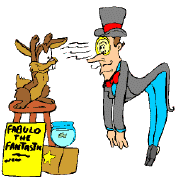 This question isn't all that unusual, but I thought the timing was kind of interesting:
A patron calls in and asks if there are any magic shows in the Boston area this weekend. I told her I didn't have a listing right in front of me, but that I'd look around and see what I could find and call her back.
The first thing I did was to go to the Boston Globe's online Events Calendar and searched for "magic" and "magician." This found a bunch of events, most of which were Harry Potter-related, in honor of the release today of the final book in the series. When I saw this, I thought the patron must be looking for somewhere to take her children to celebrate, so I noted a couple and called her back.
To my surprise, she said she was not looking for Harry Potter events. She wanted just to go see a normal magic show, as if one would go to a comedy club or movie. So, I said I'd keep looking, and this time she gave me her email address to just send her the links I found.
I went back to the Globe's calendar, and after sifting through the Potter pollution, found a listing for Franc Karpo, holding a magic show at a nearby arts center.
But, since that was the only event I found, I tried searching the internet in general for magic shows in Boston. I didn't find a central listing of shows, but I did find a listing of magicians in Boston. From that list, I linked to a few of the magicians' websites, and found their performance schedules.
I compiled these into an email and sent it, and got a nice thank-you message back.
One funny thing I did see on one of the websites was an online card trick I think I first saw around 1997. If you'd like to try it (and I highly suggest it), please do, and I'll help you figure it out if you're stumped. For more tricks, click on the rabbit above (or here).
boston, card trick, card tricks, libraries, library, magic, magic shows, magician, magicians, online card trick, online card tricks, public libraries, public library, reference question
Tags: boston, card trick, card tricks, libraries, Library, magic, magic shows, magician, magicians, online card trick, online card tricks, public libraries, public library, Reference Question
Posted under Uncategorized | Comments Off on Reference Question of the Week – 7/15/07
July 19th, 2007 Brian Herzog
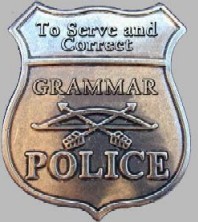 Not that I ever really paid attention before, but for as long as I can remember, my standard Reference Desk greeting has been something like "Hi, can I help you?" Recently, one of my co-workers challenged me on this.
He said that me asking "can I help you" is not grammatically correct. Instead, I should be asking, "may I help you?"
I have never excelled at grammar, but I do enjoy semantic arguments. So, even though I didn't have a concrete reason for saying "can," I tried to see if I could spontaneously generate a legitimate justification that would appease even the grammar police. Here's what I came up with:
To me, when you ask a question starting with "may," it's is kind of like asking permission. "May I help you?" Yes, you may. But when people come to the Reference Desk (or call in), the action of them approaching me implies that permission to help them is granted - if they didn't want my help, they wouldn't ask for it.
So, with the permissions out of the way, the question truly does become "can I help you?" I might be able to, or I might not. It all depends on their question, their goal, and the resources available to us.
Which I felt justified my asking "can I help you?" But my coworker doesn't like to lose arguments, so while he accepted my theory, he pointed out that it would be more correct for me to ask, "how can I help you?" Since asking if I can help isn't what the patron wants to know, asking them how I can help gets to more to the point more quickly.
But since far too much thought has already gone into something as insignificant as this, I agreed with him and we both moved on; him still asking "may I help you?" and me still asking "can I help you?" Ah, intellectual progress.
can I help you, grammar, grammar police, libraries, library, may i help you, public libraries, public library, semantics, to serve and correct
Tags: can I help you, grammar, grammar police, libraries, Library, may i help you, public libraries, public library, Random, semantics, to serve and correct
Posted under Uncategorized | Comments Off on Reference Desk Semantics
July 17th, 2007 Brian Herzog
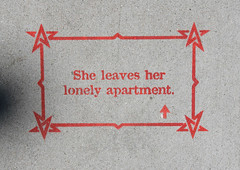
I read about a cool idea on BoingBoing the other day - a "choose your own adventure" story stenciled onto city sidewalks.
Players can start in either of two locations - I think either as "him" or as "her" - and then progress through the story making decisions and following the directions. It's a love story, so if both players choose the right paths, they end up together at the same place.
I thought this would be a great thing for a library to try - not only does it involve reading a story, but also the community. It would get people out and interacting with each other and their neighborhood, and it really sounds like fun.
I suppose any story would work, but it would be even better if it could be place-specific - perhaps following the path of a prominent local historical figure, or the growth of a local enterprise, or even highlighting local attractions or businesses. I think there are many way to make this work, but the bottom line (as I see it) is that it is a way for the library to get outside the building and doing something that people can have fun with.
boing boing, boingboing, community, libraries, library, public libraries, public library
Posted under Uncategorized | Comments Off on Story In The Streets
July 14th, 2007 Brian Herzog
 A patron came in and asked a very reasonable question:
Can you show me where you keep the high school yearbooks?
Ahem. You'd think that the public library in any town would have a complete set of the town's high school yearbooks, but here, in Chelmsford, that is not the case, and it has been a pet peeve of mine since I started working here.
We have yearbooks for the years 1944-1951, 1961, 1975, 1982, 1988-1992, 1996, and even though I've been trying to work through contacts at the high school, we still haven't gotten the Class of 2007's yearbook yet. If someone is looking for one we don't have, all I can do is refer them to the school's office, which has a complete set.
However, in this case, the patron had a bit more information. She said a friend of hers told her the school's photographer had pictures up on their website, which you could view of purchase. Huh.
After a bit of digging, we found that Chelmsford High uses Burlington Studio of Photography, which did indeed have online photographs from many schools, including Chelmsford. This find made the patron happy, as she was able to browse around and find a few shots of her son, without having to purchase the entire yearbook.
But it made me wonder, too, about whether all these kids signed waivers for their photos to be published online. And besides, it's really not quite the same, picking and choosing like that, instead of having the complete yearbook. Perhaps I'm just old-fashion; perhaps today kids leave comments on other kids' online profiles, rather than signing their yearbooks.
chelmsford, chs, high school, high school yearbook, high school yearbooks, libraries, library, public libraries, public library, reference question, yearbook, yearbooks
Tags: chelmsford, chs, high school, high school yearbook, high school yearbooks, libraries, Library, public libraries, public library, Reference Question, yearbook, yearbooks
Posted under Uncategorized | 2 Comments »