March 15th, 2012 Brian Herzog
Integrating chat into your website
You put your info desk in the middle of your physical library, so put the chat reference link central to your website.
Placement = point of service, so put it everywhere, and be consistent (catalog, website, not just handouts and flyers)
Feb 2012 = 619 sessions (at Arlington Heights (IL) Library)
- Homepage: 135
- User account signup page: 133
- Catalog pages: 124
- These three pages are 63% of the total
Placement tips
- Top-right or top-left, make sure it's above the fold
- Talk to vendors: some will let you put chat widgets inside the databases
- Put it on other community websites (local newspaper, Town Hall, social service agencies, etc)
Use a promotion to boost usage and introduce the service to patrons
"Win a Nook" promotion at Anne Arundel County (MD) Public Library
- Promotion lasted one week, which was plenty long (especially for staff who had to keep promoting it)
- Pass out bookmarks, pins/badges, and flyers to tell people how to get to the chat
- This told patrons to mention the contest when they started their chat session, so they got entered to win the Nook)
- Promotion focused on staff/patron interaction, so patron had to also mention staff person's name (staff person could then with a Nook also)
- Results: 436 people tried chat that week - 632% increase; 899 sessions for the entire month - a 162% increase over previous year
- Lessons learned: easy promotion; chat sessions increased; public "got" the service by trying it out; people love winning free stuff
- Contact Betty Morganstern ([email protected]) for more details
Tags: 24/7, 24x7, chat, Conferences, libraries, Library, oclc, pla, pla12, public, questionpoint, reference, Technology
Posted under Uncategorized | Comments Off on #PLA12 Chat Reference Discussion (OCLC QuestionPoint User Group)
March 15th, 2012 Brian Herzog
NewsBank has been conducting a study with 100+ libraries of various sizes, to look closely at how library databases are used. Here are my notes on the presentation, and the short discussion afterward.
- As daily newspaper shrink (in page count), archiving shrinks as well (many newspapers are posting more to their websites than they put in print, and they are not archiving that content)
- The trend of investment is going to "first-to-web" systems model, mobile and social network integration, and paywalls and metering systems
- Library databases appear to be ~80% remote usage
- Majority of use is for older content, not current news - 80% of articles accessed are more than 90 days old. Of that 80%:
- 18% = 1-4 years old
- 32% = 5-9 years old
- 50% = >10 years old
- Majority of searches are for local news: people names and local topics (political issues, crime, businesses, development of schools, etc)
As a bonus, the local NewsBank rep explained how to properly order a Philly cheesesteak:
- Specify the quantity you want
- Specify your cheese:
- Wiz = cheese wiz
- American = American cheese
- provi = provolone
- Specify fried onions or no:
- Wid = with onions
- Widout = without onions
So, an order for one cheesesteak with cheese wiz and onions would be:
One - wiz - wid
Posted under Uncategorized | 1 Comment »
March 10th, 2012 Brian Herzog
 This was the perfect question to research on a slow Friday afternoon:
How high is eye level?
It turns out, a patron, who was definitely on the short side, wanted to hang a piece of art. However, knowing that her "eye level" was below average, she wanted to know if there was some "golden mean" eye level that would put the art at a pleasing height, no matter how tall the viewer was.
I wasn't entirely sure how to approach this one. Actually, my first thought was to check the Statistical Abstract of the United States just to see if it would give the average height of the citizenry, but I didn't think it gave physical statistics (I checked anyway, and no, it doesn't).
I figured an open web search for phrases like "how high is eye level" would produce all sorts of opinions, and it did. Then we tried a few searches specifically for "how to hang artwork" and found a few other opinions.
The patron seemed uncomfortable with the range of answers - they were all close, but not precise. It seemed like she wanted a single answer, and a reason why that was the answer.
So, we decided to go back to the "average height of a person" approach. A search for average height of a person lead to a Wikipedia article for human height. The section on US citizens cited a Centers for Disease Control report [pdf], which gave me the idea to see if the data was on their website.
A search for average height site:cdc.gov did indeed lead to a CDC page of average body measurements (which was also the source for the report cited by Wikipedia).
Now it was just some quick math:
| Average height of women older than 20: |
63.8 inches |
| Average height of men older than 20: |
69.4 inches |
| Sum of the averages: |
133.2 inches |
| Sum divided by 2 to get average average: |
66.6 inches* |
| Average minus 3.5 inches (to get from top of the head down to eye level): |
63.1 inches, or 5' 3.1", or 5' 3-1/8"** |
So based on the data and our math, average eye level for Americans over 20 is 63.1 inches. She seemed very pleased with this answer - it seemed to me just as arbitrary as the rest we found, but at least our arbitrary figure was backed up by research and math. Regardless, I think that was exactly what she wanted, and she thanked me and left.
This was fun, and I can't help but think she will repeatedly recount this story any time someone comments on the artwork in her house.
*The average person is Satan!
**This was converted using Wolfram|Alpha and the Excel formula =INT(A1) & " ft " & TEXT(MOD(A1,1)*12, "# ??/16 ""in"""). I did this on my own after the fact - the patron though was happy with "5 foot 3 inches, and a little more," to account for the .1 - besides, the 3.5 inches down to eye level was a rough estimation anyway.
Posted under Uncategorized | 6 Comments »
March 7th, 2012 Brian Herzog
Update 3/30/12:
Library Journal published an article on the project, EBSCO's objection, and the process of working towards a resolution.
Update 3/20/12:
Good news: EBSCO and Steve have been in contact, and they are currently exploring the possibility of developing a service comparable to the Online Newsstand that would be acceptable to publishers.
Update 3/12/12:
EBSCO contacted Steve and asked him to shut down the Online Newsstand project. They said they had been contacted by a publisher who had concerns, and EBSCO cited the Online Newsstand violating their license agreements.
I'm hoping this is a temporary "let's meet and work this out" kind of deal, and not a "we don't want anyone doing something better than us" situation. After all, EBSCO isn't losing any money (and Steve isn't making money) - if anything, EBSCO and their publishers only benefit from increased database usage, because higher stats make libraries more inclined to renew their database contracts. Not to mention that EBSCO gives out awards to libraries for doing exactly this kind of innovative project (I won one):
Steve has contacted EBSCO to try to get Online Newsstand back online. If you're so inclined, you can contact EBSCO to let them know what you think:
Only EBSCO has demanded Online Newsstand be taken down, but to be on the safe side until this is resolved, Steve has also brought down the Gale version as well. What an incredibly unfortunate and unnecessary state of affairs.
Original Post:
 Do you wish the great content in your databases was easier to access and more engaging for patrons? Sure, we all do. And now it can be, with the Online Newsstand.
Steve Butzel of the Portsmouth (NH) Public Library developed the Online Newsstand Project to promote some of the great content libraries are already paying for - just by making that content more visible to patrons. Instead of having to go into MasterFILE or Expanded Academic ASAP, patrons can browse their favorite magazines on, well, an online newsstand, right on the library's website. It looks like this:
Pretty neat, huh?
Patrons don't need to know what a database is, or how to use one - they just click the magazine and article they want to read, log in with their library card number, and they're in! Almost as easy as reading an actual magazine.
And the second best thing about this (the first best is how awesome it looks) is that it's free for libraries to use.
Here's how it works: the Online Newsstand doesn't replace databases - it's just another (prettier) way to access their content. Steve compiles a list of the top articles of each magazine issue, along with the direct link to that article in the database. That way, the Online Newsstand can easily display the table of contents for a magazine, which eliminates all the searching and drilling down into publications in databases.
Check it out at the Portsmouth Library, on my library's website, and also on our mobile website (which is great for patrons on the go).
Updating the table of contents for each issue in the Online Newsstand would have been a monumental task. But it occurred to Steve that, since so many libraries are paying for the exact same content in the exact same databases, a bunch of libraries working together could make light work of it.
So, instead of libraries paying to use the Online Newsstand, participating libraries "adopt" a magazine, and they are then responsible for adding the new article titles and links to the Newsstand whenever a new issue is published. The interface Steve created makes this extremely easy - I do The Economist (a weekly magazine) and Outdoor Life (a monthly), and it takes me about ten minutes per issue - tops.
I love the approach of libraries working together. My ten minutes' labor a week benefits other libraries, and also gives my patrons access to the work done by other librarians. This is the true spirit of cooperation that is so emblematic of libraries.
The Online Newsstand is available both for EBSCO and Gale customers. And as more libraries get involved in the project, more and more magazine titles will be added. And again, this doesn't change or affect your relationship with database vendors - it just improves the patron experience of using the resources we're already paying for.
If you're interested (and I hope you are), contact Steve Butzel at [email protected]. And of course I'm happy to talk about how it works in Chelmsford, too.
Tags: database, databases, libraries, Library, magazine, magazines, online newsstand, portsmouth public library, public, steve butzel, Technology, user experience, ux
Posted under Uncategorized | 9 Comments »
March 3rd, 2012 Brian Herzog
 This isn't a reference question, and I usually don't name names when it comes to other libraries, but this entertained me. A patron came up to the desk and said,
I just wanted to say that your chairs are hard.
I automatically prepared to handle a complaint, and tell her our wooden chairs were designed to be light and sturdy, and that she's welcome to move one of the more comfortable chairs over to a computer, when she says,
It's so nice, because it makes sure you don't sit there too long. Those chairs they have at Westford let you sink in and before you know it you've wasted your whole day in front of the computer.
So good on the J. V. Fletcher Library in Westford, MA, for having comfortable chairs. And maybe good on us for not?
Posted under Uncategorized | 6 Comments »
February 25th, 2012 Brian Herzog
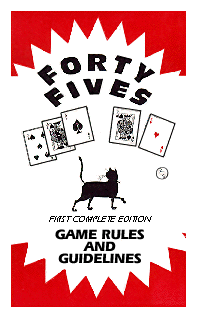 This was sort of a bizarre question, but the way I got to answer it made me pretty happy.
A patron walked up to the desk and said,
Someone told me the rules for forty-fives is available on DVD - can you show me where it is?
I had no idea what this meant. I was thinking 45 records, maybe the size and rpm that made 45's different from other records? That was flimsy though, so I just asked him what "forty-fives" was. I was surprised at the answer:
It's a regional card game, kind of like Hearts and Whist. Its complicated to learn, and I'm looking for the Merrimack Valley rules.
Huh.
[note: my library is part of the Merrimack Valley Library Consortium, so this is definitely local]
I searched our catalog for both 45 and forty-five for DVD and then everything, but didn't find anything like what he was talking about. Then I searched Amazon to try to find what the right title of this item might be, but couldn't find anything out there either.
So next I just tried a web search for 45 card game and came up with all kinds of stuff (including, of course, a Wikipedia article). Eventually we ended up at http://www.the45scardgame.com, which listed the rules online, but also linked to sites to play online, buy the game on CD, or buy a printed book of rules.
The patron was happy to see that, because he could learn the rules this way (and from a number of the other sites we found as well). He also thought his friend might have been talking about the game on a CD-ROM, and not on DVD after all.
But I couldn't resist ordering a copy of the rules book too - it's just too local and too unusual not to have in the library. I love it when the library can add something to our collection that a patron may no have purchased for themselves - not only do they get access to it then, but so does everyone else. Plus, I like card games*, so I'm really curious about this one. I've never heard of it before, but a game with rules like "black twos are higher than black tens, but red twos are not," is exactly my kind of game.
*And for the card-curious, my current favorite game has a not-kid-friendly name, so my family just calls it Rules.
Posted under Uncategorized | 3 Comments »