Last weekend I heard a story on NPR about how Sweden is turning driving the speed limit into a game - complete with cash rewards.
Instead of just using traffic cameras to catch people speeding, they're using them to also catch people obeying the speed limit - and by following the law, those people earn a chance at winning a share of the revenue generated by speeding tickets. By offering a reward, the police are hoping to encourage more people to drive safely.
The theory, called gamification, is that people enjoy playing games because of the positive reinforcement from doing something well - thus turning something normally punitive, like a speeding fine, into a game of consequences: play badly and get punished, play well and get rewarded.
How awesome would it be to do this with library overdue fines?
I prefer not charging fines at all, like my library, because I personally don't think fines should be a revenue stream for libraries. It's more important to get materials back on time than to profit from irresponsibility.
Which is why this sounds like a great idea to me - it focuses on responsible borrowing, and in a fun way.
I haven't worked out all the logistics, but it seems possible to try it for one week a month, one month a year, etc. And ideally, there would be as many "winners" as possible - so instead of one grand prize winner, a whole bunch of names could be drawn who each win $5 or $10 - chances are, many of them will donate it back to the library anyway, but still feel good about winning.
There might be a problem with libraries giving away money (although fines aren't tax money), in which case there could be a different prize - maybe a $5 gift certificate to the book sale. Anything to reward good behavior - and highlight that it is important to get library materials back on time.
I like this question on many levels - but mainly just because I just to use the phrase Library Win.
Round One
One afternoon, a patron called to request a movie titled, The Four Horsemen of the Apocalypse. She said she had already requested it through the library, but she got the wrong one - the one she wanted featured Glenn Ford.
I switched back to the library catalog to locate it, searching on the title with both four/4, and also searching just for Glenn Ford. But from what I could tell, it was nowhere in the consortium.
Next, for librarians in Massachusetts, is to search the statewide Virtual Catalog. I started this search for the title The 4 Horsemen of the Apocalypse.
Of the five results for that search, one matched both the production studio and original release date - so even though it didn't list the actors, I was fairly confident it was the right one. I requested it for the patron, and told her that since it is coming from outside our consortium, it might take a week or two before it arrives. She had hoped to get is sooner, but was happy that we could find it at all.
Round Two
About two hours later, this same patron called back. She said she had been talking to her daughter, who said that version was available on Netflix - so could I please cancel the library request we just placed, and she'll use Netflix because that will probably be faster. No problem, and I canceled her request.
Round Three
The next morning I had a voicemail from this patron. She said she talked to her daughter again, who said the movie was on long wait in Netflix, so it might take months. In that case, waiting a couple weeks for the library sounded pretty good, so she asked me to rerequest this movie for her.
Library Win
It always makes me happy when libraries can provide better service than businesses - and really, this is the kind of situation where there will almost always be a Library Win. Businesses tend to cater to the new and the sensational, whereas libraries also retain easy access to older items, classics, and items that may only turn over once a year (or less).
This is another danger of HarperCollins' self-destructing ebook plan - it would effectively eliminate this long-tail service (or at least, put a timer on it that is controlled by the publishers, rather than the needs of our communities).
The Irony
I constantly hear about the death of libraries, yet it is a movie with an apocalyptic allusion that we can deliver better than those supposedly bringing about our demise.
Someone asked me this question on Thursday this week - St. Patrick's Day:
You know how there's no snakes in Ireland because Saint Patrick drove them all out, right? Well, do they let zoos in Ireland have snakes?
I honestly couldn't tell if the patron was being funny, clever, or serious - so I looked it up.
A simple web search for zoo ireland snakes produced quite a few good links, indicated that there are indeed (captive) snakes in Ireland.
An article from the Smithsonian not only goes into the St. Patrick myth, but also the natural history of Ireland and snakes, and says that there are snakes on the island in zoos and as pets.
That seem to conclusively answer the question, and the patron apparently enjoyed the search. He chastised me for not wearing green, and then just sort of wandered away.
However, now that Yahoo support of Delicious is uncertain*, I thought I'd create a Plan B - using a similar service, Diigo. I set up a Diigo account for the library, and tested how well their linkrolls worked, compared to what I was used to with Delicious. Below are the steps to do this, and the results.
Import your bookmarks to Diigo
Browse to the file you saved, and click Import. After doing this, you'll probably get a "processing" message, and you'll receive an email once the upload is complete and your bookmarks are ready
Create a Diigo Linkroll Tools > More Tools... (bottom of the toolbar on the left) > Enhanced Linkrolls
I like to uncheck "Icon" and leave "Title" blank
Enter the tags you'd like to pull for this linkroll - or more than one tag, if you're using a structured vocabulary like I am. Click the "Retrieve" button to preview on the right
Be sure "Show Descriptions" is checked, so your Notes/annotations will be displayed
"Count" is how many to display. I prefer more than what they seem to allow, so later in the code I always edit this to count=100 (or more, if you need it)
"Style" options seem to be: Standard = no bullets, Simple = bullets, Customized lets you make some changes to colors and fonts
Lastly, click the "Create Script" button, and you'll see the code in a little box at the bottom. Now you can simply copy/paste that code into your website where you'd like the linkroll to appear.
By default, every linkroll has kind of an annoying (I think) RSS image at the end of the list. To get rid of this, you can include this code (thanks to Ryan):
Side-by-side comparison
Just for the fun of it, here's what the same "consumer health resources" linkroll looks like (with a little formatting) from both Delicious and Diigo. Below those is the linkroll code itself. Also, check out the live examples of these linkrolls embedded in the library's website:
Comparison results
Personally, I like the look of the Delicious linkroll better. My problem with Diigo linkrolls is that they don't seem as flexible as Delicious - for instance, there is no sort option (alphabetical, chronological, etc). Diigo also doesn't seem to offer the failsafe <noscript> tag, for browsers that don't have javascript enabled. Plus, you can't see their CSS styles, so you can't customize as much. I don't like that I can't seem to change the size of the description text, and that it forces a blank line between the description and the title for each bookmark. Because of that, I think you can get an all-around cleaner and tighter look with Delicious.
But, that said, the Diigo linkroll isn't totally unworkable either - just less flexible for control freaks like me. Of course, there are morebookmarkingalternativestoo.
Oh yeah, the bookmarklet
One reason Delicious is so great for library subject guides is its bookmarklet and toolbar buttons - they let you and your coworkers bookmark websites on the fly, from any computer (where they are installed). Diigo has a toolbar and bookmarklet too - and like with Delicious, I prefer the bookmarklet. For me, this is a must for any bookmarking service.
As a result of this test, I'm not rushing to switch over to Diigo. It'll work if Delicious disappears tomorrow, but I'm still going to test out a few of the other options, to see if I can find one I like a little better. But in the meantime, I feel good that I do have a very workable Plan B in place, just in case.
Update 3/27/11:
I just noticed something interesting - and troubling - about Diigo: they apparently have a "decency" filter that will automatically mark private bookmarks with "questionable" tags - for instance, porn- and illicit substance-related tags. This is a problem for me, not least because the PDRHealth website listed above keeps getting switched to "Private," and hence doesn't display in my Diigo linkroll, because it is tagged "drugs" and "drug." Others found that breast cancer websites tagged with "breast" - and similar scenarios - also automatically get removed from linkrolls. I haven't found a list of taboo tags, so it's just trial and error at this point (my testing shows that "drugs" is okay, but "drug" is not). This is another example why filtering, both here in Diigo and porn filters for computers in general, do not and will not work.
Also, it seems Diigo takes about 5-10 minutes for changes to show up in my embedded linkrolls, which is a fairly decent response time (although I think Delicious was a little quicker, more like 0-5 minutes).
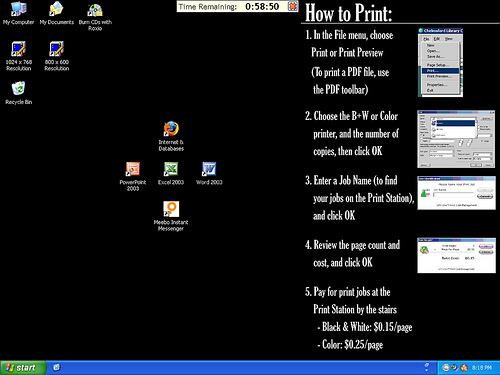
For the last few years at my library, our public computers all looked the same - Windows XP with a custom wallpaper displaying instructions on how to print. Our setup looked like this:
A month or so ago, we upgraded to Windows 7, and thought we'd also change the wallpaper.
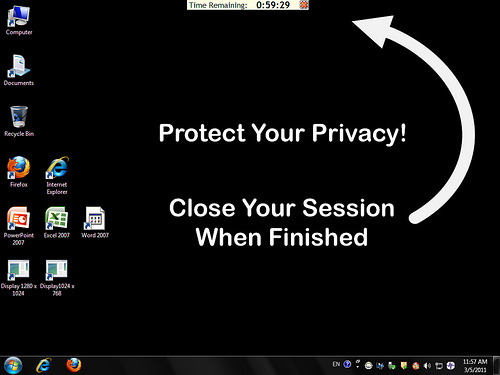
Our goal in this was to improve patron privacy. The timer software we use is Time Limit Manager (TLM), by Fortress Grand (the little "Time Remaining" clock at the top of the screen above). I like this software because it is very customer service oriented, and patrons don't need to log in with a barcode to start their session - they can just sit down, click "I Agree" to our policies, and go. The timer is basically a courtesy reminder, and for the most part we can get away with using the honor system (TLM does offer additional features for when push comes to shove).
But the main problem we were seeing wasn't that people wouldn't leave the computer - it was that patrons weren't ending their session when they left the computer. This set up the scenario where a second patron could come along and just continuing using the session of the previous patron.
This never caused a real problem in my library, but the potential was there, so we thought the upgrade would be a good time to address it.
With the Windows 7 rollout, we designed new wallpaper, hoping to prompt people end their session when they were finished with the computer. The new wallpaper looks like this:
The result? Absolutely no change whatsoever.
I didn't do a scientific survey, but just from the number of times staff has to end the session at an abandoned computer, the privacy reminder didn't seem to affect anyone at all.
I can't believe people aren't seeing this message, so it's tough not to conclude that, at least in my library, most patrons don't care much about their privacy.
So, I wanted to ask the question here - what do other libraries do to get patrons to end their session?
I haven't been following the #hcod ebook topic as closely as I should be. But, my post earlier this week, a couple conversations I've had, and the ABC article with quotes from Kate, has prompted me to spell out what it is I don't like about what HarperCollins is doing - forgive me if someone else has already, and more succinctly, made these points.
I don't like a 26 checkout limit
The logic is that 26 checkouts is basically a year life span on a book, many books never get checked out 26 times anyway, and if a library does have to buy another copy after that, it'll be at a discounted "paperback" price. I dislike this because
26 is pointless and arbitrary
if HarperCollins is allowed to set a 26 checkout limit now, what's to stop them a year from now saying, "according to our records, most ebooks only get checked out fewer than 13 times anyway, so we're lowering the limit from 26 to 13"
this kind of limit does not at all address the real threat to ebook sales - piracy. So far, attempts to fight piracy using DRM have succeeded in nothing but making digital content more difficult for honest people to use, and applying this kind of limit continues that tradition. DRM is a different conversation
Selling e-books to libraries in perpetuity, if left unchanged, would undermine the emerging e-book eco-system...and in the end lead to a decrease in book sales and royalties paid to authors...
The "in perpetuity" argument doesn't hold water because
no matter what, eventually demand for a book will fall off - regardless of whether a library has access to it or not. However, if a book stays in the library past peak demand, there remains the possibility of someone stumbling across it, enjoying it, and then seeking out additional books by that author. Self-destructing ebooks remove any chance for those future potential sales
new books are always coming out, so people are always making new purchases - this is where profits are made, and this is entirely unrelated to whether or not older books self-destruct
But really, it's not about a checkout limit at all
To me, it's not about the 26 checkouts - it's about owning something after you purchase it.
So far, all talk of ebooks has been about "buying" them, which implies ownership. Hence the huge uproar when Amazon deleted copies of 1984 that people had purchased, as those customers realized they had no ownership over the stuff they paid for.
And when we started buying downloadable audiobooks through Overdrive, it was always my understanding that anything we buy through them is ours, and if we leave Overdrive we can take it with us. That is what we've come to expect, because that is what we've been told - now HarperCollins is trying to change that. Taking away that right - ownership - is something I definitely see as worth fighting.
Libraries don't need to own everything we offer
Although I prefer outright ownership (like all the other books, CDs, DVDs, etc that we purchase), that isn't the only model we work with - all of our databases are just licensed, for instance.
If publishers want ebooks to be the same way - something we just pay for access to, but don't actually own - then fine, but they need to structure the market and mindset that way. They could sell licenses to access their "ebook catalog" and let people download them at will, just like database articles. Or, structure a model in which patrons get to browse the entire catalog and libraries pay per download, instead of "purchasing" titles up front and adding just those to our "library." There is definitely a license model that can work, but what HarperCollins came up with is not it.
So what ebook model will work?
One possibility I see with potential is the app store model. Smartphone apps are basically commodities, and sell very cheaply in huge numbers. Apps might only cost $0.99, but developers still can earn hundreds of thousands of dollars on them.
That price is also probably more in line with the actual cost of production, and is justified when you remove all the marketing the publishing industry does, and instead rely on the same kind of marketing that makes apps successful - good products thrive on word-of-mouth, and consumers seek out the niches they want. Lower ebook production cost should lead to more and varied ebooks, which fill more niches of peoples' interests, which means more opportunity for more authors to sell more books, thus higher sales.
What's holding up the progress?
I think core problem is that the shift from print to ebooks is a shift that doesn't translate well to the publishing industry's established sales channels and marketing programs. I'm not remotely an expert on the publishing industry, but it seems like they have a huge infrastructure in place to sell print books, and don't want to change. It's the same reason why energy companies have been so reluctant to explore alternative energy sources - they're comfortable with the infrastructure they have, so they defend it. It's more efficient for big businesses to be massive monocultures, rather than diddle with a variety of small and diverse avenues.
The publishing business model needs to be molded around how ebooks work, rather than try to fit the ebook peg into their existing print sales and marketing channel hole. Until they work that out, there will always be problems.
If a library decides to repurchase an e-book later in the book's life, the price will be significantly lower as it will be pegged to a paperback price...
In the world of ebooks, there is no analogy to hardback and paperback - it's an ebook from day one forward, period. The fact that HarperCollins is still clinging to the old way of thinking about initial and secondary pricing structures - what they're familiar with - shows that they're not actually in a position to generate a new sustainable model.
To boycott or not to boycott
I support a boycott of HarperCollins because I disagree with their policy. I understand they are a business, and the only way to get a business' attention is to impact their bottom line - or, to vilify them in the public spotlight.
The catch is, I don't think libraries actually have as much purchasing power as people think - so the "attack the bottom line" approach might actually backfire if all libraries boycott them and their sales aren't really impacted.
But the more uproar we cause with this, the more it will be in the news, and the greater awareness the public will have about the shifting sands of ebook policy - not only in regards to libraries, but also the nature of ebooks overall.
Hopefully, it will highlight to people that they don't own the ebooks they buy either - which, I think, gives them less incentive to buy them at all, which in turn gives them more incentive to use library ebooks. This is where a significant drop in sales will occur - when people don't see the inflated price publishers are trying to charge for ebooks as a good enough value for something they are merely renting.
Which, of course, is why libraries need to have a place at the table while this ebook eco-system emerges. We do have a role to play, because the success or failure of ebooks in libraries depends on the buying preferences of our patrons. We must speak up, and cannot just roll over and let publishers dictate whatever policies that maximize their immediate profits to the exclusion of all else.
The future of small potatoes
Right now, ebooks are just a fraction of what libraries do. Granted, that is largely due to how difficult ebooks are to use, but still - it is an ever-growing area. And undoubtedly, digital and wireless are how services will be delivered in the future. The opportunity for libraries is to leverage our role as a pooled community resource, to purchase and make available those things patrons either can't or won't get on their own, and then deliver it in a way that suits them. That is the model we need to insist on.
 Last weekend I heard a story on NPR about how Sweden is turning driving the speed limit into a game - complete with cash rewards.