Bookshelf FAIL
January 20th, 2011 Brian HerzogThis just makes me laugh...

Tags: book, Books, bookshelf, bookshelves, fail, funny, humor, libraries, Library, public, Random, shelf, shelves
This just makes me laugh...
 Last month, the Huffington Post linked to a story on Flavorwire about books that originally started as an element of a fictional story, but then were later published as a real book.
I know that sounds a little confusing, but I did recognize most of them*. For the most part, books like this are fiction, and libraries shelve them as such. As the article mentioned though, television shows have also spawned real-life books - Richard Castle's books, from Castle.
However, one of these books recently(ish) caused a bit of a debate in my library - Roger Sterling's character from Mad Men wrote a book titled Sterling's Gold: Wit & Wisdom of an Ad Man. The points of the debate were these:
We ultimately chose the last option, and shelved it at 818.6 (which was also the C-I-P suggestion). According to WorldCat, that seemed to be the most common Dewey number, but not the only one:
And those were just the libraries on the first few WorldCat results pages that were using Dewey.
But you know, within this genre, I'd actually like for Dewey to write his own book.
*My favorite book-within-a-book is the Books of Bokonon, from Kurt Vonnegut's Cat's Cradle. It never fully made it to real book status, but it has come close.
 This week's question wasn't difficult, and isn't particularly unusual, but I'm sharing it because I like the resource we ultimately found to answer it.
An older patron walked up to the desk and said,
I don't really follow popular culture, but I think I should start watching more movies. Can you tell me which movies were the most popular in each of the last five or so years?
My first suggestion was to check the Academy Awards and Golden Globes, but he felt that winning an award didn't necessarily mean it was popular. Besides, he said, he didn't just want a list, he also wanted to read summaries of the movies.
When he said that, I walked him back to where the film and movie books are (791.4375). I showed him Leonard Maltin's Movie Guide, 1001 Movies You Must See Before You Die, and a few others. None of the books on the shelve arranged films by year, but he did like all the reviews and ratings, and he especially liked 1001 Movies... because it listed movies by genre.
The patron took those over to a table while I went back to the desk to find a chronological list. At the desk I told my coworker about the question I was working on, and just then the phone rang. I answered it, helped the caller with their question, and by the time I hung up my coworker had already searched online and found the perfect resource for this question.
The website is Films101.com, and it lets you see lists of movies in all kinds of different ways - by rating, year, gross revenues, genre, award winners, and on and on. Clicking on any movie led to reviews, and the website's layout was uncluttered and easy to navigate.
The listing that best fit this question was their Yearly Top 10. Since the website format was clean with no sidebars full of ads, I was able to print a double-sided list all the way back to 2003 on a single sheet of paper. I brought this over to the patron, and his face lit up - he said it was exactly what he was looking for.
He came by the desk a few minutes later, saying he was checking out Leonard Maltin's latest book, so he could go down the list and look up each one. He also pointed out that he was happy foreign films were included, because "there's a lot going on outside this country."
Any kind of movie suggestions (or readers advisory) can be tough because once you get beyond award winners, everything is so subjective. Something else I liked about this website was that it continually took in new data, so rankings sometimes changed based on new review sources.
Yay for giving a patron what he wanted, and for teamwork.
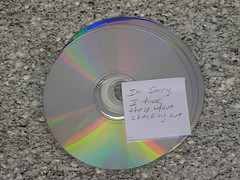 Over the last few years, we've noticed a rise in DVD thefts at my library. It seemed to happen in waves - once in awhile, we'd suddenly notice ten or so empty DVD cases on the shelf.
In general we're pretty relaxed at my library, and try to err on the side of good customer service. However, as the empty cases built up, staff started investigating ways to curtail the thefts.
But the kicker was that, when we ran the numbers, all of the security options we looked at (cameras, dummy cameras, security cases, a DVD jukebox, keeping DVDs behind the desk, etc.) were actually more expensive than just buying replacement DVDs. At least, this was true for the rate of theft we were seeing.
It seems counter-intuitive, and a little aggravating, but this is the route we took. The Circ staff was especially frustrated by the apparent "do nothing" approach, but we reviewed the numbers multiple times over the years, and replacement was always the cheapest option. Well, that combined stepped-up monitoring by staff.
And then something happened that no one expected: a stack of DVDs with a note attached ended up in our bookbox. Apparently, whoever had been stealing them got a conscience (or else, as one popular theory holds, his mother found them*). And then, a week later, a second stack of disks showed up.
We had been saving the empty cases all along, so re-adding them to the collection was easy. Hopefully, this trend will continue, and we'll end up with all of our DVDs back - just a couple years late. And we haven't noticed many missing lately, so the increased staff monitoring also seems to be working.
*Most of the DVDs that were stolen were Adam Sandler/Will Ferrell/American Pie-type movies, which implies the culprit(s) is probably high school boys.
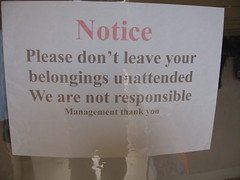
I saw this sign in Porter Square Books, and really liked it:

It is simple and to the point, while also welcoming and courteous - which I think is far more effective than harsh or impersonal. Patrons in my library are extremely casual about leaving stuff lying around (i.e., leaving a laptop on a table while they run across the street for lunch), and employing signs like this would remind people that although the library is relatively safe, it is still an open public building.
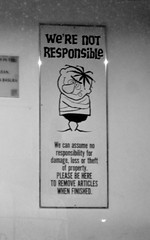
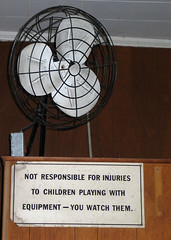
Just for the fun of it, here are some less-friendly (but sometimes funny) examples for caveat patronus signs:


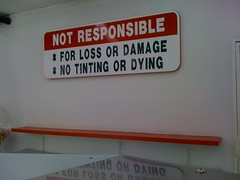
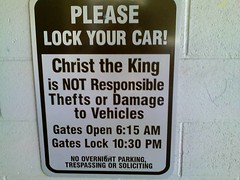
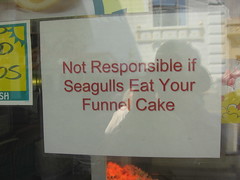

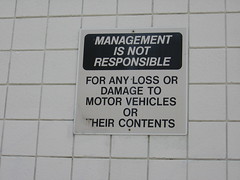

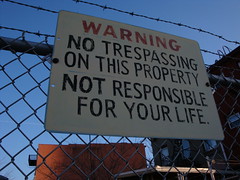
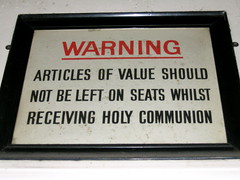
 I only got involved with this question towards the end - which was good, because that was the funny part.
An older patron came in and asked one of my coworkers:
Can you help me find an obituary? A friend told me that a woman we know died, but we're not sure when. The last time either of us spotted her alive was in October 2010.
That's straight-forward enough. The patron gave my coworker the deceased woman's name, and said she lived in Duxbury, MA. But, no matter what my coworker did, she couldn't find an obituary - that's when she asked me if I could think of anything else.
I basically retraced her steps - checking America's Obituaries and Dead Notices, Legacy.com, and the Duxbury Clipper newspaper website. When all of those failed to provide any information, we had both turned to general internet searching.
We started searching with "[name with middle initial]" obituary, but all we found was an obiturary for someone with this name in Souix City and another in Connecticut - they had the right dates of death, but were not the right people.
Next we dropped the woman's middle initial from our search and added the word "Duxbury," and this produced something very interesting: a woman by that name had left a comment on another Duxbury resident's death announcement in December 2010.
It was at this moment that it occurred to me that the person for who we were searching for an obituary may not actually have died.
My coworker changed tactics and looked for the presumed-dead woman's address phone number, and found that of her and her husband in Duxbury. When she called the patron and explained that we couldn't find an obituary and that the person may still be alive, the patron said,
Well, that is possible - the person who told me she died isn't always reliable.
My coworker gave her the person's phone number, and she said she intended to call her. But wow, what an awkward phone call that could be.