August 14th, 2010 Brian Herzog
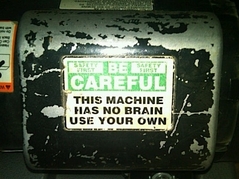 I enjoy being a librarian, and working with the public. But it can be challenging, and sometimes you just need to vent.
No matter what people ask me, I make sure the words that come out of my mouth are helpful and positive - however, those aren't always the first words that spring to mind.
In the anti-spirit of my post from Thursday, here are some answers I have not given to questions patrons have asked me. You've heard of FAQs - now here are some ALUs ("answers left unsaid"):
- Patron: The book isn't on the shelf, on a cart, or behind the desk - where else could it be?
Answer: In someone else's home.
- Patron: This computer is loading slowly - should I just sit here and wait?
Answer: You could stand.
- Patron: All the bathrooms are in use, where else can I go?
Answer: There are bushes outside.
- [five computers in a row rebooted while a particular patron was using them because she keeps pressing CTRL-ALT-DEL, after I showed her that CTRL-ALT-DEL reboots computers]
Patron: I'm sure it's not something I'm doing.
Answer: Hmm, then maybe they just sense danger.
- Patron: The computer said the book I want is "Checked out." Does that mean it's checked out?
Answer: No, that's just our way of deterring patrons who aren't pushy enough.
- Patron: The museum pass I want is already reserved for the day I want to go - can you cancel that person and give it to me?
Answer: Actually, you don't need the pass at all - just go to the museum and they'll let you in free if you tell them the secret code; it's "I need to plan ahead."
- [patron on the phone]
Patron: Can you speak up, why are you speaking so softly?
Answer: Because I'm in a library.
- Patron: Can I ask you a question?
Answer: You mean, another one?
- [patron brings in a broken playaway, and I offer to request one from another library or to show him where the book is on the shelf]
Patron: You think I want to *read* this book?
Answer: You're right, that might be asking too much.
- Patron: I love Michael Savage - do you think he's got just the best website?
Answer: No, in fact, his site is so bad that one of his fans set up a separate website just to make finding his information easier.
[note: this is from awhile ago, and apparently thesavagearchive.com is no more. But read the little "About" box on the archived version of that site - it's a polite way of saying a site is annoyingly difficult]
Sigh, I hate speaking ill of people who come into the library and ask for help, but I'm sure we've all been there. The good news is that questions like the above are few and far between (but they'll never be few and far between enough).
Posted under Uncategorized | 9 Comments »
August 12th, 2010 Brian Herzog
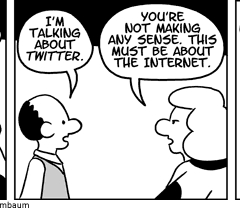 I'm not sure what got me on this, but all week I've been thinking about the language library staff use with patrons, and what we're able to convey beyond the actual words we use.
I'm sure I learned about this in various customer service workshops in the past, and I'm also sure there's a name for it, but I can't remember what it is. It seems to be most relevant when there is a problem or staff has to correct a patron for violating a policy - in those cases, the words we use can go a long way to either help diffuse or inflame the situation. Here are a couple examples of what I'm talking about:
Example 1: A patron asks for help locating a book that the computer says is Checked In, but when the staff person goes to the shelf with the patron, the book isn't there.
- Staff Response A: "It looks like someone put the book in the wrong place; let's go back to the desk and request it from another library."
- Staff Response B: "It should be right here, but is definitely missing; let's go back to the desk and request it from another library."
Example 2: A patron walks by the desk eating a hamburger, which violates the library's no-food policy.
- Staff Response A: "They don't allow food in the library, you'll have to throw that away."
- Staff Response B: "Could you please finish your meal outside before you come into the library?"
Example 3: The computer a patron is using is extremely slow.
- Staff Response A: "Yeah, these computers are really old, so you'll just have to wait."
- Staff Response B: "I'm not sure what the problem is, but you're welcome to move to a different computer or I can reboot this one for you."
Alright, these aren't great examples, but here's my point: in all the Response A's, the patron is getting the message that someone is to blame, whereas the Response B's provide the patron with a solution without any passive-aggressiveness.
This is probably a major sociological interpersonal communication issue - whether it's better to give someone a neutral third-party "they" to focus their displeasure upon, or to dissipate the anger by working on a solution rather than assigning blame. I suppose it varies depending on the level of emotion involved, but I personally prefer the Response B approach, because it addresses the cause of the problem, rather than symptoms.
Let's have a contest!
 Since I can't remember what this type of phrasing is called, I can't look up examples or tips on implementing it. So I was hoping that other library staff could suggest some common patron interactions, and some good wording to handle the situations.
I posted this as a question on Unshelved Answers, and whichever answer there gets the most votes over there will win a copy of The Librarian's Book of Lists, by George M. Eberhart. It's an interesting book, and not just because it includes my list of 10 Patron Pet Peeves.
Even if you're not interested in the contest, please do post any wording suggestions you have - I'm really interested in the subtleties of language (like the difference between "yes, but..." and "yes, and..."), and this is something that can be practically useful to a lot of people. Thanks.
Update 8/20/10: Congratulations to Jeff from Gather No Dust - his suggestion got the most votes, so he wins the book. Thanks to everyone, and be sure to check out the suggestions at Unshelved Answers.
Posted under Uncategorized | 7 Comments »
August 7th, 2010 Brian Herzog
It's been a busy week - lots of people on vacation, so we're both short-staffed and busier than usual - and often I've been rushing from one patron to the next without much of a break in between. However, this patron's question stopped me short:
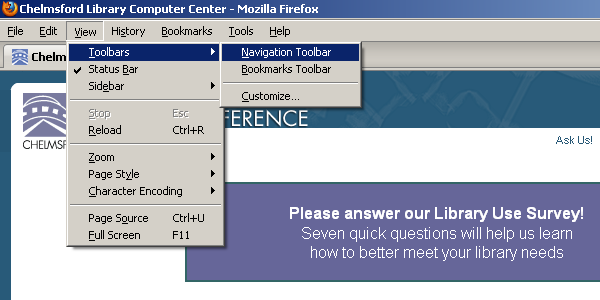
Patron: Can you show me where to put my UTI?
I was almost convinced she couldn't possibly mean a "urinary tract infection," but she immediately turned around and walked off toward the public computers - curiosity (and customer service) got the better of me, so I followed her over.
When we got back to her computer, she pointed at the screen and said,
See, there's no place for me to type in my web address UTI.
Okay - she meant URL (thank goodness). It's an easy fix to turn back on the Navigation Toolbar in Firefox:
While doing that, I said something like, "there, now you can type your URL in the box." When she heard me say "URL," she replied,
Oh, that's it, URL. I knew what I said didn't sound right.
No, it did not.
Tags: browser, firefox, libraries, Library, menu, menus, public, Reference Question, Technology, toolbar, toolbars, url, web address
Posted under Uncategorized | 2 Comments »
August 5th, 2010 Brian Herzog
 I'm not entirely comfortable talking about something I haven't used myself, but I really like the idea of this software - it automatically OCRs flat-scanned PDFs and creates text-searchable versions.
Alright, some of you might be saying, "it does what now?" From their description (and more on SlashDot), this is software you install on your server. Then, when one of those horrible originally-scanned-as-one-big-image PDF files gets saved to a "watched" directory, the software automatically converts it to a proper, search-the-text type PDF.
Since I haven't tried it, I don't know how well it works. It sounds like it'll take a bit of tinkering to get operational, but it'd be worth it to make those scanned PDF more useful.
It would also be worth exploring hooking up a scanner directly with this software, to help speed the digitization of historical (and other) records. We looked at the Library Scan Station, which was pretty awesome itself, but was just too expensive for us. This might prove to be a lower-cost solution.
Posted under Uncategorized | Comments Off on Make Scanned PDFs Text-Searchable
August 3rd, 2010 Brian Herzog
 I thought I'd pass this along in case anyone is interested - The American Physical Society is offering online access to their journals free to public libraries.
I haven't decided if my library will take advantage of the offer, because these journals seem more academic that what our patrons are usually after, and also, it's in-library access only. But on the plus side, it's free, and this is a good direction for publishers to be headed.
FOR IMMEDIATE RELEASE
APS ONLINE JOURNALS AVAILABLE FREE IN U.S. PUBLIC LIBRARIES
Ridge, NY, 28 July 2010: The American Physical Society (APS) announces a new public access initiative that will give readers and researchers in public libraries in the United States full use of all online APS journals, from the most recent articles back to the first issue in 1893, a collection including over 400,000 scientific research papers. APS will provide this access at no cost to participating public libraries, as a contribution to public engagement with the ongoing development of scientific understanding.
APS Publisher Joseph Serene observed that "public libraries have long played a central role in our country's intellectual life, and we hope that through this initiative they will become an important avenue for the general public to reach our research journals, which until now have been available only through the subscriptions at research institutions that currently cover the significant costs of peer review and online publication."
Librarians can obtain access by accepting a simple online site license and providing valid IP addresses of public-use computers in their libraries (http://librarians.aps.org/account/public_access_new). The license requires that public library users must be in the library when they read the APS journals or download articles. Initially the program will be offered to U.S. public libraries, but it may include additional countries in the future.
"The Public Library program is entirely consistent with the APS objective to advance and diffuse the knowledge of physics," said Gene Sprouse, APS Editor in Chief. "Our goal is to provide access to
everyone who wants and needs our journals and this shift in policy represents the first of several steps the APS is taking towards that goal."
--Contact: Amy Halsted, Special Assistant to the Editor in Chief, [email protected], 631-591-4232
--About the APS: The American Physical Society is the world's largest professional body of physicists, representing close to 48,000 physicists in academia and industry worldwide. It has offices in Ridge, NY; Washington, DC; and College Park, MD. For more information: www.aps.org.
Tags: access, american physical society, aps physics, database, databases, free, journal, journals, libraries, Library, online, public, resource, Resources, Technology
Posted under Uncategorized | Comments Off on American Physical Society Offers Free Access to Libraries
July 31st, 2010 Brian Herzog
 This question wasn't difficult at all, just surprising. One of our semi-regular patrons, an elderly woman, came over to the desk and asked for help at a computer.
When we got back to where she was working, she explained that she had moved from one end of her retirement complex to the other, and was on the Post Office's website trying to change her address. She was stuck on the first step - the difference between a "permanent" move and a "temporary" move. She felt, at her age (86), she wanted to get a second opinion on how "permanent" I thought her move was. I know she has a good sense of humor, but I honestly couldn't tell if she was kidding this time.
We got her through that step, and I went back to the desk. The whole process is only about five screens, but over the course of the next half-hour, she came back twice more to ask for help. It was a busy day so I wasn't able to stay with her, and usually she's very good on the computer.
However, the last question stumped us both: they required her type in her credit card number, and were going to charge her $1.00 to change her address.
Well, after a half an hour of frustration, that was the last straw. I know you can do change of addresses at the Post Office for free, so she said she was going to go right over to do it the old-fashioned way, and to give them a piece of her mind.
Initially, I thought this was another annoying example of an online place charging service fees or "internet surcharge" to use their website. I see this a lot buying tickets and things online, and to my mind, it seems like a pure scam - buying online should provide a discount, since it saves them effort.
After the patron left, I went back to the website to see if they mentioned this $1 fee earlier in the process. On the first page, I found a not-too-easy-to-read note at the bottom, saying a valid credit card was required - and that you have to change your address with the credit card company before you can change it with the Post Office. It reads:
Note: A valid credit card and a valid email address are required to complete the Online Change of Address process. For your security, the credit card billing address MUST match the address you are moving from or the address you are moving to (for business moves it must match the address you are moving from). If you are unable to use a credit card and a valid email address, you will have the option to print the Change of Address form and then mail or deliver the printed form to your local post office™.
From this, and from the page where you enter your credit card number, it seems like it's more of a security feature, to deter random people from changing the address of other people. However, you can still do it for free with no questions asked using the paper form. There has to be a better way to handle things like this, so that security doesn't impede convenience.
I've got to apply this logic the next time we revamp our library website.
Posted under Uncategorized | 3 Comments »