June 22nd, 2010 Brian Herzog
 Last week at a meeting of area reference librarians, the topic of research databases came up - which ones we like, which we wish patrons would use more, etc.
One librarian remarked that her favorite database is one of the most expensive, but doesn't get used much so she's considering cutting it. She happened to mention the price they're paying, which got everyone's attention.
That particular database vendor bases their pricing on population. For her town of 32,000, they're paying over $7,000 for that database. My town is exactly the same size, but we pay only $4,400 - and another town, of 25,000, pays over $5,000. What?
Then we started relating other database pricing anecdotes:
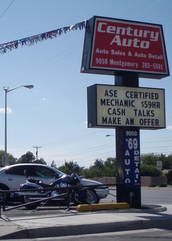
- A sales rep told one librarian a database cost $4,000. When the librarian said she couldn't even come close to that, the sales rep asked, "well, what can you afford?" - she said $1,500, and the rep made the deal for that price
- One vendor said they don't like losing customers, so when I called to cancel a database, they gave it to me for free provided I kept access to the others I had from them
- Another vendor gives volume discounts, so when I called to cancel two of the three databases we got from them, he said buying just the one database (without the volume discount) would be more expensive than getting all three
I hate this. Don't get me wrong - I like the database sales reps I work with - I just don't understand the business model behind databases. And the difference between charging a library $4,000 for something instead of $1,500 seems like price gouging.
It's great that reps are able to work with small-budget libraries, but it would be so much easier to have fixed, posted prices, rather than everyone paying different rates (isn't that one of the things that got the health care industry in trouble?).
All the librarians at the meeting agreed to compare notes and prices, so we can try to save money the next time we renew our contracts. I hate to haggle and negotiate for prices, but now I feel like it would be fiscally irresponsible of me not to - and never accept the first quote. Since what we pay is public record anyway, maybe libraries should post their database contracts in a central place, so we can all get better deals.
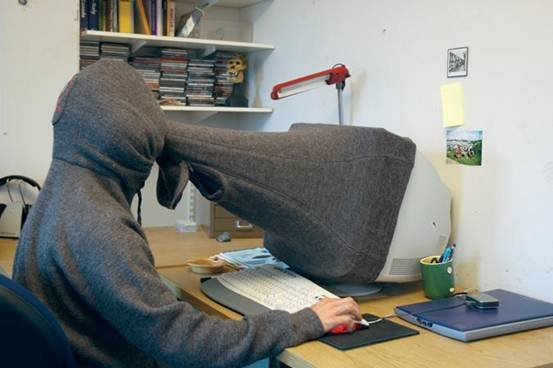
(And just as a funny aside: while I was looking for a photo to accompany this post, this clever one cracked me up. Ah, sales - it's why I left the business world for librarianship.)
Tags: access, contract, contracts, database, databases, libraries, Library, online, public, purchase, purchasing, Resources, subscription, Technology
Posted under Uncategorized | 7 Comments »
June 19th, 2010 Brian Herzog
 One of the complaints I have with my library are the questionable architectural decisions made when the building was designed - lots of glass, so even small sound echos a great deal, aisles that are blocked because fixtures stick out to far, not enough meeting space, etc.
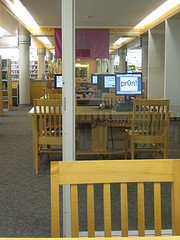
Another quirk is our Quiet Study Room - it sits at the end of the Reference collection, next to one of our computer areas. Half the computers face it and half face away, and whoever is in the Quiet Study Room could look up and see a lot of computer screens (but so can anyone walking by).
One afternoon, the phone rings, and the patron says,
Hi, I'm in your study room right now. I can see the computer screen of the first guy right outside the room, and he's been looking at graphic porn for ten minutes.
Most of the time we get porn complaints, it's after the porn viewer has left, so there's not much we can do about it. When we're able to "catch someone in the act," I print our Computer Use Policy and hand it to them saying something like,
Another patron objected to something they saw on your screen. This is a public building, so please remember that anything appearing on your screen must be suitable for children who might accidentally see it walking by.
I did that in this case, and then went back to the Reference Desk. A few minutes later, the phone rang again:
Hi, this is me, in the study room. Thank you for talking to him - he stopped looking at porn.
Her calling back made me laugh, but I hope she wasn't continually monitoring what the guy was doing.
Lots of porn stuff recently - to read what other libraries do with porn offenders, check out Unshelved Answers (my answer is there, too), and of course the Foolproof Porn Filter from earlier this week. Also, check out the Blackbelt Librarian's tips for handling difficult patrons.
Hmm - maybe we should just install a hotline in the study room for people to report porn offenders.
Posted under Uncategorized | 2 Comments »
June 17th, 2010 Brian Herzog
 We had sort of an odd situation in my library a little while ago - the story is a bit long, so please bear with me:
As circ staff were checking returned items back in, they found a DVD case with no disc in it (not unusual). They called and left a message for the patron to check their DVD player and please return the missing disc.
The patron called back after we were closed, left a message that she returned the wrong case, and asked we call her at work the next day.
What? Wrong case?
When our Head of Circulation called her the next day, the work number the patron gave was for a video reproduction company(!). When she finally spoke with the patron, the patron told her that she had the disc and the library's case, and the one she returned (accidentally) was a color photocopy she'd made of the DVD jacket (which it was, and confirmed in that the barcode and other stickers were no longer stickers).
This set off debate amongst the department heads in my library. It seems, clearly, that this patron worked at a video reproduction company that was checking out DVDs from the library and not just ripping the DVDs, but creating reproductions of the cases too - to who knows what end. Even if they're not mass reproducing them for sale, this activity is still illegal.
But, we have no actual proof of DVD copying, just speculation (maybe she just liked the DVD jacket?), and it'd be a major step to accuse a patron of this or to notify the police (or FBI?). So after some debate, we decided the library's role is to:
- make information and materials available to the public, and
- make the public aware of the copyright limitations of library materials
Our logic is that we can't police patrons and force them to follow intellectual property laws, but it is our responsibility to make sure they are informed of those laws.
To do that, we wanted to make a small handout or bookmark that informed patrons of copyright restrictions, but I wasn't sure exactly where to begin. I had bookmarked a Columbus Dispatch article entitled "Copying library CD? You just broke the law" awhile ago because of something I'd heard of going on at another library* and that article mentioned Carrie Russell, a copyright specialist for the American Library Association.
I found her ALA contact information, sent her an email explaining our situation and asking if she had concise wording we could use for a short copyright handout. Her response was hands-down the quickest (next day!) and most helpful reply I've ever gotten from someone at the ALA:
Brian:
I usually suggest that the library suspend the patron's borrowing privileges when it is clear they are infringing.
You can use language from the CFR to craft a letter. This is the language that libraries should use when lending software, but you can use it for this situation too.
Notice: Warning of Copyright Restrictions The copyright law of the United States (title 17, United States Code) governs the reproduction, distribution, adaptation, public performance, and public display of copyrighted material. Under certain conditions specified in law, nonprofit libraries are authorized to lend, lease, or rent copies of computer programs to patrons on a nonprofit basis and for nonprofit purposes. Any person who makes an unauthorized copy or adaptation of the computer program, or redistributes the loan copy, or publicly performs or displays the computer program, except as permitted by title 17 of the United States Code, may be liable for copyright infringement. This institution reserves the right to refuse to fulfill a loan request if, in its judgment, fulfillment of the request would lead to violation of the copyright law. (37 C.F.R. 201.24)
Hope this helps.
-Carrie
Some of us liked the idea of suspending the patron's borrowing privileges (at least temporarily), but we decided against that as a first step. From the wording Carrie sent, I created the following copyright notice brochure (changing references to "computer programs" to be inclusive of all library material). These bookmarks are kept at the Circ Desk and given to those patrons we suspect need the information most.
Feel free to edit and use this for your own library, and let me know if you can recommend any improvements. I was going for "fewer words = more likely to be read" but didn't quite get there.
*Another long story, for another time. In the meantime, here's a Video Pirates clip that's worth watching.
Tags: burn, burnning, cd, cds, copy, copying, copyright, dvd, dvds, intellectual freedom, intellectual property, law, legal, libraries, Library, notice, public, rip, ripping, scan, scanning, Technology, warning
Posted under Uncategorized | 11 Comments »
June 12th, 2010 Brian Herzog
 A middle-aged male patron approached me while I was at the desk alone and asked,
Do you know any good jokes?
In fact I do, so I told him my current favorite:
A duck walks into a bar wearing one shoe. The bartender says, "Hey duck, you lost a shoe." And the duck says, "Nope, I found one."
Awesome. Anyway, he said he liked it, but he wanted a lot of jokes. I showed him where our humor section* was, and he said he'd look around.
A little while later, he came back up to the desk and said he wanted jokes delivered by text message to his phone. We started searching the internet for "jokes by text" and "joke of the day" and found a ton of jokes people could retype and send out as text messages. There were also lots of jokes by email, and other joke sites, but most looked kind of sketchy.
Then we found Comedy Central's jokes.com. It offers signups for a joke of the day by both email and text, and they seem reputable enough to trust. The text messages were not free, and when he saw that he kind of gave up on the idea.
Before he left, he asked if I knew any other good jokes, so I told him my all-time favorite:
A hotdog walks into a bar and orders a beer. The bartender says, "Sorry, we don't serve food."
Ah, the many required skills of a librarian.
*Of all the classes of the Dewey Decimal System, the 800's irritate me the most. Patrons just want to browse for poetry, but no, the books are arranged geographically by the author's country, and sometimes chronologically by publication date, which means similar books are in multiple sections. Our humor books are in 818.5 (or .6), which is something like Literature > Miscellaneous Writings > American Authors of the 20th (or 21st) Century, but could also be in the 808's, 817's, 827's, blah blah blah.
Posted under Uncategorized | 8 Comments »
June 11th, 2010 Brian Herzog
 I'm at the Portland (ME) Public Library today, for the ebook workshop from the New England Library Association's IT Section.
I'll be live-blogging, so check back for updates, and also follow others with #nela on Twitter.
Notes from Elizabeth Thomson
- Idea for using ereaders in libraries: buy one for the ILL department, for them to download public domain books to and loan, instead of the patron waiting weeks to request all those out-of-print books from far-away libraries.
- Idea for doing ebook collection development: buy the trash romance or how-to sex manuals that someone would by too embarrassed to buy or check out or be seen reading on the subway
- "The Kindle is about reading, not the device." It seems to me the iPad is the opposite - it needs to dazzle people with movement and flashy colors, which either enhances the text, or terminally distracts from it, depending on your point of view.
- Ebooks needs a business models - publishers, bookstores, libraries need their own. People buying print books because they feel guilty or don't want bookstores/libraries to die out is not a business model. People will do what's most convenient in the end, regardless of how they feel.
Notes from Tom Corbett, Cushing Academy
- Libraries need to be in the reading an research (information) business, not the book inventory business (just like people who used to be in the horse and buggy business instead of the transportation business went out of business)
- Cushing's logic: books are no longer the best approach for their goal (supporting 9-12 students), library staff were focus on the wrong skills (inventory management rather than information access and aggregating data), provide 21st century education with 21st century tools (kids also learn how to use technology, which is important for the future)
- "It's not information overload, it's filter failure"
- Brutal Facts:
- Most high quality information will never be free
- Information in the 21st century is almost entirely created and delivered digitally
- By it's nature digitization ties information technology and information literacy together
- The filters and skills need to successfully navigate the digital world are not the same as the pre-digital world
- Libraries need Digital Rights Management (DRM)
- There will be a better medium for reading than paper (it's the content, not the paper)
- It doesn't really matter what libraries think. Markets happen. (Kindle is Amazon's #1 best-selling and highest-rated product)
- Digital content delivery should be "just in time" not "just in case" (which is what print is, and also Overdrive's model of collection-development-by-ownership) - focus on managing access, not managing collection inventory
- EBook Library gets it right with "non-linear lending" - you get access to hundreds of thousands of titles, and libraries pay rental fee when the book is checked out (also option to buy if a title is heavily used). You get X number of hours of book use, which can be mixed and matched amongst titles that get used - you pay for the use of your patrons, not an inventory of ebooks
Notes from Jeffrey Mayersohn, Harvard Book Store
Speaking about the Espesso print-on-demand machine. This is the way of the future, because Amazon has way more inventory than can be kept in a single location.
But the single location is the advantage that bookstores have - local staff, local interest, and with print-on-demand, local production of that same large inventory. Use bookstore shelves to be well-curated showroom.
Books never die, because with print-on-demand, everything stays in print. Also much easier for new authors to promote their self-published books.
- 1/3 (about 34) of Espresso machines are in libraries (many also in academic book stores)
- Replace copies for very old, out-of-print copies
- Provide copies of rare book collections to patrons
What's next?
- Full color interiors
- Expanded public domain access
- Expand access to "current" books
- Continued publishing of local authors
Notes from Emily Smith, Belmont Public Library
Donor provided 16 Kindles to circ at library
How we circ:
- 14 days, 1 renewal (same as book)
- Local requests only, check in and out at Belmont circ desk only - must turn it on to see it works at check out and check in
- 1 per person, $1 fine per day, $259 replacement cost, $15 charger, $35 cover
- No age restriction, but we mostly buy non-kids title to limit kid interest, and circ them from the adult section
- Circ in padded bag with charger, laminated policy, Kindle with leather cover, Getting Started guide
- Put VHS box on shelf with titles listed on back, and when someone wants Kindle they bring the box to the circ desk, where Kindles are kept
Selection
- Purchase alerts, holds list, bestseller lists
- 75% fiction
- Amazon requires credit card to purchase, which the library doesn't have, so we have corporate account (which is paid via purchase order and gift cards and person account - it is complicated)
- We deregister when it circs, and ask patrons not to register to their account (which they can do, and add content, but if it doesn't get deregistered then other patrons can buy books on that first patron's account
Problems
- Turning it on/off has been a challenge for some patrons - switch is very small. Some patrons put it to sleep rather than turning it off, and screen saver kills the battery
- Some patrons delete books accidentally - library can get the books back free, but it is a pain
- 5-way control is difficult to use, but people eventually figure it out
- Doesn't work with Overdrive, not all titles are available through Amazon, and not all titles have text-to-speech
- Be sure to get the 2-year extended warranty, which makes replacing damaged devices easier
Notes from Gerry Deyermond, Memorial Hall Library (Andover, MA)
Use Audible.com for eAudio digital audiobooks, and circ library's Otis players as well as download to patrons' devices.
Most users are 40+. Patrons can request downloads by email, and work out time with staff when to come in to download. Use Excel to track circulation (players circ for 3 weeks).
MVLC also uses Overdrive - this has picked up the slack for patrons who can't get to the library Almost 10,000 iPod-compatible book circs since 9/2009; almost 1,000 ebook downloads since 5/2010.
Notes from Chris Cooper, Southern New Hampshire University
Use 2-pronged approach to ebooks
- Ebook Downloads for popular works: Sony eReady and Kindle, patron-driven - library will buy any book under $25
- Ebook Databases for academic/professional titles: databases such as NetLibrary, Books 24x7, Sarafi Tech Books, ACLS Humanities ebooks to support business, IT psychology and other programs
Ebook Downloads
- Successes: Positive publicity (mentioned on campus tour), efficient use of funds, broad popular content availability, show engagement with technology
- Challenges: Consumer product, work flow issues (only tech services can load books, which slows things down), rarely find academic titles students need, number of units (5 kindles, 2 eReaders), registration, damage to devices
Ebook Databases
- Successes: 24x7 remote access, professional publications, up-to-date and complete (no missing CDs), integration with the catalog (easier to find), e-reserve, full-text searchable (huge advantage for research)
- Challenges: DRM eccentricities (each database is different, none are very good), multiple interfaces (patrons want content, so unfamiliar interfaces are a barrier and we lose people), cost (always have annual contracts - difference between owning content and buying access to content), finding specific titles (we can always find content, but not always exactly what they want)
Questions and Answers from Panel Discussion
Any childrens books on ebooks? Like Tumblebooks?
Belmont didn't put them on, because we want adults to be more careful with the devices. Nashua uses Tumblebooks and people like them. Cushing still actively collects print picture books.
Do teachers "silo" their class material and not use library eresources?
They do, because they always have, but we're working with them to show them how they can use ereserve and other tools for class. The focus needs to be on the students, and what works best for them.
Do people purchase or lease Espresso machine?
Harvard Book Store leased it, but other people buy them. However, there are also leasing companies.
How has the School Library Association viewed what is happening at Cushing?
They're both skeptical and interested, and want feedback on how it goes.
What kind of budget does Cushing have?
The space redesign and purchase of ereaders came out of the capital budget, not library budget. This year the econtent budget is coming from the library budget. It all happened before Tom was there, so not sure of the figure, but it's hundred of thousands of dollars.
If students have their own laptops/devices, why does the library offer ereaders?
Kindles only do reading, whereas other devices have lots of distractions built-in, and we want to focus on literacy.
How have faculty accept the change, technically?
To do this well, the administration must require adoption, but there was a lot of buy-in from faculty. There is also ongoing back-and-forth discussion, so we're all working together to meet the goal requirement.
By deauthorizing Kindles, does that turn off Amazon's big brother aspect or monitoring, and can use track highlighting and other activity for statistics?
We delete most patron activity, and never thought to track it.
Do you backup Kindle books?
Once you register a Kindle, all the books stay in your account and you can download them as many times as you want. You can backup locally on your server, but you need to sync it to your computer, and is just more difficult that relying on Amazon.
How do you provide students access to color content, like graphic novels?
We don't really - we never had much of a graphic novels collection and students haven't asked. But it's a trade off, because there are things the devices let you do that can't be done with print.
Espesso machine - what is the cost, and is there a backlog?
Cost of each book depends on source - publisher books (in copyright) are same price as book on the shelf (machine does this automatically, and store loses money on some books); for Google books we charge $8.00, which averages 400 pages, so we were losing money so now it depends on page count - $10-$20 average cost now; self-published set price with author, usually $9 cost and $15 retail, which is better for authors than they would get with a publisher. You can also order online and we will delivery locally via bike-delivery
Do Kindles need certain staff to make them work?
Only for downloading and fixing - check in and out goes through the circ desk so any staff can do it, including the 4-5 minute demo of how it works and checking to see if the titles are there
Are you concerned about the lack of physical ownership of Kindle content, and whether you'll be able to use it in the future?
Belmont: not really, because all the titles we have we also own in print, and are popular, so we think that when the interest in these titles die off, we won't need them any more
SNHU: We expect that to be the case, and it's all about cost - if we get the value out of the book via circs, we don't worry about the future
Cushing: We don't worry about it
What percentage of SNHU is eresources? And is it growing to accommodate Cushing students who expect digital resources?
Databases and downloads are right about the same, but nothing drastic is happening - print is staying steady.
What factors drive book sales for Harvard Book Store?
The general economy is very noticeable in the bookstore, but sales have increased each month this year. I haven't noticed any real affect with the advent of ebook readers - most customers say they like books, but use ebooks for travel (so in that respect it is a niche product). Sales of new hard covers (the most expensive) are the sales that are increasing. Our author events (over 200/year) really drive sales - not unusual to draw 600 people - authors can't sign ebooks
Libraries can offer more than one device, as a way to allow patrons to try the technology and use Overdrive titles.
Tags: conference, Conferences, ebook, ebooks, libraries, Library, nela, nela-its, new england library association, public, Technology
Posted under Uncategorized | 4 Comments »