December 8th, 2016 Brian Herzog
 One of those on-going discussions in the library world is how to display new books.
Well, new-new books are easy: when something is recently published, it goes in the new book room, or on the new book shelf, for six months or a year or whatever you're library's practice is. And usually, it also gets marked with some kind of sticker so pages know to shelve it as "New" rather than in the regular collection.
The question has been - at least for me - what is the best way to handle books that are not recently-published, but that are still new to the library (and therefore possibly new to our patrons)?
If I missed ordering something when it first came out, and then a patron donates a copy, should it go into the new book room like a new book (even though it's not "new"), or should it just go right into the regular collection (even though people might miss it there)? I've heard arguments both ways on this, but the Jackson (NH) Public Library has a great (and obvious) solution that just never occurred to me.
They do put these old-but-new-to-the-library books into the new book room - and just mark them "NEW-ish." Brilliant.
This labeling lets people know the books aren't just published, but also allows the people who browse the new book room (rather than search the catalog) to easily find them. And that's the important thing.
This might be commonplace in other libraries too, but like I said, it never occurred to me before. Now I just need to convince the staff at my library to go for it. We'll see.
Way to go, staff at the Jackson Library.
Posted under Uncategorized | 3 Comments »
April 15th, 2015 Brian Herzog
A friend of mine sent me a link to this:
Pretty neat, and not too difficult a display to make. Good job, whichever library this is. Thanks Chris.
Posted under Uncategorized | 1 Comment »
March 26th, 2015 Brian Herzog
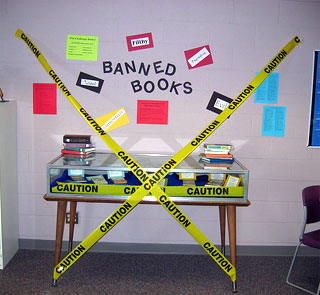 We had an interesting request from a college student who is doing a project on book challenges in libraries.
We didn't have a lot to contribute, but I thought I'd share the exchange here anyway to hopefully hear about other libraries' experiences. This student asked [edited for privacy],
Date: March 8, 2015 at 10:40:31 PM EDT
Subject: Banned Books
Currently I am attending Franklin Pierce University in Rindge, NH, and ... am taking a class this semester titled "Banned Books." As part of the course requirements we are reading various books that have been banned such as:
And Tango Makes Three by Justin Richardson
Fahrenheit 451 by Ray Bradbury
Fanny Hill by John Clelland
The Witches by Roald Dahl
The Chocolate War by Robert Cormier
Looking for Alaska by John Green
Many other texts are also touched upon within this course. After reading the texts we discuss why we believe some of these books have been banned. We also look up information about the individuals promoting the banning of these books and their beliefs and values.
As a research project for this course I am supposed to be researching if there have been any challenges towards books in my community. I am also supposed to find information about the book challenging/banning policy within the Chelmsford Public Library. It would be sincerely appreciated if you could send me some information about your library’s policies and experiences with book challenges and/or bans.
A few of us at the library looked around for the paper trail on our book challenges, and were surprised at what we didn't find. This is what interested me most. Book challenges are just a part of life in a public library, but I've never really examined the long view.
Here is the response I sent back [again, slightly edited]:
We actually haven't gotten a lot of challenges to items like what you're researching. In the ten years I've been here, I can only remember a handful of times.
Our official policy on the matter is covered in the "Censorship" section of our Materials Selection Policy (http://www.chelmsfordlibrary.org/library_info/policies/materials_policy.html), which states,
"The Library Director is available to review selection decisions, and welcomes the opportunity to discuss the interpretation of library goals and principles with interested individuals or representatives of groups.
Formal requests for withdrawal of specific items must be submitted to the Director in writing. A copy of the form is appended. Copies of the form are available at all circulation desks and the Reference Department. If the Library Director cannot resolve the issue to the satisfaction of the citizen in question, that person may request a hearing before the Selection Committee (See: “Responsibilities for Book Selection,” above.)"
The Request for Reconsideration of Library Materials form itself is available at
http://www.chelmsfordlibrary.org/library_info/policies/pdf/reconsideration_form.pdf.
We do have this on hand and give it to any patron who wishes to challenge an item. However, what we've found in practice is that patrons will verbally challenge an item, and usually want to speak to the director as well. But when we looked into our records to find the challenges, we determined that we've never gone beyond this stage to a patron actually submitting the challenge form in writing.
However, this doesn't mean that we've taken no action in situations like this. Here are a few examples that I hope will be helpful:
- In one case, a mother was upset when she discovered that her 13 year old daughter had checked out the DVD "Thirteen" (http://chelmsford.mvlc.org/eg/opac/record/883844), and she came in to complain about this movie. After a discussion though, she realized she wasn't objecting to the movie itself so much as that someone underage would be able to check it out (this goes into a much larger area of libraries not being able to act in place of parents, and that MPAA rating are just suggestions and not strict mandatory limits). But as a result of this patron's challenge, the library decided to start putting MPAA rating stickers on our DVD collection, to make the rating (and therefore the intended audience) easier to identify.
- Our Childrens staff said in the last 14 years, they remember about four "informal" challenges. In those cases, like the movie Thirteen, the issue is really about age-appropriateness. They said that in three of the cases, after reviewing the item in question, they decided to recatalog the item to the Young Adult collection so it wouldn't be in the Children's Room - which is an easy way to make the patron happy yet still provide public access to the item.
- A slightly unusual challenge was to the book "It's Perfectly Normal," by Robie H. Harris (http://chelmsford.mvlc.org/eg/opac/record/1200161). When staff spoke to the patron who was challenging it, we learned that the patron had never seen or read the book, but was part of a church group who were all being encouraged to challenge it (which made national news in Lewiston, ME: http://lj.libraryjournal.com/2007/12/legislation/maine-librarys-its-perfectly-normal-not-obscene-police-agree/#_). I believe that after a discussion, and asking the patron to read the book before challenging it, the patron dropped the complaint.
- In another case, the library purchased a DVD for the movie "Brown Bunny," based on reviews. After it arrived but before it was put on the shelf for patrons, a staff member watched it and was surprised at how sexually graphic it was. After further review by another staff person, the library decided not to add it to the collection after all. So this wasn't exactly a patron challenge, but more of a self-censoring once we'd seen what the item was actually like.
- And finally, although not strictly about challenging books, occasionally parents will complain that we don't do enough to keep their kids off of social media websites or other places online, and essentially ask us to "ban" these websites. This brings up larger issues as well, and in these cases we try to address the underlying issue. The first time this happened, we held a workshop for patrons on internet safety, and we do use filtering software on the computers in the Childrens and Teen areas, but we have not changed our computer use policies.
I hope this information helps, and please let me know if you need clarification or elaboration, or just have additional questions. Thanks, and good luck with your project.
Brian Herzog
Head of Reference
Chelmsford Public Library
How far have item challenges gotten in your library? The ALA collects information on challenges (although the deadline has passed for 2014 incidents), and I've seen compiled stats before, but it was entirely different to review specially what has happened in my library.
Posted under Uncategorized | 6 Comments »
January 29th, 2015 Brian Herzog
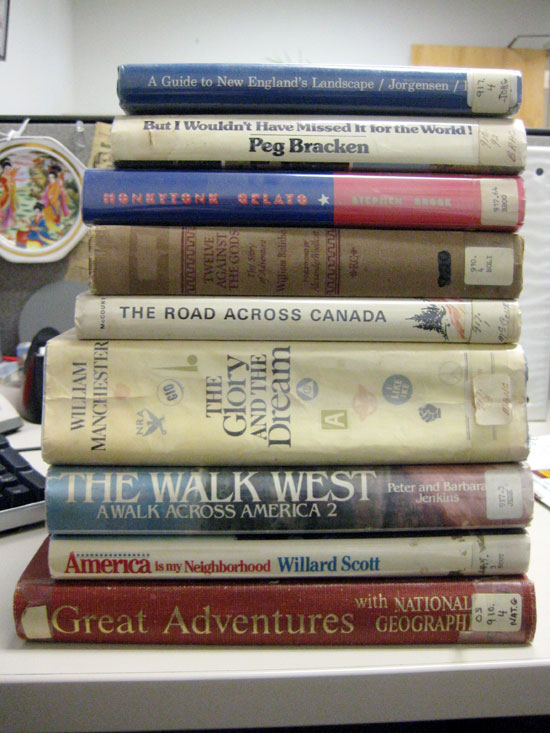
It's not, actually, but perhaps it should be. We had a plumber in the library today fixing one of our men's restrooms. In the course of his repair work, he had to go into the drop-ceiling in the bathroom, and this is what he found:
I've heard of library bathroom ceilings being used as dead-drops for drug deals - which at least has a logical utility - but I don't understand why these books would have ended up in the bathroom ceiling.
They all seem like old travel books, had been part of our branch library's collection, and have all been withdrawn and deleted. Not just lost and deleted, but actually stamped by staff as withdrawn.
I have no idea how they went from deleted from the branch to above the men's room of the main library. Plus, it's a ten foot ceiling too, so it's not like it'd be an easy place to store reading material.
So, if you get a chance today, pop your head up into the bathroom ceiling - who knows what interesting things you may find (I for one can't wait to check the rest of our bathrooms).
Tags: bathroom, Books, ceiling, hidden, libraries, Library, public, Random, restroom, secret, toilet
Posted under Uncategorized | 7 Comments »
October 31st, 2014 Brian Herzog
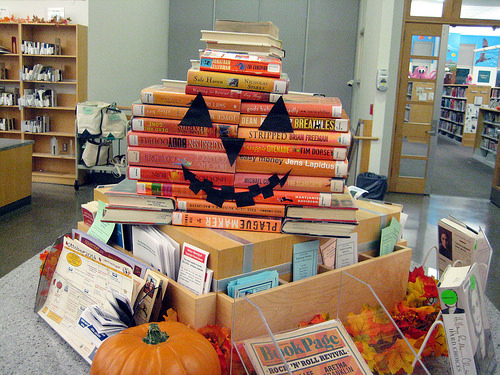
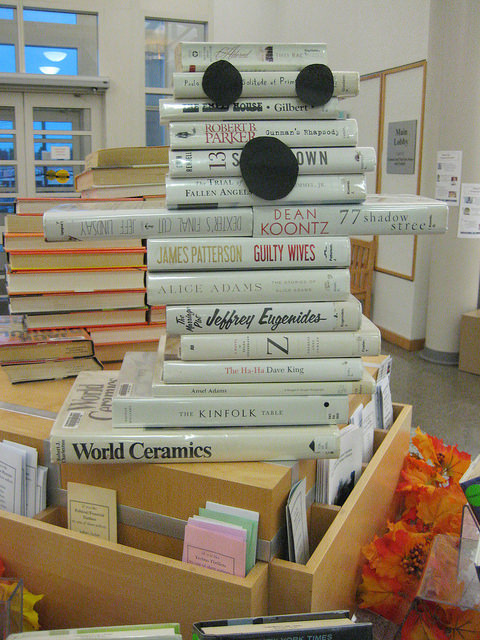
One of my coworkers got creative for our Halloween book displays, and I think they look great:
Happy Halloween everyone!
Tags: book, book display, Books, ghost, halloween, holiday, libraries, Library, orange, public, pumpkin, Random, white
Posted under Uncategorized | Comments Off on Halloween Book Displays
February 20th, 2013 Brian Herzog
This infographic came out earlier this month, but I thought it had some interesting statistics on the coexistence of ebooks and print books:
Tags: book, Books, ebook, ebooks, infographic, libraries, Library, print, public, statistics, stats, Technology
Posted under Uncategorized | 4 Comments »