June 29th, 2010 Brian Herzog
 In library near me, the Director did most of the reference work. When she announced her retirement, the staff was worried about having to do reference themselves, until a replacement was found.
She emailed me saying she had just read The Checklist Manifesto, by Atul Gawande, and asked for my help in creating a "reference checklist" for her staff - hopefully, it would help them cover all the bases when helping patrons at the Reference Desk.
I haven't actually read the book (although did read lots of reviews when it was published), but I think the general idea is summarized in this quote from the New York Times review:
In medicine, he writes, the problem is “making sure we apply the knowledge we have consistently and correctly.” Failure, he argues, results not so much from ignorance (not knowing enough about what works) as from ineptitude (not properly applying what we know works).
This is also true of reference work. Some sort of checklist or decision tree is probably covered in most library school reference text books, but I thought I'd take a crack at it. Of course, any checklist like this could vary widely by library, depending on available resources, but the following few questions might help make sure all bases are covered consistently:
Are you sure you understand the question?
- Don't be afraid to ask follow-up questions and to restate the question in your own words to make sure you and the patron are on the same page
Is the patron looking for a specific item?
- It's okay to use Amazon to verify the spelling of an author's name or title, and Novelist or other websites to check titles in a series. Once you know what you're looking for, be sure to check the local catalog, other libraries in the network, and also the state-wide catalog (if you have one) to interlibrary loan the item if necessary. If it's nowhere to be found, should this item be purchased? (refer to your Collection Development policy)
- If the patron is comfortable with it, many books are now available online through Google Books, Project Gutenberg, and other ebook sources
Is the patron looking for a subject?
- Use the catalog to find the right Dewey range so the patron can browse the shelf, and see where other libraries have cataloged their books on this subject
- Remember to also check
- other collections (Reference, Young Adult, Childrens, Oversized, Vertical File, Special Collections, etc)
- research databases (especially for homework research or very current information)
- the library's website (for subject guides, readers advisory, web links, etc)
- general internet searching to find public websites
- remember also to search government websites - add site:.gov to Google searches to limit to government websites
- if you're in the right Dewey section but there are no books on the specific topic, look for a general book on the subject and check the book's index for your specific topic
Is the question about something local?
- Check the local newspaper, local websites (especially newspaper and municipal websites, as well as meetup.com and yelp.com for socializing and events), printed brochures and fliers available in the library, event calendars, etc. Remember also to ask coworkers, as they may have heard of something or be involved with it
Is your answer still “no” or “I don't know” - what else can you do?
- Is the problem that you're in the right place and the information is just not there, or that you can't think of where to look? Keep the patron informed, but don't waste their time - there is nothing wrong with referring them to a larger or specialized library, another Town office, or organization that is more likely to have the resources to answer their question. Be sure to give them contact phone numbers/email address/web address/driving directions/operating hours
- Ask a coworker or supervisor for help
- Take the patron's name and number and offer to contact them when you find something
A strategy I use to try to make reference interactions go more smoothly is this:
- Sometimes it's hard to find the answer with the patron hovering above you watching and waiting. If possible, get the patron started on looking in one area, and then go back to the catalog/database on your own for more thorough research
And to make future reference questions better, here's a checklist about patron interactions in general:
- Have there been a lot of questions on the same topic? If so, is there a way to make this information more readily available for future patrons?
- Pay attention to what kind of questions make you uncomfortable, and then ask for training or explore those areas further
- Remember to show patrons how to do something, instead of just giving them answers. It's also okay to think out loud when working on a question - explaining why you're consulting the resources you are, or why books are in a certain spot in the library, will help the patron and possibly make you think of something you may have otherwise forgotten.
- Look around the Reference Desk - things within reach are probably there for a reason, but can also be the hardest to find if you don't know where they are
- Remember to review applicable common tasks and policies, such as booking museum passes, helping with printing, turning everything on/off
This could definitely be distilled more. At the same time, no checklist will cover every patron interaction, but should at least get people started down the right road. And I'm sure I missed things - what are more tips to give staff new to the Reference Desk?
Tags: checklist manifesto, desk, interaction, libraries, Library, patron, patrons, public, question, reference, staff
Posted under Uncategorized | 15 Comments »
June 26th, 2010 Brian Herzog
 Instead of a reference question this week, here's a question posed to Unshelved Answers this week:
[What is your] most ironic/moronic question?
A number of librarians have posted almost painful exchanges they've had with patrons - mine is:
A patron came in and asked for information on homeschooling her kids. I showed her the section, and ten minutes later I saw her leaving with our copy of Homeschooling for Dummies - come on, should a "dummy" really be teaching kids?
Check it out and post one of your own.
Posted under Uncategorized | Comments Off on Reference Question of the Week – 6/20/10
June 24th, 2010 Brian Herzog
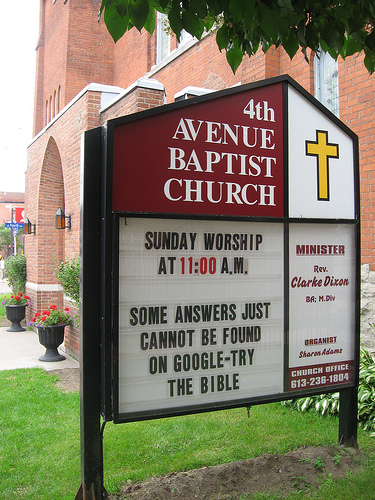
I passed this church sign while walking around Ottawa:
I'm used to hearing the "Google is not as good as libraries" rhetoric, so it was funny to see another profession facing the same struggle. By the way, Bibles in my library are shelved at 220.5/Bibl - maybe our slogan should be, "find a library, find your way."
Posted under Uncategorized | 7 Comments »
June 22nd, 2010 Brian Herzog
 Last week at a meeting of area reference librarians, the topic of research databases came up - which ones we like, which we wish patrons would use more, etc.
One librarian remarked that her favorite database is one of the most expensive, but doesn't get used much so she's considering cutting it. She happened to mention the price they're paying, which got everyone's attention.
That particular database vendor bases their pricing on population. For her town of 32,000, they're paying over $7,000 for that database. My town is exactly the same size, but we pay only $4,400 - and another town, of 25,000, pays over $5,000. What?
Then we started relating other database pricing anecdotes:
- A sales rep told one librarian a database cost $4,000. When the librarian said she couldn't even come close to that, the sales rep asked, "well, what can you afford?" - she said $1,500, and the rep made the deal for that price
- One vendor said they don't like losing customers, so when I called to cancel a database, they gave it to me for free provided I kept access to the others I had from them
- Another vendor gives volume discounts, so when I called to cancel two of the three databases we got from them, he said buying just the one database (without the volume discount) would be more expensive than getting all three
I hate this. Don't get me wrong - I like the database sales reps I work with - I just don't understand the business model behind databases. And the difference between charging a library $4,000 for something instead of $1,500 seems like price gouging.
It's great that reps are able to work with small-budget libraries, but it would be so much easier to have fixed, posted prices, rather than everyone paying different rates (isn't that one of the things that got the health care industry in trouble?).
All the librarians at the meeting agreed to compare notes and prices, so we can try to save money the next time we renew our contracts. I hate to haggle and negotiate for prices, but now I feel like it would be fiscally irresponsible of me not to - and never accept the first quote. Since what we pay is public record anyway, maybe libraries should post their database contracts in a central place, so we can all get better deals.
(And just as a funny aside: while I was looking for a photo to accompany this post, this clever one cracked me up. Ah, sales - it's why I left the business world for librarianship.)
Tags: access, contract, contracts, database, databases, libraries, Library, online, public, purchase, purchasing, Resources, subscription, Technology
Posted under Uncategorized | 7 Comments »
June 19th, 2010 Brian Herzog
 One of the complaints I have with my library are the questionable architectural decisions made when the building was designed - lots of glass, so even small sound echos a great deal, aisles that are blocked because fixtures stick out to far, not enough meeting space, etc.
Another quirk is our Quiet Study Room - it sits at the end of the Reference collection, next to one of our computer areas. Half the computers face it and half face away, and whoever is in the Quiet Study Room could look up and see a lot of computer screens (but so can anyone walking by).
One afternoon, the phone rings, and the patron says,
Hi, I'm in your study room right now. I can see the computer screen of the first guy right outside the room, and he's been looking at graphic porn for ten minutes.
Most of the time we get porn complaints, it's after the porn viewer has left, so there's not much we can do about it. When we're able to "catch someone in the act," I print our Computer Use Policy and hand it to them saying something like,
Another patron objected to something they saw on your screen. This is a public building, so please remember that anything appearing on your screen must be suitable for children who might accidentally see it walking by.
I did that in this case, and then went back to the Reference Desk. A few minutes later, the phone rang again:
Hi, this is me, in the study room. Thank you for talking to him - he stopped looking at porn.
Her calling back made me laugh, but I hope she wasn't continually monitoring what the guy was doing.
Lots of porn stuff recently - to read what other libraries do with porn offenders, check out Unshelved Answers (my answer is there, too), and of course the Foolproof Porn Filter from earlier this week. Also, check out the Blackbelt Librarian's tips for handling difficult patrons.
Hmm - maybe we should just install a hotline in the study room for people to report porn offenders.
Posted under Uncategorized | 2 Comments »
June 17th, 2010 Brian Herzog
 We had sort of an odd situation in my library a little while ago - the story is a bit long, so please bear with me:
As circ staff were checking returned items back in, they found a DVD case with no disc in it (not unusual). They called and left a message for the patron to check their DVD player and please return the missing disc.
The patron called back after we were closed, left a message that she returned the wrong case, and asked we call her at work the next day.
What? Wrong case?
When our Head of Circulation called her the next day, the work number the patron gave was for a video reproduction company(!). When she finally spoke with the patron, the patron told her that she had the disc and the library's case, and the one she returned (accidentally) was a color photocopy she'd made of the DVD jacket (which it was, and confirmed in that the barcode and other stickers were no longer stickers).
This set off debate amongst the department heads in my library. It seems, clearly, that this patron worked at a video reproduction company that was checking out DVDs from the library and not just ripping the DVDs, but creating reproductions of the cases too - to who knows what end. Even if they're not mass reproducing them for sale, this activity is still illegal.
But, we have no actual proof of DVD copying, just speculation (maybe she just liked the DVD jacket?), and it'd be a major step to accuse a patron of this or to notify the police (or FBI?). So after some debate, we decided the library's role is to:
- make information and materials available to the public, and
- make the public aware of the copyright limitations of library materials
Our logic is that we can't police patrons and force them to follow intellectual property laws, but it is our responsibility to make sure they are informed of those laws.
To do that, we wanted to make a small handout or bookmark that informed patrons of copyright restrictions, but I wasn't sure exactly where to begin. I had bookmarked a Columbus Dispatch article entitled "Copying library CD? You just broke the law" awhile ago because of something I'd heard of going on at another library* and that article mentioned Carrie Russell, a copyright specialist for the American Library Association.
I found her ALA contact information, sent her an email explaining our situation and asking if she had concise wording we could use for a short copyright handout. Her response was hands-down the quickest (next day!) and most helpful reply I've ever gotten from someone at the ALA:
Brian:
I usually suggest that the library suspend the patron's borrowing privileges when it is clear they are infringing.
You can use language from the CFR to craft a letter. This is the language that libraries should use when lending software, but you can use it for this situation too.
Notice: Warning of Copyright Restrictions The copyright law of the United States (title 17, United States Code) governs the reproduction, distribution, adaptation, public performance, and public display of copyrighted material. Under certain conditions specified in law, nonprofit libraries are authorized to lend, lease, or rent copies of computer programs to patrons on a nonprofit basis and for nonprofit purposes. Any person who makes an unauthorized copy or adaptation of the computer program, or redistributes the loan copy, or publicly performs or displays the computer program, except as permitted by title 17 of the United States Code, may be liable for copyright infringement. This institution reserves the right to refuse to fulfill a loan request if, in its judgment, fulfillment of the request would lead to violation of the copyright law. (37 C.F.R. 201.24)
Hope this helps.
-Carrie
Some of us liked the idea of suspending the patron's borrowing privileges (at least temporarily), but we decided against that as a first step. From the wording Carrie sent, I created the following copyright notice brochure (changing references to "computer programs" to be inclusive of all library material). These bookmarks are kept at the Circ Desk and given to those patrons we suspect need the information most.
Feel free to edit and use this for your own library, and let me know if you can recommend any improvements. I was going for "fewer words = more likely to be read" but didn't quite get there.
*Another long story, for another time. In the meantime, here's a Video Pirates clip that's worth watching.
Tags: burn, burnning, cd, cds, copy, copying, copyright, dvd, dvds, intellectual freedom, intellectual property, law, legal, libraries, Library, notice, public, rip, ripping, scan, scanning, Technology, warning
Posted under Uncategorized | 11 Comments »