Archives for Reference Question:
April 14th, 2012 Brian Herzog
 This reference question marks the unofficial start of blood-borne pathogen season:
A patron called Monday morning and said he had been bitten by a tick Sunday while hiking, and wanted to have it tested for Lyme Disease.
He knew he could mail it to UMass-Amherst for testing, but wanted to know if there was a more local testing facility, so he could get results quicker. I didn't know of anything, so before consulting our Town's Board of Health, I just searched for tick testing massachusetts to see what came up.
The first result was a Massachusetts Department of Health and Human Services listing of the testing services they trust - perfect. Only one was closer than UMass, but still not close enough for him to drop it off. It was $20 per tick, as opposed to the $40 UMass charges, and although the patron liked the cheaper price, he decided to go with UMass. They do their testing on Tuesday, so if he overnighted it, he'd get results quickly - besides, he said, he had already filled out the envelope before he called me.
Before we hung up, I offered to contact our local Board of Health to see if they knew of any services in the immediate area. He said they already did - it was they that told him about the testing at UMass, and they also referred him to the library if he wanted to look for more.
Ha. It makes me laugh when the resource I would consider the authority on a subject refers people to the library. It's always good to check multiple sources, but referral-looping like that makes me feel like I'm missing something.
And on another note: it's only April, and the ticks are already out in force and biting. Man, it's going to be a long summer.
Posted under Uncategorized | 1 Comment »
April 7th, 2012 Brian Herzog
 One night this week, a father brought his eight year old daughter to the desk, along with her new laptop and Nook Touch, and asked that I show her how to download ebooks. This was, hands down, the most interesting ebook instruction I've ever given.
Happily, everything went smoothly - usually the biggest hurdle is actually finding an ebook the patron is interested in downloading, but in this case, there were quite a few kids books that caught her eye (she struggled to decide between Junie B. Jones Has a Peep in Her Pocket and Barbie and the Three Musketeers).
We checked out and downloaded one, but when it came time to transfer it to the Nook, the father realized that he had left the Nook's cable out in the car. The daughter stayed at the desk with me while he ran out to get in. While we were waiting, I asked the girl if she had any homework to do that night.
She said she had expanding math to do, which they were just learning and she really didn't understand. I told her I had never heard of "expanding math" before (which was true), and asked her if she could show me. We got some scrap paper and a pencil, and the practice problem she came up with was 104 - 57. She explained it as she worked it out, and when she was finished the paper looked something like this:
| 104 |
= |
10090 |
+ |
0 |
+ |
14 |
|
|
| - 57 |
= |
0 |
+ |
50 |
+ |
7 |
|
|
|
| |
|
90 |
+ |
0 |
+ |
7 |
|
|
| |
|
|
|
50 |
|
|
|
|
| |
|
|
|
40 |
+ |
7 |
= |
47 |
This seemed slightly over-complicated, but I was able to follow her, and she actually explained it quite well. I had just never heard it called "expanding math," I guess. But when her father came back, his reaction made me laugh. He just stared at the paper, and commented that he's never seen her doing homework like that.
Anyway, cable in hand, we were back to ebooks. We plugged in the Nook, transferred the ebook with no problem, and they were delighted to see the text and pictures on the Nook's color screen. They went through the whole process again, this time downloading Go, Dog. Go! for her little brother, and again, everything worked smoothly.
The dad reminded the girl that she had homework, and said it was time to go. He started putting the Nook away, and told her to pack up the laptop. When she clicked Start > Shut Down, I overheard this exchange:
Father: Oh, you don't need to shut it all the way down, just put it to sleep.
Daughter: I don't like putting it to sleep.
Father: Why not?
Daughter: [leaning over and whispering] Sometimes it has bad dreams.
Again, a puzzled look on the dad's face, but mixed with a little humor, because it was a random and funny comment.
After they finished packing everything up, the only thing left on the desk was the scrap paper with the girl's math problem on it. The dad picked it up to take with him, saying,
Father: Come on, it's time for you to teach me how to do your homework.
And they walked away from the reference desk holding each other's hand.
All in all, this was one of the most ridiculously saccharin slice-of-family-life scenes I have witnessed at the library. The bad dreams comment kind of bothered me, but hopefully they will bond while doing her homework together.
Posted under Uncategorized | 9 Comments »
March 17th, 2012 Brian Herzog
This isn't so much a reference question as it is just me venting about two different reference interactions that ended up having the same answer.
 Situation 1:
A patron comes up to the desk and asks to see Consumer Reports. In my library, we get two copies of the magazine - one to circulate, and one to keep behind the reference desk (otherwise, it would only circulate in one direction*). Generally this works well. Our circulating versions are usually checked out, so often people using the reference copies just photocopy the article or ratings or whatever they want.
Such was the case with this patron - except, when I suggested photocopying, I also offered the fact that we have online access to Consumer Reports (through EBSCO). The patron got excited about that, so I showed him how to find it and log in from home. By this time we had found the article he was looking for in the reference copy of the issue, but he said instead of photocopy it he would look it up tonight online, as well as spend more time researching the ratings.
But the next day, he called and said he couldn't find in the database the article that he saw in the magazine. I thought it just must have been his searching skills, so I grabbed the issue to get the title, and then searched the database myself - and I couldn't find it either. And then I noticed that none of the articles seemed to be in the database - the ratings and reviews were, but not the magazine articles.
I apologized to the patron, and told him I'd contact the database vendor to see why those were missing from our account. He said he got enough information from the ratings, so that was good, at least. But I emailed EBSCO anyway, and then got a call later in the day from our sales person (new sales person actually, so he was calling to answer my question and to introduce himself).
He said that our experience was correct - the Consumer Reports database we purchased through them was limited (by the publisher Consumer Union, as EBSCO is just the distributor) to the ratings and reviews only. The full magazine is only available for customers of MasterFILE, which has the full text of each issue.
So, that sucked, and was not something I realized when I originally subscribed to the database (which was probably an oversight on my part, even though it might be a natural assumption to think buying the magazine database would give you full access to the magazine).
Meanwhile...
 Situation 2:
The day after I first spoke with the Consumer Reports patron, another patron asked for help with our Ancestry database. She said she was in the library the week prior doing genealogy work, had printed a page of search results, and now she couldn't figure out how to get back to it.
That seemed simple enough - she was in the family tree section, so I helped her drill back into the family tree search for the name she was researching - and nothing. Not only was there no matches for that name, but the family tree screens didn't look like what she had printed out.
When I realized the menus were all different from our library interface, it occurred to me that perhaps she had gone directly to the ancestry.com website, instead of through our subscription database. So I switched to their website, drilled into that family tree search (called Public Member Trees) - and sure enough, we found the page she had seen before.
But when we clicked the name to see more information (which of course is what she wanted), we were prompted to purchase Ancestry. We were both puzzled as to why something behind the website's paywall wasn't available in the subscription the library was already paying for, so I told her I'd contact the vendor to find out.
I emailed ProQuest, who we buy Ancestry Library Edition from, but they wrote back in a few hours saying that since my question was about the Ancestry.com website, I'd have to contact them directly (and provided the contact information). I did, and a few days later I got this reply from them:
Thank you for contacting Ancestry Library Edition support.
Unfortunately, the Ancestry Library Edition does not have access to the Member Trees that a personal account does. While there is a "Family Trees" section of the library edition, it is limited to the databases listed on the following URL:
http://search.ancestrylibrary.com/search/CardCatalog.aspx#ccat=hc%3D25%26dbSort%3D1%26filter%3D0*42%26
The answer to your question is that the databases available to the library edition do not contain a match for the person being searched for when limiting to the "Family Trees" category.
If there is anything else with which we might assist you, please let us know.
Also in looking around the Ancestry.com website, I found this:
About Public Member Trees
This database contains family trees submitted to Ancestry by users who have indicated that their tree can be viewed by all Ancestry members. These trees can change over time as users edit, remove, or otherwise modify the data in their trees. You can contact the owner of the tree to get more information.
Perhaps I can understand that, since the family tree information is uploaded by users, there is some licensing reason it cannot be resold to libraries. At any rate, I informed the patron, and she was disappointed, but okay - in fact, she thought she knew which Ancestry.com member posted that family tree, so she was going to try to contact her directly.
The Resolution
But the bottom line was, in both situations, the library version of the subscription database didn't have the information in it that the patron was looking for - even though it was available through other (not free) sources. And probably in both cases, it was me being a bad librarian for not having known this beforehand, or evaluated the library editions more thoroughly when I signed us up for them.
I'm sorry for concluding such a long post without some great insight or happy ending. It was just a odd coincidence that these two situations happened at the same time, and with the same (unsatisfying) resolution.
*By which I mean, get stolen.
Posted under Uncategorized | 8 Comments »
March 10th, 2012 Brian Herzog
 This was the perfect question to research on a slow Friday afternoon:
How high is eye level?
It turns out, a patron, who was definitely on the short side, wanted to hang a piece of art. However, knowing that her "eye level" was below average, she wanted to know if there was some "golden mean" eye level that would put the art at a pleasing height, no matter how tall the viewer was.
I wasn't entirely sure how to approach this one. Actually, my first thought was to check the Statistical Abstract of the United States just to see if it would give the average height of the citizenry, but I didn't think it gave physical statistics (I checked anyway, and no, it doesn't).
I figured an open web search for phrases like "how high is eye level" would produce all sorts of opinions, and it did. Then we tried a few searches specifically for "how to hang artwork" and found a few other opinions.
The patron seemed uncomfortable with the range of answers - they were all close, but not precise. It seemed like she wanted a single answer, and a reason why that was the answer.
So, we decided to go back to the "average height of a person" approach. A search for average height of a person lead to a Wikipedia article for human height. The section on US citizens cited a Centers for Disease Control report [pdf], which gave me the idea to see if the data was on their website.
A search for average height site:cdc.gov did indeed lead to a CDC page of average body measurements (which was also the source for the report cited by Wikipedia).
Now it was just some quick math:
| Average height of women older than 20: |
63.8 inches |
| Average height of men older than 20: |
69.4 inches |
| Sum of the averages: |
133.2 inches |
| Sum divided by 2 to get average average: |
66.6 inches* |
| Average minus 3.5 inches (to get from top of the head down to eye level): |
63.1 inches, or 5' 3.1", or 5' 3-1/8"** |
So based on the data and our math, average eye level for Americans over 20 is 63.1 inches. She seemed very pleased with this answer - it seemed to me just as arbitrary as the rest we found, but at least our arbitrary figure was backed up by research and math. Regardless, I think that was exactly what she wanted, and she thanked me and left.
This was fun, and I can't help but think she will repeatedly recount this story any time someone comments on the artwork in her house.
*The average person is Satan!
**This was converted using Wolfram|Alpha and the Excel formula =INT(A1) & " ft " & TEXT(MOD(A1,1)*12, "# ??/16 ""in"""). I did this on my own after the fact - the patron though was happy with "5 foot 3 inches, and a little more," to account for the .1 - besides, the 3.5 inches down to eye level was a rough estimation anyway.
Posted under Uncategorized | 6 Comments »
March 3rd, 2012 Brian Herzog
 This isn't a reference question, and I usually don't name names when it comes to other libraries, but this entertained me. A patron came up to the desk and said,
I just wanted to say that your chairs are hard.
I automatically prepared to handle a complaint, and tell her our wooden chairs were designed to be light and sturdy, and that she's welcome to move one of the more comfortable chairs over to a computer, when she says,
It's so nice, because it makes sure you don't sit there too long. Those chairs they have at Westford let you sink in and before you know it you've wasted your whole day in front of the computer.
So good on the J. V. Fletcher Library in Westford, MA, for having comfortable chairs. And maybe good on us for not?
Posted under Uncategorized | 6 Comments »
February 25th, 2012 Brian Herzog
 This was sort of a bizarre question, but the way I got to answer it made me pretty happy.
A patron walked up to the desk and said,
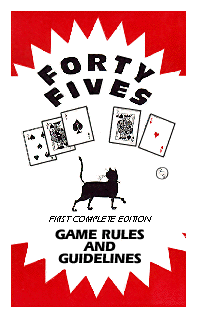
Someone told me the rules for forty-fives is available on DVD - can you show me where it is?
I had no idea what this meant. I was thinking 45 records, maybe the size and rpm that made 45's different from other records? That was flimsy though, so I just asked him what "forty-fives" was. I was surprised at the answer:
It's a regional card game, kind of like Hearts and Whist. Its complicated to learn, and I'm looking for the Merrimack Valley rules.
Huh.
[note: my library is part of the Merrimack Valley Library Consortium, so this is definitely local]
I searched our catalog for both 45 and forty-five for DVD and then everything, but didn't find anything like what he was talking about. Then I searched Amazon to try to find what the right title of this item might be, but couldn't find anything out there either.
So next I just tried a web search for 45 card game and came up with all kinds of stuff (including, of course, a Wikipedia article). Eventually we ended up at http://www.the45scardgame.com, which listed the rules online, but also linked to sites to play online, buy the game on CD, or buy a printed book of rules.
The patron was happy to see that, because he could learn the rules this way (and from a number of the other sites we found as well). He also thought his friend might have been talking about the game on a CD-ROM, and not on DVD after all.
But I couldn't resist ordering a copy of the rules book too - it's just too local and too unusual not to have in the library. I love it when the library can add something to our collection that a patron may no have purchased for themselves - not only do they get access to it then, but so does everyone else. Plus, I like card games*, so I'm really curious about this one. I've never heard of it before, but a game with rules like "black twos are higher than black tens, but red twos are not," is exactly my kind of game.
*And for the card-curious, my current favorite game has a not-kid-friendly name, so my family just calls it Rules.
Posted under Uncategorized | 3 Comments »