Archives for Reference Question:
July 7th, 2012 Brian Herzog
 A patron called asking about videos to rent*. My standard reply in this situation is to ask for the the title the patron is looking for - to my surprise, she replied:
I'm not exactly sure, but I think it's "The Midget Bible."
I had no response to this. Luckily, the patron followed it up with,
Tim Conway was in it.
Ah, I bet she was talking about the Dorf on Golf videos. A quick search for dorf bible showed the title is Dorf's Golf Bible.
Unfortunately, we don't have it in the catalog - actually, there were no Dorf videos in our consortium at all. She was a little sad, but not entirely surprised. I, on the other hand, got to speculate on the other possibilities for a "Midget Bible" for the rest of the day.
*I know it's kind of just semantics, but people using the term video bothers me (and not just because it's ambiguous). But even moreso when people talk about "renting" things from a library. I think they know what they mean, but I believe that thought can follow speech, and not speaking accurately can lead to thinking inaccurately. But, I'm like that.
Posted under Uncategorized | 4 Comments »
June 23rd, 2012 Brian Herzog
 This reference question can be filed under, "no matter how much you know about something, there's still more to learn."
One afternoon this week, a patron called in and asked for me specifically. She had a question about Microsoft Word, and since I've always been able to solve her technology questions in the past, she knew I'd have an immediate answer this time. Her question was:
How do you make Word automatically indent the first line of every paragraph?
I thought for a minute, and then realized - I had no idea how to do this. Whenever I want to indent, I just hit the Tab key. But she wanted it to indent automatically - which I was sure Word probably did, I just didn't know where this was in the menus.
I figured it had to be a Paragraph format option though, so I clicked the little square in the bottom right corner of the Paragraph box on the Home ribbon in Word 2007. Nothing immediately stood out, so I did a quick web search for word indent first line of every paragraph, and the first result explained how to do it - turns out I was on the right track.
Once you get to the Paragraph format box, you need to select "First line" from the "Special" dropdown box in the middle of the page. Then you can also set how much to indent by.
Great. I found all this in a minute or so, making small talk with the patron while I searched. As I started guiding her through how to do it, we hit a snag: she's still using Word 2003, and I'm on Word 2007 (which is also what the online directions were for).
I use this Paragraph format box all the time, but for the life of me I could not remember how to get to it in the Word 2003 menus. So, it was another web search for word 2003 paragraph menu, and again it was the first result that gave me the answer: Paragraph was an option on the Format menu.
Now I can navigate the patron to the Paragraph box and explain how to set the auto-indent feature. It work, she was delighted, and I was able to maintain my perfect record for her tech support - even though I had never done this before in my life.
Which just goes to prove the reference librarian's motto: you don't need to know everything, you just need to know how to find everything.
Tags: 2003, 2007, indent, libraries, Library, microsoft, paragraph, public, Reference Question, tech support, Technology, word
Posted under Uncategorized | 3 Comments »
June 2nd, 2012 Brian Herzog
 This was one of those questions that was was only of throw-away curiosity to the patron, but made me wish we could have spent more time on it.
One day about lunchtime, a patron walks up to the desk and said:
I just stopped in on my lunch hour to pick up some things I had on hold, but while I was here I thought I'd ask: is there a measurement for smell? Someone in my office uses our microwave to cook his lunch and usually it smells bad. Is there a way to measure how bad it smells, so we can tell him he can't cook things that smell worse than X?
Let me tell you right now, I love this question.
And honestly, I had no idea. I know sound is measured in decibels and light is measured in candlepower or lumens, but I've never heard of a measurement for smells (or for taste, for that matter. Touch I suppose is PSI).
My favorite go-to source for questions like this (definitions in search of a word) is the Descriptionary, but it turns out our copy is missing. So, being pressed for time with the patron on his lunch break, I just searched the internet for unit of measurement for smell, which brought us to the Wikipedia article for Odor, which has a "Measurement" section.
Our quick skim indicated two aspects involved in measurement - concentration and intensity - and that it appears there is no easy way to measure smells (nothing like a convenient light meter, for example). Measurement seems to be done in labs by professionals, using carefully controlled sample. We did learn, however, that there is a 0-6 scale for smell intensity, and that the unit of measurement for smell concentration is the European Odor Unit, (OUE).
We were both kind of disappointed at this point - I think we were hoping for a little handheld device that you could stick in a room and it would give a quantitative reading like "42 stinks" or something. The patron had to go, so I took his name and email address, and told him I'd send him anything else I found.
And I did find more, but nothing that would really help. Here are some of the highlights:
- Devices that measures smells are an olfactometer and an electronic nose
- Glossary of scent and smell terminology
- From a different glossary:
- Olf: an empirical unit of indoor odor intensity introduced by the Danish environmental scientist P.O. Fanger in 1988. One olf is defined as the odor intensity produced by one 'standard' person (a standard person is also defined). The name comes from the Latin olfacere, to smell. Ventilation reduces pollution, and the resulting pollution in ventilated, enclosed spaces is measured in decipols.
- Decipol: an empirical unit of indoor odor intensity introduced by the Danish environmental scientist P.O. Fanger in 1988. One olf is defined as the indoor odor intensity produced by one "standard person", and one decipol is the perceived odor intensity level in a space having an odor source of strength one olf and ventilation at the rate of 10 liters/second with unpolluted air. Measurements are recorded by human observers using protocols laid out by Fanger and his colleagues.
- Popular Science article on two Cornell students who created a machine to quantify farts
- Further reading:
That was the academic information I found. For non-academic information, I also found:
- Hobo Power: Coined by Adam Carolla and Dr. Drew on the radio show Loveline as a measure of how bad something smells. Ranging from 0-100, anything near 100 hobo would smell bad enough to cause death by asphyxiation.
Although more colloquial than OUE, I don't like this, because ever since I was little I wanted to be a hobo. But not everyone must share my romanticized view. A quick breakdown of the Hobo Power scale can be found here, and it's also listed in the Urban Dictionary.
I liked the "Olf" the best, but without any way to really measure it in the field, it's still not very helpful to the patron. I sent him what I found, with a note that I'll keep looking, but unfortunately I don't have much hope for finding something that will prevent his office lunchtime odors.
Tags: libraries, Library, measure, measurement, odor, public, Random, Reference Question, scent, smell, unit
Posted under Uncategorized | 2 Comments »
May 26th, 2012 Brian Herzog
 It's been a very slow week in the library (school winding down + beautiful weather), so this week's question isn't an actual reference question - but it is something I recently learned.
Did you know Wikipedia has a reference desk?
The Wikipedia reference desk works like a library reference desk. Users leave questions on the reference desk and Wikipedia volunteers work to help you find the information you need.
Questions/answers are broken up into categories, and are both interesting and sophisticated. I also like the format of crowdsourcing answers - even when someone had given what I thought was a great answer, subsequent responders added new information or aspects that were useful.
Actually, it reminded me of any other online forum, which I use all the time for answering questions (especially for coding problems or frustrating technology issues). No one response provides a complete answer, but putting all the bits and pieces together often solves the problem.
Not that using the internet as a big Help archive is anything new - I was just happy to find another source to search when I get a real stumper. But if nothing else, the Wikipedia Reference Desk Guidelines does make for interesting reading.
Tags: answer, archive, faq, libraries, Library, public, question, Random, reference desk, Reference Question, Technology, wikipedia
Posted under Uncategorized | Comments Off on Reference Question of the Week – 5/20/12
May 5th, 2012 Brian Herzog
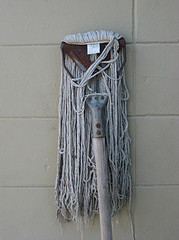 I always feel bad when I can't find an answer for a patron, but can still be amused by the situation. One afternoon, an older woman walked up to the desk and asked for help finding reviews of floor mops.
It took me a second to register this - and immediately I was skeptical that we'd be able to find anything at all.
We started with Consumer Reports magazine and their online database. We found reviews of steam mops, but not the old-style floor mop that she was looking for.
Next we tried Amazon and other online review places for "wet floor mops" and other descriptors, and there were lots of the Swiffer-type mops, but again, not what she was looking for. The only thing that came close was the (appropriately-named) Libman Wonder Mop.
She was disappointed, but wasn't surprised, and I really liked the way she expressed this:
Well, I guess it makes sense that something as fancy as the internet doesn't care about mundane things like an old-fashioned floor mop.
In the end, she just decided to go to the hardware store and ask them which they liked - and as long as it was light enough for her to use, it would be good enough.
I was impressed that she was willing to put this much effort into just a minor purchase - but if you mop a lot, I don't suppose it's all that minor after all. Not finding anything for her really made me want to go to the store with her to keep helping, but I hope the hardware store people find something for her.
Posted under Uncategorized | 4 Comments »
April 28th, 2012 Brian Herzog
 A friend of mine from library school, who now works in a library in Northeastern Ohio, told me about an interesting reference transaction that is worth sharing here:
On a recent Monday, a customer approached me with a stack of paperbacks from another library. We don’t carry many, preferring to stock our fiction shelves with hardcovers and replacing with paperbacks only when necessary, so I assumed he wanted to order some more. Instead, he said, “I don’t think W.E.B. Griffin really wrote these books. I would like to know who did.”
The question took me by surprise. “I’ve read all of his books,” the customer insisted, “and these aren’t like his other ones. I want you to let everyone know that he didn’t write them. Including this other library that I got them from.”
My friend knew, which I did not, that Griffin was currently writing his books with a co-author (his son, William E. Butterworth IV). The titles in question were from Griffin’s early writing career though, so she searched Fantastic Fiction and NoveList but could find no evidence that Griffin hadn't written the books himself.
Her mind went to the same place mine did: James Frey, The Last Train from Hiroshima, and the many other book hoaxes and fake memoirs that have been identified.
My friend is a writer, and she explained to the patron that the difference could be attributed to the author’s age, his style changing over time, and the influence of his son’s writing style. I thought this too, and it reminded me of an NPR story of someone applying textual analysis to Agatha Christie's books. They found that, although never acknowledged in real life, the vocabulary and writing style of her last book seems to indicate that she was suffering from Alzheimer's when she wrote it.
The patron seemed satisfied with her explanation, although he still wanted my friend to “let the other libraries know” - she felt a responsibility to the patron to do so, but just wasn't sure how.
We have had this same discussion in my library, most recently with The Last Train from Hiroshima. We discussed putting a note in the catalog record, a label on the book itself, or shelving it in fiction, but ultimately just sent it back to the publisher. In a cut-and-dry case such as that, I think it'd be okay. But in this case, with just a single patron's suspicions, I don't think there can possibly be any library responsibility here.
Finding out a non-fiction book is false is one thing - just one person suspecting an author of a fiction book didn't actually write is entirely different. My friend went on to say that if the patron had kept pushing, she would have found contact information for the author and publisher, so the patron could contact them directly. I agree - I don't think we can investigate claims like this, but we certainly can handle them once they've been proven. In this particular case, I think my friend did the right thing - made the patron happy.
Posted under Uncategorized | 1 Comment »