April 14th, 2007 Brian Herzog
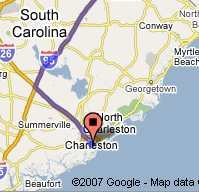 With all my travels these days, this reference questions is quite appropriate. A patron comes to the desk and says she is going to go to Wilmington, DE to Charleston, SC, and wants to get driving directions.
But what's more, she's planning this trip for later in the summer, and also wants to know what the weather will be like in June and July. And, she seems to fully intend on planning her trip around whatever long-range weather forecasts I can locate.
But so, first things first: driving directions. Despite my general mistrust of Google, I really do like Google Maps. I don't know how their directions compare (in accuracy, directness, etc.) to MapQuest, Yahoo! Maps (which now looks a lot like Google Maps), or even AAA TripTiks, but I prefer their interface. I like maps, and I like being able to type in the little notes field at the top of the page.
For weather forecasting, I needed to check a few resources. We keep the Old Farmers Almanac on our ready reference shelf, so I first grabbed that. As with most almanacs*, they forecast out what the year will be like in general terms on a regional basis.
This wasn't specific enough for her, so I then turned to the internet. I believe that NOAA has the most reliable weather data, but they only seem to forecast out seven days (they do have a few months worth of historical data, which I've used in the past).
Next I tried the Weather Channel's website. Being commercial, I think they try to pack in more features, but they had what the patron was looking for. In addition to the current forecast, they also have both a monthly planner and monthly averages.
In the case of this patron, the monthly averages were good enough, but we also looked at the daily averages to see if the beginning or end of the month was better. I did feel a need to remind her that these were averages and long-range forecasts, and hence not exactly something to plan a wedding around, but she seemed pretty satisfied.
* In the interest of full disclosure, I used to work for a division of the company that publishes the Farmers' Almanac, a rival of the Old Farmer's Almanac. I personally prefer the Farmers' Almanac, but there you go.
directions, driving directions, forecast, libraries, library, public libraries, public library, reference question, weather, weather forecast, weather forecasts
Tags: directions, driving directions, forecast, libraries, Library, public libraries, public library, Reference Question, Resources, weather, weather forecast, weather forecasts
Posted under Uncategorized | Comments Off on Reference Question of the Week – 4/8
April 12th, 2007 Brian Herzog
These two weeks see me traveling to both Charleston, SC, and Washington, DC.
Pleasure in Charleston, SC
I was in Charleston to visit one of my closest friends, who I haven't seen in way too long. In addition to just getting to spend time with her, we also spent a day on Bull Island, which is part of the Cape Romain National Wildlife Refuge. Bull Island is an unspoiled and undeveloped barrier island just north of Charleston, and we spent the day hiking around and taking pictures. If you ever get the chance, definitely visit. Here's a few pictures:
Library Business in Washington, DC
(calling library stuff
"business" seems odd to me, but there you go)
This weekend I'm heading to Washington for the Computers In Libraries 2007 conference. I always enjoy Washington, and am also looking forward to the conference.
My goals for the conference are:
- talk to vendors with time management software for public PCs
- learn more about incorporating rss and css into web design
- look at cms systems to replace our static html/Dreamweaver current way of doing things
- talk to vendors about federated searching
- find out as much as I can about open source ILSs, since Horizon 8 is a no-go
- be on the lookout for product like Delicious Library, but for PCs and web-ready
Specific Sessions I will be attending (I usually play it by ear after I arrive, but these are definites):
- [preconference] Michael Sauers' Integrating RSS into Your Web Site session
- Tim Spauling's LibraryThing session
- Jessamyn West's Firefox session
We'll see how far I get. I'm also plan to tour the House of Representatives, sit in the gallery of the Senate, finally get to the National Archives, and hang out with a cousin of mine who lives in the area. If you see me there, please say hi. Otherwise, I'll be back next week.
bull island, bulls island, cape romain, cape romain national wildlife refuge, charleston, charleston sc, cil, cil07, cil2007, computers in libraries, computers in libraries 2007, libraries, library, public libraries, public library, washington, washington dc
Tags: bull island, bulls island, cape romain, cape romain national wildlife refuge, charleston, charleston sc, cil, cil07, cil2007, computers in libraries, computers in libraries 2007, Conferences, libraries, Library, Personal, public libraries, public library, washington, washington dc
Posted under Uncategorized | Comments Off on Traveling for Business & Pleasure
April 10th, 2007 Brian Herzog
I liked Jessamyn's post about the high cost of everything. Databases are expensive, and intangible, which makes it trickier to justify them. But librarians are often challenged to justify our existence in general, and the burden is usually on us to convey to the public how valuable libraries are.
This talk about how much things cost reminded me of the Library Use Value Calculator. This tool lets patrons enter their library usage (how many books they check out, how many reference questions they ask, etc), and see a dollar figure of how much their library usage would cost them if they had to pay for it "retail."
The calculator we use started as a spreadsheet developed by the Massachusetts Library Association, which I then converted to javascript to be more interactive. The Maine State Library then approached me, asking if they could edit my code and make available a more accessibility-enabled version with installation instructions.
They did, and since then it has spread. Here's a list of library websites that either feature or link to the calculator (if I missed you, please include a link to your library in the comment section). Below that are a few other blogs and websites that mention the calculator, including Library Journal and PLA.
If you're a librarian and looking for a tool to justify your existence, this might be a way to give people actual numbers. Feel free to modify and reuse the calculator code yourself, and let me know if I can help - [email protected].
Libraries using the Library Use Value Calculator
People talking about the Library Use Value Calculator
Again, If you're a librarian and looking for a tool to justify your existence, this might be a way to give people actual numbers. Feel free to modify and reuse the calculator code yourself, and let me know if I can help - [email protected].
cost, libraries, library, library calculator, library use calculator, library use value calculator, library value calculator, public libraries, public library, use calculator, value, value calculator
Tags: cost, libraries, Library, library calculator, library use calculator, library use value calculator, library value calculator, Marketing, public libraries, public library, use calculator, value, value calculator
Posted under Uncategorized | 4 Comments »
April 8th, 2007 Brian Herzog
A patron walks up to the desk...
patron: can you give me a list of all the radio stations in the area, what their numbers are, and what kind of music they play?
At first this sounded like a tall order, but then I realized that it really shouldn't be. My first thought was that, if anyone, the FCC should keep track of some kind of list like that. So I tried their website, and their search feature, but saw nothing obvious. The search returns were so bogged down with regulations, filings and rulings that I couldn't find anything useful.
While searching here, as a stall tactic, I asked the patron if he has seen a list like this. He said he had one, that was published in the newspaper a few years ago, but it was all out of date.
So, I switched to the general internet. I thought that if I didn't find something quickly, then I could try out newspaper databases.
I searched for "radio station listing" on Google, and the first result was Radio-locator.
I'd never heard of it before, and can't speak to its authority, but it seemed to be exactly what we were looking for. It lists itself as "formerly the MIT List of Radio Stations on the Internet," with over 10,000 radio station websites. So apparently this only includes radio stations with websites, but it was a good start.
It allows a zip code search (as well as other search options), and provides a nice listing of the station, the call letters, the frequency, signal strength, city, and even format. The patron was very happy with this, so I printed it for him and he went away.
A couple other notes about this website:
- Another element of each record is a link to the station's online feed, if it exists
- Oddly, the page would not let me (in Firefox) highlight and copy just the radio station listings. When I went to print, it took up two pages because of all the ads and formatting. I wanted to copy out just the station information and paste it into Word so I could print just one page, but it didn't see to want to allow this.
- The search included functioning AM and FM stations. There was also a link to find unused frequencies - that isn't particularly useful to me, but I find it interesting.
libraries, library, public libraries, public library, radio locator, radio station, radio station finder, radio station guide, radio stations, radio-locator, reference question, station finder, station guide
Tags: libraries, Library, public libraries, public library, radio locator, radio station, radio station finder, radio station guide, radio stations, Reference Question, Resources, station finder, station guide
Posted under Uncategorized | 1 Comment »
April 5th, 2007 Brian Herzog
 In response to the recent local press coverage of "Sunshine Week," the Chelmsford Police Department held a public records seminar. The seminar was led by Rebecca Murray, an attorney in the Public Records Division of the MA Secretary of the Commonwealth's Office.
The seminar was designed to inform public employees (in this case, mostly police department clerks and officers) how the MA Public Records Law (as opposed to the federal FIOA) addresses access to public records, and how to handle requests for public records from the public.
The seminar was excellent, and I learned a lot. There were two handouts - one was the Commonwealth's A Guide to the Massachusetts Public Records Law [pdf], and the other a bulletin from the Supervisor of Public Records that can serve as sort of a "frequently asked questions" list (contact for copies).
I posted a summary on my library's blog. I structured it to be from the public's point of view, rather than that of a public records clerk. I also developed a handout [pdf] based around information from this seminar.
Library Records as Public Records
Also, a footnote for libraries: to the information available through the public records law, there are a number of exemptions that can exclude information (such as personnel information, information about an ongoing investigation, etc.). Up until 1988, Exemption (k) excluded patron records from public libraries from public record. In 1988, the Commonwealth repealed this exemption in order to make it a separate law unto itself. MA General Law chapter 78 section 7 reads in part:
"...[T]hat part of the records of a public library which reveals the identity and intellectual pursuits of a person using such library shall not be a public record..."
I know state law gets trumped by the USA PATRIOT Act, but still - it's nice to have this on the books.
libraries, library, public document, public documents, public libraries, public library, public record, public records, sunshine laws, sunshine week
Tags: libraries, Library, public document, public documents, public libraries, public library, public record, public records, Resources, sunshine laws, sunshine week
Posted under Uncategorized | Comments Off on Accessing Public Records
April 3rd, 2007 Brian Herzog
I don't really like being a repeater for products and advertising, unless I think they are helpful. I've never used WebFeat before, but from what I know about it, I would love to.
I recently received a marketing email from them, offering a free trial, with a pitch that caught my eye:
...The WebFeat Express 2.0 trial isn’t just a canned demo – you’ll be able to...add your own databases and subject categories...
This is of particular interest to me now. My consortium's reference committee met last week, and we were told that the directors are looking to cut our database budget. The consortium itself only pays for three databases (NoveList and History Reference Center [HRC], both from ebsco, and Overdrive), and want to do away with one of them.
These are three very different resources, so this alarmed me. So, too, did the way they were being compared to each other. We were given a sheet with the cost for each database, the number of sessions for the Ebsco databases, and the number of audiobooks downloaded in Overdrive. They then divided the usage by the cost, to come up with a per usage dollar figure, and suggested cutting the most expensive one.
The figures came out like this:
| Database |
Total Usage |
Cost Per Use |
| HRC |
3776 |
$6.28/session |
| NoveList |
3697 |
$4.69/session |
| Overdrive |
4342 |
$4.38/checkout |
Now, there's all kinds of extra information that goes along with this breakdown. But, based on this comparison, it seems like HRC is the most expensive, so we should get rid of it.
My issue with it, though, is that a session is not the same as a checkout. In the ebsco databases, patrons will access the database (a session), search for their keywords (searches), and then read articles (end product). In Overdrive, patrons will access the catalog (a session), search for audiobooks (searches), and then checkout something (end product).
See that subtle difference? In the comparison above, they are looking at sessions in HRC and NoveList, but the end product in Overdrive - the proverbial apples to oranges comparison. To meaningfully compare these three, I think you have to look at sessions across the board, or searches across the board, or end product across the board.
So, they should compare the audiobook downloads in overdrive to the number of articles viewed in the other two - which I think would significantly bring down that cost per use number. This is my statistics rant. Having an undergrad degree in Market Research, I am sensitive to such things.
But back to WebFeat: regardless of the cost per use breakdowns, I think the real problem is that we generally do a poor job of promoting our databases. Most patrons don't know what "database" means, nor when to use one. And our websites don't help much. This trial lets us see what searching with WebFeat would be like, with the databases we currently subscribe to.
Which is why a product like WebFeat (and SchoolRooms) is great - it incorporates all of these resources into a patron's information search without the patron even realizing it. It gives the patron access to information from resources they didn't know existed, without them having to go out of their way to find it. In the future, I hope library ILS are all designed this way - a single, unified information search.
That should be our bottom line goal, not just bringing down cost per use figures or inflating our database statistics.
database, databases, ebsco, history reference center, libraries, library, novelist, overdrive, public libraries, public library, webfeat, webfeat express, webfeat express trial
Tags: database, databases, ebsco, history reference center, libraries, Library, novelist, overdrive, public libraries, public library, Resources, Technology, webfeat, webfeat express, webfeat express trial
Posted under Uncategorized | Comments Off on Databases Stats and WebFeat Express Trial