I've used this exact same technique before to answer a question, but the end result of this one still made me laugh.
A patron I know asked me to put a book on hold for him. Since I know him, I didn't ask for his library card number - I just figured I'd look him up.
Unfortunately, he has a fairly common name, so there were three patrons by that name in the catalog. I didn't know his street address either, but I do know what his pickup truck looks like - so I thought I'd look up these addresses on Google Maps and see if his pickup was parked at any of them. I suspect this is how all reference librarians think.
I type in the first address and switch over to street view. What do I find? Not only was his pickup parked in the driveway, but he was in the yard cutting the grass - case closed!
Of course, you can see him better when you move around and zoom in on Google Maps, but even from the back I was positive it was him. Ha.
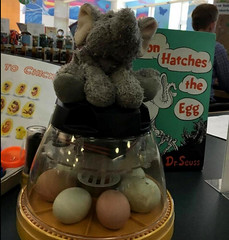
Here's something kind of neat we're doing in my library: our Children's Room has eggs in an incubator so the kids can watch them hatch, and then our IT person got the idea to livestream the eggs (and subsequent chicks) to our website.
The eggs came from a farm in Western MA, and the chicks will go back there a couple weeks after they hatch. In the meantime, the incubator has been sitting on the Children's Desk - and of course has been very popular with kids (and the local paper).
After they hatch they get moved into a larger cage, and that's when the livestream should get more interesting (watching eggs isn't actually that much fun).
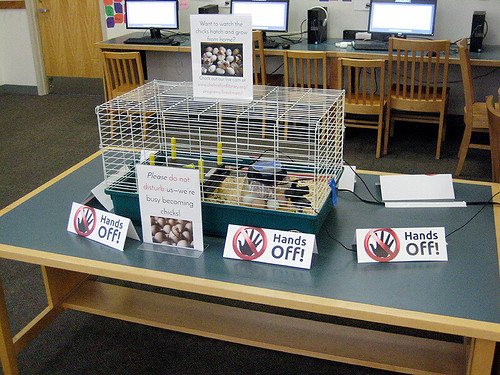
Here's our setup - the incubator is inside the cage, along with water, food, and a heater for after they hatch. Maybe a bit "hands-offy" for my taste, but you know kids, I guess.
Setting up the livestream was surprisingly easy too. First I contacted our webhost to see if they had any issues with this or any suggestions, and they said the best route for them is to use YouTube's livestream feature. That way, we're just embedding a video, and not really bogging down their servers.
I found some instructions for YouTube Stream Now and first verified our YouTube account (which was a click of a button). Next our IT person installed an encoder (he chose Wirecast Play) on the computer we were going to use to host the camera. We decided to dedicate an extra computer to this, so it didn't slow down a staff desk computer.
Next on the YouTube livestream dashboard, we could edit things like the stream title and other basic information. This is also where you get the key for the encoder, and also where you get the embed code (like any other YouTube video).
The one change I made was to make the embed code permanent by including our Channel ID, based on a StackOverflow article:
You can find your CHANNEL_ID at https://www.youtube.com/account_advanced
Our IT person did all the hard work of installing and configuring the encoder, and setting up the computer with the camera, but really, none of this was difficult. Nonetheless, I was still amazed when I embedded the livestream code and it just worked:
Neat. I was also thoroughly entertained coming up with a title for this post that sounded click-baity yet accurate. "Live Nude Chicks" was my second choice.
While I was sitting at the desk one day this week, an older gentleman patron walked up and said,
Brian, can I ask you a question? It's kind of personal.
Whoa-boy, I can only imagine where this is going. But of course I said sure.
Where do you get your hair cut?
Okay, now we're in my wheelhouse: I get asked for fashion and grooming advice all the time!
Anyway, he and I proceeded to have a nice exchange about local barbers and the advantageous way our hair style lends itself easily to do-it-yourselfers. I actually received Wahl clippers a few Christmases ago, and have been cutting my own hair ever since.
The patron was delighted to hear this - he has been too, but felt guilty about it. He was worried he wasn't doing a good enough job, and so had recently gone to a real barber. But he was shocked at how high the price was since the last time he went, and basically, I think, was looking for someone to tell him it was okay to cut his own hair. We also compared notes on clipper comb numbers and which is the best to use (I use #2 on the sides and #1 on the top).
I've been mostly bald since my twenties, and this is the bright side of having the same hair pattern as older guys: they are one more segment of patrons I can relate to through shared personal experience.
And although he complimented me on how nice my hair looked before he left, this interaction did remind me to put "cut hair" on my weekend to-do list.
One of the things I truly hate, hate, is clickbait. I find myself specifically not clicking on things that sound clickbaity, just because I feel insulted by something thinking I can be manipulated. (That'll teach 'em.)
Especially though when it is totally unnecessary. A recent Lifehacker article entitled "This Secret Trick Will Save You From Getting Lost In Central Park Forever" could have just as easily, and less annoyingly, been titled, "How To Use Central Park Lampposts To Avoid Getting Lost." I still would have clicked and read, and would have felt less dirty about it.
Of course these show up as links all over the internet, but I've also seen a trend on YouTube to name videos with clickbait titles too. One of the channels I used to watch, Wranglestar, has become terrible for this, and I've all but stopped watching him because of it. Recently though, he published a video explaining why he uses clickbait video titles. It was interesting, and the tl;dw version is that he found it to be the only way to make money on YouTube anymore: regular titles don't get clicked, which means videos don't get watched, which means no monetized ad revenues for him.
If it is that effective, maybe libraries ought to pay attention. So, just as a "funny thing to think about but I would never do for real" project, here are a few of our library programs re-titled as clickbait:
I'm at work on a Saturday covering our "Info Desk," which is kind of like a mini-Reference Desk right inside the front door.
During my lunch today, one of my coworkers from the real Reference Desk relayed an interesting interaction she had this morning:
A guy came up and said he was locked out of his car. I asked if he wanted to call AAA or something, but he just asked if we had a wire coat hanger.
I said I thought that didn't work on new cars, but he said he thought he knew a trick and wanted to try it.
So I went into the lunch room and found the one wire hanger we had on the rack*, and I gave it to him. And it must have worked, because I saw him a little later and he just gave me the thumbs-up.
Ha, that made me laugh. I think I'd be a little uncomfortable giving a patron a hanger, but I'm sure I've given out worse. My three favorite things about this are:
he thought to ask the library for something (even something unusual)
we were able to give it to him (even though it was unusual)
and his life was better off for it (or so the thumbs-up seems to imply)
And even better, now this patron has a great "guess what happened to me today at the library!" story to tell people. Nice.
*By the way, she had just dumped everything that was hung on this hanger onto the nearest chair. Me asking her, "why is all this crap on my chair?" is what prompted her telling me this story in the first place.
Our new YA librarian is redefining the teen area in the library. In the course of listening to her plans though, I remembered a display our previous YA librarian had done that I thought was pretty neat.
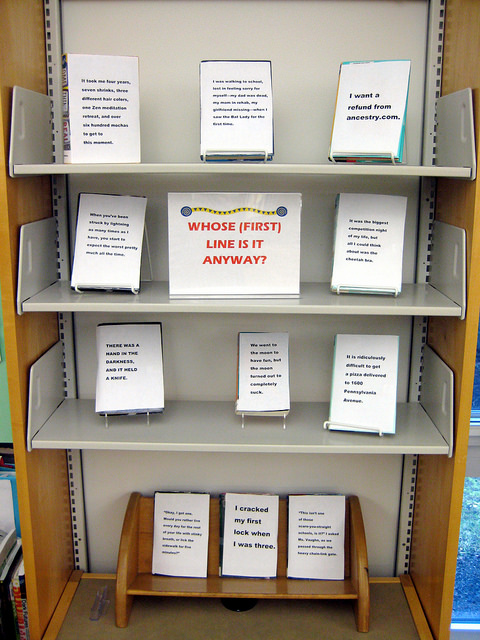
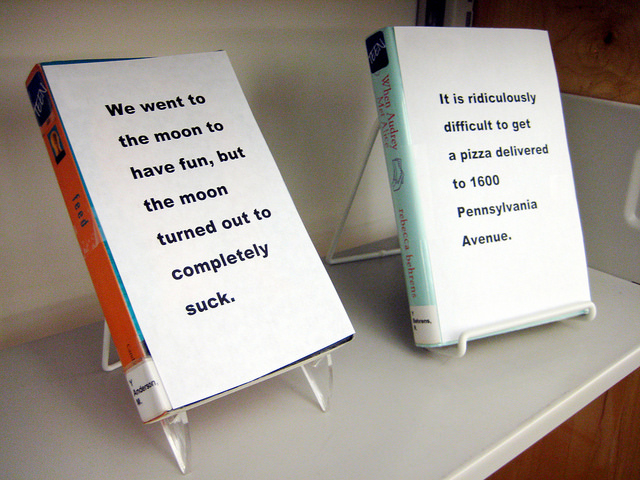
It looks odd, but she covered popular books with a blank sheet printed with the first line of the book. Partly to gamify the display so people could guess what book it was, but also just as a novel and eye-catching way to get people engaged with books they may not otherwise have picked up.
Also: looking at these photos on flickr, I realized I took them in December of 2015 - oops. Still, it's a cool idea.

 Here's something kind of neat we're doing in my library: our Children's Room has eggs in an incubator so the kids can watch them hatch, and then our IT person got the idea to