March 21st, 2013 Brian Herzog
 In case you haven't heard, the Supreme Court issued their decision in Kirtsaeng v Wiley, and common sense has carried the day. Publisher's Weekly has a good write-up, and so does SCOTUSblog.
This of course doesn't mean libraries will never face another copyright-related threat, but it does prevent things from getting ludicriously horrible right now. If you're interested in following copyright and intellectual property news, I highly recommend the Copyfight blog, written by Alan Wexelblat.
And speaking of copyright, this decision also reminded me that I never posted a link to this great Copyright Guide from Cornell. It's a handy little quick-reference to figure out if something is or is not covered by copyright. Thanks Jason, and I'm sorry for taking so long to post it.
And finally, one of my pet-peeves: remember world, the past-tense of copyright is "copyrighted," not "copywritten."
Posted under Uncategorized | Comments Off on Copyright Good News
March 16th, 2013 Brian Herzog
This week is actually a crowdsourcing request to find the answer to a question. Last month, a friend of mine at the Robbins Library in Arlington, MA, tweeted:
I followed up with her and got a little more detail on what she's after:
What I am looking for is basically a timeline showing when repair of certain things became obsolete; for example, approximately when most people stopped taking their shoes to a cobbler and just bought new shoes, or when radio or toaster repair became a thing of the past and you just had to get a new one instead.
That sounded like a chart I'd like to see, and I'm always happy to help, so I started researching to see what I could find. The search so far has been unsuccessful, and earlier this week she posted an open request on her blog asking for help. If you're interested, please lend a hand - unanswered question bother me.
 The search has turned up some good stuff though. I like making and repairing my own things, so of course this question - and the notion of planned obsolescence in general - interests me. Jenny listed some of the resources we've found so far, including the one I found most eye-opening, "Consumer Society Is Made To Break," because of this:
“Planned obsolescence” may sound like a conspiracy theory but it was once openly discussed as a solution to the Great Depression. In fact, most scholars trace the origin of the term to Bernard London’s 1932 pamphlet, “Ending the Depression Through Planned Obsolescence”, in which London blames the global economic Depression on consumers who disobey “the law of obsolescence” by “using their old cars, their old tires, their old radios and their old clothing much longer than statisticians had expected”. London’s sinister solution was to propose a government agency that would determine the lifespan of each manufactured object whether it is a building, a ship, a comb or a shoe. Those frugal consumers who insisted on using their products past the expiration date would be penalized.
The full text of the pamphlet is included in their post. To me, planned obsolescence did seem like some kind of manufacturer's conspiracy, so I was surprised to read it originated as a solution to the great depression. I suppose that makes sense, but the idea of deliberately building a short - and unextendable - lifespan into products to force people to spend more money on a replacement is just offensive.
Anyway, if anyone manages to find what Jenny is looking for, please let her know (and me too). Thanks!
Posted under Uncategorized | 6 Comments »
March 14th, 2013 Brian Herzog
If you haven't seen it already, please take a minute to check out Jessamyn's picture-laden post on some really great ideas currently happening in the library world.
 I point to her post because I had a couple of these in my to-blog folder, but, not surprisingly, she hits the important points much more concisely than I would (but I'll add my two cents anyway).
The Awesome Box
This idea circulated around my library a few weeks ago, and we all agreed it indeed is an awesome idea, and we want to make it happen here. We're in the (early) process of adding an Awesome Box to our circulation desk, and once it's there, I'll update people on patrons' reactions (which I am very curious to see).
Blind Date With a Book
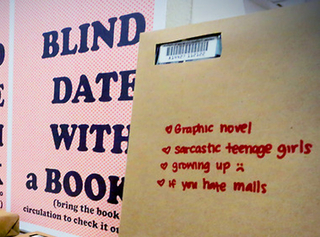 Another good idea that was new-to-me recently (around St. Valentine's Day), was a lot of libraries doing "blind date with a book." The idea is for staff to choose good books, and then wrap them so patrons don't know what it is. Some libraries put a little information on the cover, but basically the point is for the patron to read this book blind (so to speak) - and, hopefully, enjoy something they may not have otherwise checked out. (By the way, this wasn't in Jessamyn's post, but I like it anyway.)
Non-Traditional Collections/Next Generation Libraries
Jessamyn pointed out that there is such a thing as the West Seattle Tool Library - unfortunately, I don't think there is an Awesome Box big enough for this. I like the trend of makerspaces in libraries (like in Westport, CT), and this is sort of in that same vein. Also too, I think non-traditional collections (like seed libraries) are a great idea.
I have also been collecting links about "Next Generation Libraries" - you know, the bookless type that are nothing but rows and rows of computers and the collection is all ebooks. Here's a few I've bookmarked:
On San Antonio's Bexar County Public Library:
Other varieties of new tech trends in libraries
I'm certainly not a Luddite (well...) and generally don't shy away from evolution and change, but this picture really bothered me:
My library has rows of public computers too, but this picture makes these terminals (and the library overall) look so cold and isolating - not to mention the stools look designed to be uncomfortable and unwelcoming.
But anyone can pick out the pros and cons of a particular instance of a trend, so I decided to focus on what my library would be like if we went bookless.
I started with the obvious: maintaining access to information, which is a core library mission. The current state of ebooks is barely tolerable, primarily because not all ebooks are available to libraries. Which means we'd probably need to purchase ebooks as a consumer and load them on physical devices (which itself is not exactly a model made for libraries).
Anyway, if we were going to be providing devices, and expected to maintain our same level of service and circulation, the number of devices we'd need to purchase depended on our circulation. A one-day snapshot showed that we had 3,142 patrons with at least one item checked out.
That number is kind of sobering, and leads me to think that there is no realistic way we could afford to make this switch and still provide our patrons with access to all the titles they want to read, watch, and listen to. I'm certainly not denying the trend, nor the success that some libraries have had with a bookless model, but it doesn't seem like we'd be able to accomplish this any time soon.
Posted under Uncategorized | 4 Comments »
March 9th, 2013 Brian Herzog
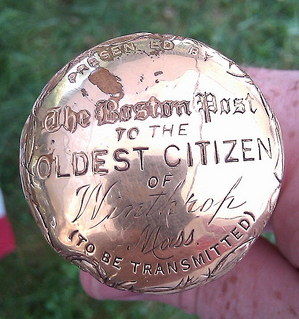 I think this is my absolute favorite reference question so far this year. It took a few days before the final answer emerged, and it all started with a patron sending in this message from our ChelmsfordHistory.org website's contact form:
Does Chelmsford have a Boston Post cane, if we do who is the lucky holder?
I've lived in New England for about twelve years, and have heard of these canes. What I knew about them was just that some towns had them and some didn't, and they were handed out around the turn of the last century by a newspaper or magazine.
I've been in Chelmsford for seven years, and never heard of one of these canes in connection with Chelmsford. I did a bit of research, and then replied to the patron:
I haven't heard of a cane in connection with Chelmsford. I found a list online of the communities that have them, and Chelmsford isn't included:
http://web.maynard.ma.us/bostonpostcane/the-canes/massachusetts
I think when the canes were passed out by the Boston Post, Chelmsford was a much smaller town than now, and perhaps didn't make the cut of the original 700 towns that received them. I'll check with the Historical Society to be sure, and let you know. Thanks.
Brian Herzog
Head of Reference
Chelmsford Public Library
From this website, I learned more details about the canes: in 1909, they were given to 700 towns in Massachusetts, New Hampshire, Vermont, and Rhode Island, by Edwin A. Grozier, Publisher of the Boston Post newspaper. The tradition was to give the cane to the oldest living resident in town, and then it was passed on to the next oldest when that person died. The cane itself belonged to the town, administered by the Selectmen, but was always supposed be held by the oldest resident. Of course, as towns grew, this became harder to track, and many canes were lost or retired and put on display somewhere.
Anyway, I emailed the Historical Society to be thorough, and while waiting for a reply, continued to check our vertical file and local history resources. I wasn't able to find anything about a Chelmsford cane, so I was surprised by the message I got the following day from the Historical Society:
We have it at the Historical Society now, but I don't think it is on display yet. It went missing for many years but turned up at the Senior Center a couple of years ago. [One of our members] has more details on the mystery if you are interested.
Holy smokes - do you know what this means? The internet lied to me!
I was certainly happy I checked with them. I emailed the patron the good news, but also followed up with the other Historical Society member to see what else I could learn about the cane. The next day, I heard back:
Hi Brian,
You can find out all about the cane in Judy Buswick's book Looking Back with Eleanor Parkhurst. I'm sure the library has a copy. There is a chapter on the cane.
Take care
 Oops - we do indeed have multiple copies*, and it wasn't one of the books I looked in. The title of the chapter on the cane is "Mystery defines cane's history," which is why this book didn't come up when I searched the catalog for keyword combinations that include Boston or Post (however, a search for "Chelmsford cane" produces this book as the only result).
So, bad on me for not conducting a more thorough search on my own, but I'm glad my reaching out to an expert resource directed me back to the right place.
This chapter, which was originally published as a newspaper article in 1996, detailed the Chelmsford cane's history, from the first few recipients through it being lost, and then suddenly turning up one day at the Senior Center. After that it made its way to the Historical Society for safe keeping, and another Historical Society member said that it is in fact currently in a display case there.
Again, I emailed the patron with what I had learned, including letting him know we have this book in the library. A few days later he came in to pick it up, and we had a nice little talk about the canes, and his interest in them.
Apart from me dropping the ball and not finding the right book when I should have, this was a great reference question. The internet was wrong, local resources were vital, I learned something about local history, and the patron got exactly what he wanted. But best of all, I get to email the people who run that Boston Post cane website to have Chelmsford added, doing my little part to make the internet a better place.
*This book is also available for purchase from the Chelmsford Historical Society.
Posted under Uncategorized | 9 Comments »
March 6th, 2013 Brian Herzog
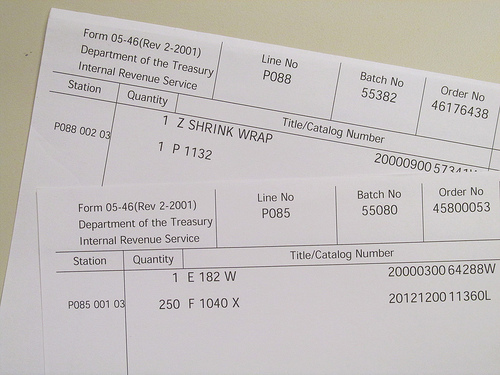
I know the IRS prides itself on keeping track of assets, but it makes me laugh every time I see the packing lists that come in tax forms shipments from the IRS:
The first line on the top packing list (1 Z Shrink Wrap) accounts for the shrink wrap used to seal the forms, and the first line on the lower list (1 E 182 W) accounts for the one Envelope used. Now that is some fine-tuned accounting, and I can appreciate that.
Posted under Uncategorized | Comments Off on IRS Accounting Thoroughness
March 2nd, 2013 Brian Herzog
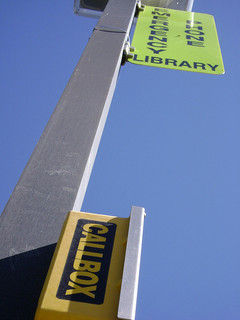 This sort of happened once before, and I think it's awesome - although it probably wasn't very awesome to experience.
One member of our staff recently took a two-week cruise, leaving from Florida. She and her partner flew to Florida, took a shuttle from the airport to the dock, and were just about to get on the boat when the realized one of their suitcases was missing. But worst of all, it was the suitcase that contained his blood pressure medicine.
They simply could not go on the cruise without it. And they only had an hour and a half before they had to check in on the ship, so they didn't have enough time to get all the way back to the airport and try to track down the bag.
So, she did the only smart thing - she called the library.
Her logic was this: they knew the name of his doctor and the town in which he practiced, but no other contact information. The Reference Desk was able to easily find the doctor's office phone number, which she then called from her cell phone in Florida.
The doctor's office said they could send a new prescription to a local pharmacy down there - but of course they were at a cruise ship terminal and had no idea where a drug store might be.
The ensuing story sounded like the stuff of a Benny Hill sketch: they found a taxi, but the driver barely spoke English. He tried to locate a CVS Pharmacy on his smartphone's GPS, while my coworker tried to keep the doctor's office on the phone. I can just hear Yakety Sax playing while picturing this cab racing down the street, cell phones blazing, communication barrier humming, and the clock ticking.
They finally find a pharmacy, (hopefully) convince the cabbie to wait in the parking lot because they'll be right back out and need to race back to the dock - my coworker still has the doctor's office on the phone and gives it to the pharmacy technician so they can work out where to send the prescription.
After a few tense minutes the new prescription is filled, the smiling taxi driver is happily waiting for them, and they make it back to the cruise ship just in the nick of time. The rest of the cruise goes smoothly, they have a wonderful time, and they even manage to pick up their lost suitcase on their way back through the airport going home.
And the moral of this story? Never go on vacation without taking your local library's phone number with you.
Posted under Uncategorized | 3 Comments »