I freely admit to being entertained by immature things, but the sheer unexpectedness of this discovery will hopefully make everyone laugh.
A few weeks ago, my library decided to revamp our DVD collection: the "fiction" DVDs were split into separate sections for Feature Films and for TV Series, and all the non-fiction DVDs were interfiled, by Dewey, with the non-fiction books.
This has elicited mixed reactions from patrons, as they adjust to looking for documentaries and exercise videos in a new place. However, interfiling with the non-fiction books also sort of put me in charge of them - or rather, since Reference is now the closest desk to them, we're the ones who get asked why we don't have DVDs on particular topics.
So something new for me in the last week or so has been to fill some of the holes in our non-fiction DVD collection by finding DVDs to purchase on the specific subjects patrons had asked for. That's what I was doing this week - looking for videos on massage therapy, prenatal yoga, travel (we definitely do not have enough travel DVDs) - when I stumbled across something odd.
I was searching on Amazon, and had found a few good prenatal yoga DVDs. Great. So I started looking for DVDs on massage therapy, but wasn't having as much luck. I broadened my search to just massage, and was mildly surprised (although I suppose I shouldn't have been) to see all manner of "sensual massage" DVDs. Interesting, but not what I was looking for.
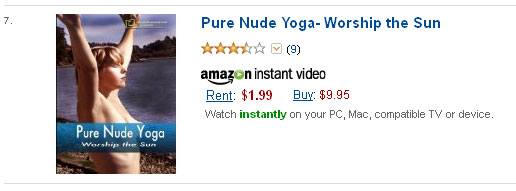
Amazon's default sorting method is by Relevance, so I thought if I tried something else - Average Customer Review or Most Popular - I'd find DVDs that our patrons might be interested in. The Average Customer Review sorting was productive. Then I switched to sort by Most Popular, and that's when I learned the most popular massage video on Amazon is:
And a little further down on the list was:
One of the greatest things about being a librarian is that you learn something new every day. I had no idea nude yoga existed, nor that it was available as an on-demand video download from Amazon, nor nor that it would be Amazon's most popular "massage" video.
Although I'm sure this would also be popular with my patrons, this did not make the selection cut for the library.
More on Interfiling DVDs and Books
Incidentally, for those interested, we made this change to our DVD collection to try to make it easier for people browsing for movies to watch. All of the television series and anime DVDs got a TV Series sticker, and are now on different shelves, separate from the feature films. We have a lot of TV shows, so this greatly reduces the number of DVDs someone has to look through just to find a good movie to watch that evening.
The comments I've heard so far regarding the non-fiction DVDs (aside from the fact that people had memorized where their favorites were) is that it's now more difficult for someone who wants to browse documentaries. As a result, we may pull all the documentary DVDs - the ones you can watch for entertainment or edutainment - and create a "Documentaries" section by the Feature Films and TV Series DVDs. On the other hand, the people looking for exercise or travel DVDs have really liked having all the related books in the same place, so those will probably stay. This will take some fine-tuning, but eventually I'm sure we can reach the happy medium.
Last week, a salesman from Library Ideas, LLC, came to demo their new ebook product, Freading. This is the same company that has the DRM-free music download product Freegal, so I was curious to hear their approach to ebooks (tl;dr version is their excellent FAQ).
Ebooks are more popular than ever in my library, and our Overdrive ebook catalog (which we share with 36 other libraries in my consortium) just cannot keep up. Patrons are disappointed that everything they want to read isn't available for immediate download (either because the publishers won't deal with Overdrive or because other patrons already have that ebook checked out).
And that's how Freading is different: instead of the Overdrive model of building your library ebook collection by purchasing one ebook that only one person can use at a time, the Freading model gives immediate access to their entire 15,000+ ebooks, and any number of patrons can download the same ebook at the same time.
A Better Model?
I really like this model much more than Overdrive, because patrons never have to wait for books, and right off the bat you're offering a huge collection. Although there is the question of sustainable cost, which I'll get to later.
They also have a lot of kids books - at least, more than we currently offer with Overdrive.
Another huge plus is that I find the interface and whole download process way easier than Overdrive. You can check it out at http://freading.com - it's not the most elegant interface, but the process really is just three steps:
Search for an ebook
Click to view the ebook details (title, author, summary, etc)
Click to download (all are epub, some are also pdf)
Yay for not having to "add to bookbag" first, and all the other extra steps.
Multiple authentication methods are available, so there is also the step of the patron entering their library card number. Then, downloaded ebooks go through Adobe Digital Editions just like Overdrive, and patrons would use that to transfer to their devices (or their app for smartphones and tablets).
Some Drawbacks
One major drawback is that it doesn't work with the old-style Kindles, but it does work with Kindle Fire and pretty much any other ereader. This is almost a deal-breaker, as about 70% of the people I've been helping use basic Kindles.
Another drawback is that they don't have books from the major publishers in there. They do have books from 45 publishers, but I searched for our most popular Overdrive ebooks, and none of them were in Freading. So at best, this would be a supplement to Overdrive, until the bigger publishers get on board.
Which, according to the salesman, is just a matter of time, because of the payment model Freading uses. In their model, libraries will be paying every time an ebook is downloaded (rather than buy it once and use it indefinitely like Overdrive [except for HarperCollins]), so theoretically the publishers stand to make more money this way.
Something else is that, even though I like their interface, it amounts to being yet one more place patrons need to check to cover all their bases. I asked about MARC records to put in our main ILS catalog, (which we do for ebooks from Overdrive and Safari), to make it easier for patrons to find the ebooks we have access to. The salesman said they can do it, but it's still in process and should be available by PLA in March. But then there's the question of whether we want to dump 15,000+ new records into the catalog, on the off-chance someone might want it.
Pay-Per-Download Model
Within Freading, "paying" for downloads all happens on a "token" system. A token is $0.50, and it takes different amounts of tokens to download different types of books. Their breakdown is:
Ebook Type
#tokens/download
Renewal
Ebooks published less than 6 months ago*
4 tokens ($2.00)
once for 1 token ($0.50)
Ebooks 7 months - 2 years old
2 tokens ($1.00)
once for free
Ebooks older than 2 years
1 token ($0.50)
once for free
*Publishers do make exceptions for bestsellers or popular books - the example he gave was Water for Elephants which, although it is more than 2 years old, is still a 4 token book.
Patrons would each get, say, 5 tokens a week (this can be adjusted by the library). Unused tokens continue to rollover for 4 weeks, and then are lost (so if you had 1 token left after week one, week two you'd have 6 tokens, but week one's extra token, if not used, would disappear in week five). Libraries can also cap the total number of tokens their patrons can spend a month, to control how much money the library spends.
I looked into my library's Overdrive stats for Jul-Dec 2011. We averaged about 356 downloads a month. If the 4/2/1 token breakdown is averaged at 2 tokens, that means we'd be spending about $356/month on downloads, or about $4200/year. It's hard to estimate, because I think Overdrive stats are way down because so many people are on waiting lists, but if Freading doesn't have a lot of the popular titles that Overdrive has anyway, then it might be a wash (not to mention subtracting out all the Kindle users).
The other cost to factor in is a one-time setup fee of $150. After that, libraries only pay for downloads, not a platform fee or annual subscription or anything else.
How it Works for Patrons
Once someone does download a title, they have it for 2 weeks, and then it automatically expires (like Overdrive). At any point after that 2 weeks, the patron can renew the book once (whether it be immediately after the first two weeks, or months later - and see table above for renewal costs). After the one renewal though, the price goes back to regular, and they would need to spend more tokens to check it out a third time.
We haven't decided whether or not we'll go with this product, but I certainly think they have a lot in their favor. The salesman said three libraries in Connecticut are already running it (http://www.westportlibrary.org is one), and I found an article saying their count is up to 50 and lists some other libraries.
And again, check out their FAQ for more information on how it works. Hopefully I got all the details right, but please weigh in if your library is using this - or NetLibrary, or any other ebook service.
I wasn't directly involved in this reference question, but my coworker who did handle it had to consult me because it was just so odd.
Sometime in November, she was working the reference desk when a patron called to ask if we had a specific magazine article. We didn't, and our process for requesting articles through interlibrary loan is to submit the request through the Boston Public Library's online ILLiad form, as they are the regional center for this type of ILL.
The bizarre part came in when the patron called back a week or so later and asked:
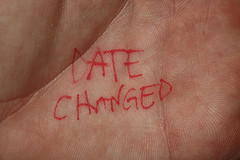
I work at a law firm - can my article request be back-dated to July 28th?
This is where my coworker came to me, because she wasn't sure if this was something we would consider doing as a matter of policy, and she also wasn't sure if it was even technically possible.
And as far as I know, it isn't, at least for us. Since we use the BPL's online form, all the timestamp information is on their servers. We have no control over that, and to really completely back-date this would probably be extremely involved.
Regardless though, this isn't something I would have been comfortable doing anyway. The article in question didn't seem like something that would be used in any kind of court case, but who knows. And if their request records were subpoenaed by the court (if it came to that), manipulating library records certainly isn't something a librarian should be caught doing.
We don't keep any article ILL records beyond what is in BPL's system, so there wasn't anything we could do for this request anyway. My coworker called the patron back to let her know.
The article arrived shortly thereafter, and a few weeks later someone from the law firm came in to pick it up - and didn't mentioned the back-dating. We never learned more about what the request was for or why it would be important to back-dated it, but this is something I've never heard of before.
Inspired, in equal measures, by Hurricane Katrina, Buster Keaton, The Wizard of Oz, and a love for books, “Morris Lessmore” is a story of people who devote their lives to books and books who return the favor. Morris Lessmore is a poignant, humorous allegory about the curative powers of story. Using a variety of techniques (miniatures, computer animation, 2D animation) award winning author/ illustrator William Joyce and Co-director Brandon Oldenburg present a new narrative experience that harkens back to silent films and M-G-M Technicolor musicals. “Morris Lessmore” is old fashioned and cutting edge at the same time.
The only criticism I could make is this: scotch tape?!?!
I had thought that by doing fewer posts per week, I'd end up with higher quality overall. However, not so much, exactly.
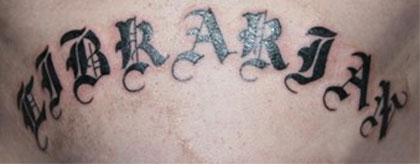
My friend Chris emailed me a link to the image below, which showed up on failblog under the "ugliest tattoos" category. This font wouldn't be my first choice, but I don't think it's so bad (although I cropped out the worst parts - click through to full size if you dare).
Now that is truly lib-core. Incidentally, the title of the post comes from the Geto Boys "Damn It Feels Good To Be A Gangsta," featured in one of my favorite movies, Office Space (NSFW, literally and figuratively):
And in case someone doesn't follow my leap from this tattoo to gangsta, it's the font. Check out, homies.
This reference question happened over the course of two days. This particular patron is in the library almost every day doing anti-abortion research, so this type of question isn't actually all that unusual for us - but I thought the details were interesting.
She came up to the desk with an article quoting President Obama talking about adoptions that initiated with Planned Parenthood, and another article citing the number of abortions they perform every year. She wanted to verify each of the numbers, and then find out the ratio of abortions-to-adoptions.
I thought the most reliable place for statistics like that would be the Planned Parenthood website, so we started there. Their About Us section had a link to their Annual Reports (perfect!), and the most recent one listed was for 2009-2010.
We clicked into the report itself, and on page five we found what we were looking for:
Health Service
2009
2010
Abortion Procedures
331,796
320,445
Adoption Referrals to Other Agencies
977
841
Those were a little off from the numbers given in the article, but she was happy with that, and wanted me to print a copy for her records. Sounds straight-forward, right? Turns out, it's not. Planned Parenthood uses issuu.com to host their documents, and in order to print anything, I had to sign up for an issuu.com account. I did, but then had to wait for the verification email before I could print.
Our email server doesn't deliver messages instantly, because it holds them to filter out spam. And of course, all this was happening fifteen minutes before we closed, and the verification email didn't arrive in time. The next morning I verified my account and printed the information for the patron.
But she also wanted the ratio, so that was my next task. But when I asked myself, "what is the ratio of 329,445 to 841," I could not for the life of me remember how to do that. I thought I just needed to divide 329,445 by 841, but I did that on a calculator and it didn't seem right.
I thought Google could do that calculation (329,445:841), since it does others, but it didn't. Next I searched for a simple online ration calculator, but couldn't find that did what I wanted.
Then I remembered about Wolfram|Alpha, which was designed not just as a search engine, but as a computational engine. When I typed 329,445:841 into that it gave me an answer - and to my surprise, it was the same answer I got myself on the calculator.
So the answer is that, in 2010, Planned Parenthood performed 392 abortions for every 1 adoption. The patron felt this number was way low, according to other news articles she had read, but I showed her the data and the calculations. She reluctantly accept it and thanked me - I was just glad I actually remembered some of my grade school math.
 I freely admit to being entertained by immature things, but the sheer unexpectedness of this discovery will hopefully make everyone laugh.