January 12th, 2013 Brian Herzog
 This reference question happened before Christmas. As I came into work one afternoon to start my evening shift, the staff person I was replacing had to pass off to me a patron she had already been helping for a little while.
The patron was looking for an article she had read in the Lowell Sun (a local daily newspaper) within the last couple months - she couldn't remember the title, author, or date, but knew it had something to do with with how changes in Social Security will affect the pension the spouse of a state employee will receive.
The patron had called the newspaper and they told her they didn't know exactly which article it was, but it probably would have run on a Thursday.
When I came in, the patron was going through a stack of newspapers, looking at Thursdays issue-by-issue, working backwards. My coworker had already spent time searching our Lowell Sun subscription database, but neither approach was succeeding.
After my coworker left, and since the patron was still using the physical newspapers, I thought I'd try again with the database. Different people use different search techniques, so perhaps (and hopefully) I'd find something my coworker missed.
I started with just keyword searches for combinations of "social security" "pension" "spouse" and a few other things, limited to the last 3 months, but none of the results really seemed to fit the patron's description. I opened it up to six months, then removed the date limiter all together, and still nothing. Then I stopped combining keywords, and just searched the individually - still nothing.
I knew the database wouldn't contain AP stories or articles from other sources, but the patron was pretty sure it was a regular column of a local writer. She knew what he looked like too (from his headshot running along side each column), so she was hoping that she could at least find one of his columns and then we could get his name.
Since I wasn't having any luck in the subscription database, I thought I'd try their website's searchable archive - it's not full-text, but an index of authors and titles could still be helpful. However, the only thing coming up were the same articles I'd already seen - and the website said "Generally, the material is current 24 hours after publication," so it should have been up-to-date with no embargo.
Just then, the patron came over very excited - she recognized the columnist's picture in one of the papers. It wasn't the right article, but at least we now had his name: John Spoto.
While she was looking over my shoulder, I searched the database for author/byline=John Spoto, and oddly, only two matches came up. Odd because there were so few for a regular columnist, and because they were both dated July 2012. I did a keyword search instead of an author search for his name, and then got 55 results - much better (however, slightly annoying).
But we still had a catch, because the most recent was dated September 9th. The patron was sure the article she read was more recent than that, but no matter what I tried I couldn't find any other articles by this person in the database (nor on the website, which indicated it was current).
However, when I started reading the dates - September 9th, August 26th, July 29 - I noticed that most were Sundays. Because the paper had told her this column ran on Thursdays, she had only been looking at Thursday's papers. So, the patron went back to check the Sunday editions, and hit the jackpot on Dec 2nd.
The column was titled "Public pensions do affect Social Security benefits," by John Stopo. We both thought it was odd this didn't come up in the database, so I tried searching by the title - guess what? No luck.
It looks like the database hasn't been updated in awhile, at least for this writer's columns.
Regardless, I helped the patron photocopy the column*, and while we were doing that she talked about the importance of perseverance and how you can do great things by taking only little steps at a time. It seemed to me that, in this case, the work the patron put into finding the article made it that much better when she did find it - if she came in and found it right away, it would have been a whole different experience.
Not that things need to be difficult, but it's nice to appreciate the results of extra effort.
*Helping patrons photocopy odd-sized newspaper articles, that don't readily fit on legal-size paper, is a reference question unto itself.
Posted under Uncategorized | 2 Comments »
January 5th, 2013 Brian Herzog
 This has been a heck of a holiday season for some reason, and I'm still trying to get caught up. So, this is just a quickie reference question - although it's more like "readers advisory gone wrong."
One of our patrons submitted a purchase suggestion through our website for the DVD Amongst White Clouds, a documentary on Buddhism and monks. Since it wasn't already owned by any libraries from which it was easily requestable, I looked it up on Amazon to check it out, read reviews, and see if it was worth purchasing.
Most of the reviews were positive, which is good, but sometimes the bad reviews are more informative. This time though, one of them made me laugh out loud:
After reading the documentary description and several rave reviews, I was anxious to watch this movie. It provides a lesson in Buddhism, but not the one I was expecting. ... I got more wisdom from watching Kung Fu Panda with my son, than I got from this movie.
Pretty harsh, but funny. One of my favorite features of professional review journals is when a reviewer says a book isn't very good, and then provides titles that are better. But in this case, I don't think my patron would have been happy with this Amazon reviewer's alternate suggestion.
And actually, after reading about this DVD, I really want to see it now - thanks for the good suggestion, patron.
Posted under Uncategorized | Comments Off on Reference Question of the Week – 12/30/12
December 19th, 2012 Brian Herzog
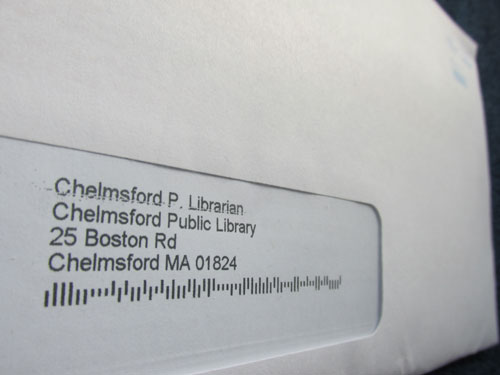
Nicely serendipitous with last week's reference question, the library recently received this envelope in the mail:
I'm not sure if this was deliberately done by a person, or just a computer filling in empty fields - either way, this sort of thing can brighten my entire day.
I hope everyone has a good holiday season - I'm visiting family in Ohio for Christmas, so I'll be off until next week. Oh, and regardless of your religion or tradition, be sure to search for Festivus on Google - enjoy! (hint: look to the left, and scroll down)
Posted under Uncategorized | 2 Comments »
December 15th, 2012 Brian Herzog
 This is actually a "personal experience" reference question - I liked it because it was a fun challenge, but also it made me laugh because it shows you what I get up to in my free time.
Earlier this week I received an envelope in the mail at my house, and it was obviously a Christmas card. However, it wasn't addressed to me - it had my address, but not my name, and I didn't recognize the return address.
Being a reference librarian (and very neighborly), I thought I could just find the right person and deliver it myself, instead of sending it back to the post office to be returned all the way to Texas (based on the return address) - which means it wouldn't have arrived in time for Christmas.
So, looked up the name in the phone book to get the correct address, but it wasn't listed. I also tried searching online, but couldn't find it there, either.
At the library, we have a "List of Residents" which lists people both by name and by street address - however, I don't work in the same town in which I live, so I called my own town's library to see if they had a similar list.
I explained my situation to my colleague there, and of course she was happy to help. She looked up the name I gave her, but it wasn't listed. Then, she went to the "by address" section and, starting with my address, looked at my neighbors' names to see if any matched. I live and #36, and she got all the way to #3 before she found something - but not an exact match.
The first name matched, but the last name, compared to what was written on the envelope, contained a couple extra letters. Phonetically the names probably sounded the same, and I figured that if the sender got the address wrong, she might have misspelled the last name too.
This all took place on a Wednesday, and when I drove by the house after my night shift at the library, all the lights were off in the house so I didn't stop.
However, the next morning on my way in to work I did. I rang the doorbell twice, but no one answered. Just as I was getting back into my Jeep, an older man stepped out of the doorway. I think he regarded me with a little suspicion, but when I walked up and said I lived down the street, he relaxed a little. I gave him the envelope and asked him if it was his name, and it was (although misspelled). We had a little laugh over it, he thanked me, and I continued on to work.
The funny thing is, not a single Christmas goes by that there isn't someone who comes in to look up a neighbor's last name, or a friend's street address, so they can send them a card. Our List of Residents is one of my favorite resources - hyper-local, authoritative, and there is nothing else like it that is as exhaustive.
Posted under Uncategorized | 3 Comments »
December 8th, 2012 Brian Herzog
 If this question were a tweet, the hashtags could be #bestguess or #thisiswhycitationsareimportant.
A patron walked up to the desk and asked if I could help find the source of a quote. She slid me a small piece of paper with this written on it:
The punishment which the wise suffer who refuse to take part in the government, is to live under the government of worse men.
-Plato
My favorite quote resource is Bartlett's (I still like print resources - sue me) but it wasn't in there - not under government, punishment, wise, or Plato. I checked a few other large quote dictionaries we had on the shelf, but still no luck.
So I turn to the internet, and am able to find the quote mentioned in plenty of places - but they just attribute it to Plato, without citing where in Plato's work this quote appears.
Until I find the quote on PoemHunter.com, which gives a citation of
Plato (428-347 B.C.), Greek philosopher. Quoted in Ralph Waldo Emerson, "Eloquence," Society and Solitude (1870).
Emerson's Eloquence wasn't hard to find - one place is in the Google Books copy of The Complete Works of Ralph Waldo Emerson: Society and solitude. I scrolled in to where Eloquence started and then skimmed until I found:
And the footnote is:
From there, I merrily skipped on over to Google Books' The Republic, and did a series of searches for "punishment," "government," "wise," and "suffer" - but didn't find the quote.
From the context, I really couldn't tell if Emerson was directly quoting Plato, or just paraphrasing his sentiments from Republic. Since the search didn't turn up the quote though, I'm leaning towards paraphrasing.
I brought everything over to the patron, and let her know what I found. I offered to get a copy of Republic for her, in case she wanted to read it herself more thoroughly to find the quote, but she declined. She thought the Emerson source was good enough for her need, and was happy.
I have to admit, this is one of my favorite kind of research - where one resource leads to another, and along the way you uncover bits and pieces you wouldn't have expected. You'd think that with having resources like Google Books online, more and more people would be doing this sort of thing. However, I have the feeling that most people stop after the first website or two. Oh well - just more fun for reference librarians.
Posted under Uncategorized | 1 Comment »
December 5th, 2012 Brian Herzog
 I've seen this survey popping up in lots of places, and I was asked to post it here as well. If you haven't already, please take a few minutes to fill out the survey.
This short survey is being conducted on behalf of the Bill & Melinda Gates Foundation Global Libraries (GL) Initiative. The purpose of the survey is to help the Global Libraries Initiative identify opportunities to focus their current support of public libraries in ways that foster innovation and dramatically accelerate positive and lasting change in libraries throughout the U.S. and around the world.
The vision of Global Library Initiative is one where libraries, world wide, provide public access to information for people who would not otherwise have access, and that this information is relevant to them and used in ways that improve their lives. The GL Initiative has been supporting public libraries for over 15 years because they passionately believe libraries are vital to healthy vibrant communities. Libraries offer access to information and knowledge to all community members and in doing so they bring opportunity to all.
Leadership and staff of the GL Initiative believe that public libraries are grappling with how they can best meet the needs of their communities in a time of extraordinary and rapid change. With this change, comes both challenges and opportunities. The GL Initiative wants to better understand these challenges and opportunities and identify ways in which the Foundation can support – and accelerate – libraries’ change efforts.
The GL Initiative has contracted with an independent consulting firm to reach out to a broad swath of people to get your thoughts and ideas about how public libraries can best serve their communities in a future where e-books and ubiquitous digital content is the norm. Each individual response to this survey will be anonymous, however, the aggregate responses along with common themes will be provided to the GL team to help inform their strategy for the next three years.
Please take a moment and answer this short survey. The survey should take no more than 5 minutes to complete. Your response is critical to the GL Initiative and they are committed to listening deeply to what you have to say.
Take the survey.
Posted under Uncategorized | Comments Off on Help the Gates Foundation’s Global Libraries Initiative Identify the Future Role of Public Libraries