Here's a story about why follow-up questions are important in the reference interview.
An older patron walked up to my coworker at the Reference Desk and asked if we had a list of Massachusetts radio stations.
Instantly I felt a sense of dread - we used to have a book exactly like that, but I think I weeded it when we eliminated our reference collection. I remember thinking, "no one will ever come looking for this - besides, I'm sure it's on the internet."
My coworker also remembered the book, and of course set about searching for it in the catalog. When it didn't come up, she got up to check our Ready Reference collection behind the desk.
At this point I told her I think it had been weeded. We also get a "list of lists" book about the top 10 of everything in Boston, which - I hoped - would also list the top 10 radio stations. So while she continued to search the catalog at the desk, I walked down to our oversized shelves to grab a copy and check - no luck.
By the time I got back to the desk, my coworker was searching online for a list of Massachusetts radio stations. Before she got very far though, the patron - who had been waiting patiently this entire time - said,
Well, all I really want to know is the dial numbers for WODS.
Ha. In a few seconds my coworker located that and gave it to the patron, who left happy, talking about how he likes listening to the oldies.
But it took us about five minutes to get here, and both of us felt a little bad about wasting his time. We let ourselves get sidetracked by focusing on a resource we thought the patron wanted, instead of making sure we actually understood what answer the patron wanted. A good reminder why initial follow-up questions are important.
However, feeling bad about that was quickly curtailed, when few minutes later my coworker recalled this radio station had recently switched formats. The patron was already gone at this point, but I'm sure it won't take him long to figure out - and probably lament - this change.
This is one of those things I think people joke about, but it turns out, we actually did it in my library.
My library's floor plan has the Reference Desk at one end of a room, the YA desk and collection at the other, and the non-fiction collection and public computers in between. One problem we've found with this arrangement is that Reference Desk staff, and patrons, could never see when someone was sitting at the YA desk. And conversely, the YA librarian could never see what was going on at the Reference Desk.
For years we said, "we need is to build a stage to raise up the YA desk." Although it does seem like a good and simple solution, I never thought it would actually happen. But I guess we'd talked about it enough, because when we did have some extra money in the budget for such a project, we went and built a stage.
Hopefully the photos show it well. It raises the desk up just enough to make it, and the YA librarian, visible from the rest of the room, and also lets her see if we need help at Reference.
But the great thing about the stage is that it's multi-purpose. It isn't attached to the floor, and was designed to be modular and movable. So, if we have a speaker or performer and we expect a big crowd (which we do a few times a year), we can push the YA desk out of the way and move the front half of the stage to wherever the program will be. It's light enough to be easily carried, narrow enough to fit in the elevator, and if we need a bigger stage, we can always move both sections. Neat.
The whole thing cost about $1500, which I thought was a good price. We also had some carpet left over from some other project, so it matches the library interior perfectly.
It has only been in for a couple weeks, so time will tell if a stage like this really was the solution we were hoping for. I think it will be, but if not, at least we tried, learned something, and we'll try something else.
Some of my favorite reference questions are those that I can answer from personal experience. If a patron asks a question about hiking, knitting, shooting, history, woodworking, seaglass, gold panning, technology, or any of a variety of my other hobbies, I can do more than just find books or resources for them. Personal touches like this can make a good library experience a great community connection.
But of course, the opposite is true. Last week, a patron walked up to the desk and laid this on me:
I won a whole chicken in a Church raffle over the weekend. The women there told me to cook it at 375 degrees, but didn't say how long. How long do you cook a chicken?
Cooking is not one of my hobbies. I know how long it takes to cook minute rice, but that's about it. I felt dumb, but I honestly had no idea how long it takes to cook a chicken.
But I do know where our cookbooks are. To save time, I searched our catalog for "chicken recipes" and The best chicken recipes looked promising.
I gave it to the patron, who didn't look too impressed - he wanted a time, not a book. I made some comment about my cooking abilities (or lack thereof), and with no coworker around for me to ask (and I'm sure any of my coworkers would have known), he sat down with the book.
A little while later, he came up to the desk to return it - he also said he found a great recipe. So that's good - he might not have gotten what he expected, but he did get what he needed.
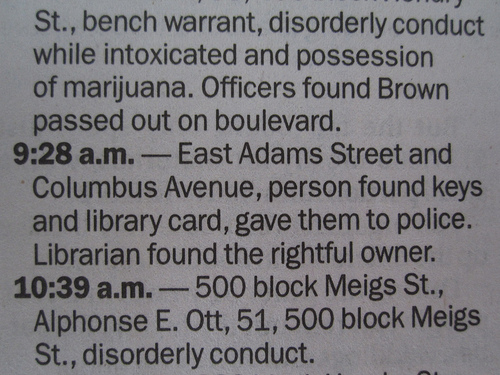
My brother sent me this photo, from the August 3, 2012, Police Blotter in the Sandusky Register:
I know this isn't an earth-shattering achievement, and that most libraries routinely do this with lost cards, but yay for it being in the paper and yay for it working out in the end.
Once a librarian, always a librarian. So, my family came to visit, and it was fun to show my niece and nephews around Boston. However, just as we were finishing lunch outside Quincy Market, a man with a German accent walked up to my dad and I and asked:
German: You are Americans, yes? Us: Yes. German: Good, I was wondering, can you tell me, why are Americans called Yankees? Us: Um...
I had no idea. It is one of those questions that feels like it should have an answer that everyone knows, but I couldn't remember ever hearing where this nickname came from - and on the spot, I couldn't even come up with anything that even sounded reasonable.
So we apologized for not being able to help him. He said it was no problem and merrily walked off - but I felt kind of bad, and of course was curious.
Since I was on vacation and not at the library, all I had was the internet - and of course my first stop was Wikipedia's article for Yankee. The Origins and history of the word section starts off with "The origin of the term is uncertain," and cites some pre-Revolution instances, as well as details Faulty theories. Ultimately though, it says that a Dutch origin is the most likely scenario.
When I got back to work the following week, I checked some of our word origin books, but none that were checked in included Yankee. So, my next stop was our Oxford English Dictionary.
Although the OED also indicated [Source unascertained], it dedicated almost a full two columns to the word. And what it did say about the etymology basically echoed what I'd already found:
So, I'm sorry German tourist, but it looks like there actually isn't a good answer to your question (so, technically, my Dad and I saying we didn't know was the correct answer).
Regardless, I still felt like I should have given him a business card or something and told him I'd let him know after I I got back to work and looked it up. I guess librarians never go on vacation - just wider roving reference.
Just about everyone who works in a library is a de facto tech support person - whether it be for your own work station, or helping a coworker or patron. So instead of an normal reference question, hopefully this post will help in answering reference questions.
The tips they provide really run the gamut of applicability, but tips I think are most relevant are:
10. Disable Crap You Don't Need.
Helpful in the way they intend, but also relevant in patron support in terms of "focus on one aspect of the problem." For instance, if a patron says, "I can't download books from Overdrive," you have to go through a mental checklist every single time: is their computer connected to the internet, are they getting to the Overdrive catalog, are they checking out the book properly, is their any kind of block on their account, are they getting the right format for their device, etc. By ignoring extraneous details and deliberately going through the process, you can usually fairly quickly identify whatever the problem may be (fixing it, on the other hand, is a different matter).
8. Talk It Out with a Troubleshooting Buddy
This is good for any type of reference question - if you get stuck, ask a coworker. Any two people will probably approach a question differently, and someone else might think of something you haven't. Relying on colleagues is a great way to provide excellent customer service (well, provided you have excellent colleagues).
7. Make Sure It's Not Just You
I actually use downforeveryone.com frequently (and am always oddly delighted when I find someone else who does too). Patrons seem to be less upset about not being able to get into their email if you can show them that the problem seems to be with their email provider, not the library's network.
3. Use Alternative Search Engines When Looking for Help
Definitely. It's good to be come very familiar with your standard tools, but don't be locked into them. And not just search engines - remember to use the library's print resources, databases, vertical file, local resources, etc, when looking for an answer.
2. Hit Up Helpful Q&A Web Sites
I do this all the time, both for answering patron questions and IT support within the library. Patrons think up some pretty weird things, but chances are someone else on the internet has already figured that weird thing out. Look for help forums, and don't be afraid to interact on them. And tell the patron you've asked their question, just to give them a heads-up that the answer might not be immediately forthcoming. Also, any time I get a strange error code, or try to do something slightly counter-intuitive (like read Kindle books on an iPad), searching web forums is a quick way to pick the internet's collective brain. Likewise, calling other libraries, relevant organizations, or real-life experts can be a good idea, too.
1. Restart
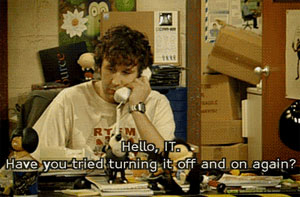
This applies to so many things - from literally restarting a frozen public workstation to taking a fresh tack on a difficult problem. Turn it off and turn it back on again is the #1 suggestion for a reason - and why Roy always answers the phone that way:
 Here's a story about why follow-up questions are important in the reference interview.