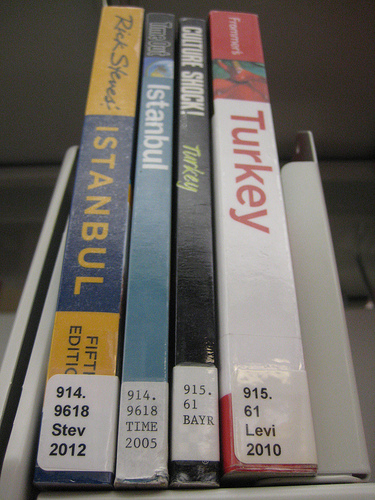
I know I've given the Dewey Decimal System a hard time for its quirks, and have experimented with other shelvingsystems when Dewey wasn't getting the job done. But recently, I stumbled on another great example of how Dewey totally misses the point - to wit:
Now, keep in mind this photo was staged - I pulled these books off the shelf to photograph them. In real life, they're about three shelves away from each other.
And that's the problem: Istanbul is a city in Turkey, but Istanbul travel books are shelved in the "Europe" Dewey section, while general Turkey travel books are shelved in the "Asia" section. Ridiculous!
Yes, I know Turkey spans two continents, and the majority of Istanbul is in Europe while the majority of Turkey is in Asia. That's all very clever and precise, but totally fails patrons browsing the shelves. Chances are, someone looking for travel books to Turkey are going to find them and stop, and not think they've got to look for more books in a different section.
I talked to the cataloger at my library and (happily) we decided to apply Ranganathan's fourth law and move the Istanbul books to the Turkey section. But come on - a system is only good as the number of compensations you need to make for it.
Then again, perhaps this is nobody's business but the Turks.
A friend of mine from library school, who now works in a library in Northeastern Ohio, told me about an interesting reference transaction that is worth sharing here:
On a recent Monday, a customer approached me with a stack of paperbacks from another library. We don’t carry many, preferring to stock our fiction shelves with hardcovers and replacing with paperbacks only when necessary, so I assumed he wanted to order some more. Instead, he said, “I don’t think W.E.B. Griffin really wrote these books. I would like to know who did.”
The question took me by surprise. “I’ve read all of his books,” the customer insisted, “and these aren’t like his other ones. I want you to let everyone know that he didn’t write them. Including this other library that I got them from.”
My friend knew, which I did not, that Griffin was currently writing his books with a co-author (his son, William E. Butterworth IV). The titles in question were from Griffin’s early writing career though, so she searched Fantastic Fiction and NoveList but could find no evidence that Griffin hadn't written the books himself.
My friend is a writer, and she explained to the patron that the difference could be attributed to the author’s age, his style changing over time, and the influence of his son’s writing style. I thought this too, and it reminded me of an NPR story of someone applying textual analysis to Agatha Christie's books. They found that, although never acknowledged in real life, the vocabulary and writing style of her last book seems to indicate that she was suffering from Alzheimer's when she wrote it.
The patron seemed satisfied with her explanation, although he still wanted my friend to “let the other libraries know” - she felt a responsibility to the patron to do so, but just wasn't sure how.
We have had this same discussion in my library, most recently with The Last Train from Hiroshima. We discussed putting a note in the catalog record, a label on the book itself, or shelving it in fiction, but ultimately just sent it back to the publisher. In a cut-and-dry case such as that, I think it'd be okay. But in this case, with just a single patron's suspicions, I don't think there can possibly be any library responsibility here.
Finding out a non-fiction book is false is one thing - just one person suspecting an author of a fiction book didn't actually write is entirely different. My friend went on to say that if the patron had kept pushing, she would have found contact information for the author and publisher, so the patron could contact them directly. I agree - I don't think we can investigate claims like this, but we certainly can handle them once they've been proven. In this particular case, I think my friend did the right thing - made the patron happy.
I don't post nearly enough instances of Things Done Well (check out Walking Paper for lots of examples), but here are two things I saw recently that deserve attention:
Thing One: Ramp-In-Stairs
What I like about this is that they were designed together, from the start, and not only look nice, but (presumably) work well too. Much better than having a magnificent grand staircase, then a rickety wooden ramp up the side, or worse, a sign saying "ramp access around the back."
It's similar to deliberately designing websites and catalogs that look good and work well on multiple browsers at multiple screen resolutions. The best approach, I think, is starting from the ground up with responsive web design (à la Canton (MI) Library, à la One-Pager), instead of trying to backward-hack mobile-compatibility in after the fact, or just tacking a mobile-friendly site on in parallel to your main website.
Thing Two: Domino's Engine Noises
So apparently, Domino's delivers pizza via scooter in the Netherlands, but the scooters were so quiet that cyclists couldn't hear them. To help prevent accidents, Domino's added a "motor" sound to the scooters - but instead of just a typical engine noise, they had fun with it:
Awesome, because it not only serves the purpose of an audible warning, but it's also extremely well-done audible advertising - it's funny, attention-getting, memorable, and shows an unexpectedly playful side of an otherwise perhaps impersonal company.
When libraries start delivering items to people via scooters, this would be a great thing to try - the engine noise could be "vrrrlibrarylibrarylibrary BOOKS librarylibrarylibrarylibrary DVDs librarylibrary..."
One evening this week, a patron walked up to the desk and said,
Can you find me a website to adopt a cat? But not a real cat.
What he wanted was an online virtual pet. I had never looked for this before, but a search for adopt a cyber cat returned lots of results.
We looked at a few sites*, but he ultimately chose adoptme.com, because it had the best graphics. For the next forty-five minutes, he sat at the computer playing and chatting with it, and every once in awhile he'd come up to the desk to tell us something the cat did or said.
But the last time was the funniest: he came up and said, "the cat said I talk too much." Maybe he exhausted the repertoire of the artificial intelligence of the program that responds to chat messages, and that was how the program forced the conversation to end.
He wasn't deterred though - he left, saying he couldn't wait to come back the next day to play with the cat some more.
Pick an Emergency Web Address (URL):
(You will be sent to this address if you click the special emergency button while playing with your cat. We recommend your company website, or something business related, in case you need it to look like you are working on something else.)
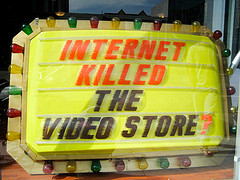
Here's a topic that I've heard come up multiple times recently in different contexts, and I'm curious if there is any kind of wider consensus on it. The question is, what does the word "video" mean to people?
We're redesigning our catalog, and in the process of coming up with format description, we had a discussion (and disagreement) on whether "video" means just VHS tapes, or if it refers to to DVDs and other formats as well (like "music" is a generic term for anything on CD, tape, etc). We're also redesigning our website, and in that context, we weren't sure if the word "video" means physical tapes/discs, or if people would presume it means online clips/episodes/tutorials/etc - or both.
So I thought I'd take a quick poll - please make a selection, but also leave a comment below on why, or if I've missed an option entirely.
This reference question marks the unofficial start of blood-borne pathogen season:
A patron called Monday morning and said he had been bitten by a tick Sunday while hiking, and wanted to have it tested for Lyme Disease.
He knew he could mail it to UMass-Amherst for testing, but wanted to know if there was a more local testing facility, so he could get results quicker. I didn't know of anything, so before consulting our Town's Board of Health, I just searched for tick testing massachusetts to see what came up.
The first result was a Massachusetts Department of Health and Human Services listing of the testing services they trust - perfect. Only one was closer than UMass, but still not close enough for him to drop it off. It was $20 per tick, as opposed to the $40 UMass charges, and although the patron liked the cheaper price, he decided to go with UMass. They do their testing on Tuesday, so if he overnighted it, he'd get results quickly - besides, he said, he had already filled out the envelope before he called me.
Before we hung up, I offered to contact our local Board of Health to see if they knew of any services in the immediate area. He said they already did - it was they that told him about the testing at UMass, and they also referred him to the library if he wanted to look for more.
Ha. It makes me laugh when the resource I would consider the authority on a subject refers people to the library. It's always good to check multiple sources, but referral-looping like that makes me feel like I'm missing something.
And on another note: it's only April, and the ticks are already out in force and biting. Man, it's going to be a long summer.