November 3rd, 2012 Brian Herzog
 My coworkers know I'm always on the lookout for unusual reference questions. I was sitting at the desk with a coworker yesterday, when she answered the phone - of course, I could only hear her side of the conversation, but it was enough:
[ring ring]
Coworker: Reference desk, can I help you?
[...]
Coworker: [turns towards me] You're looking for a version of the movie Casablanca that stars Bugs Bunny, but you don't know the title? Sure, let me check.
[she searches online for casablanca bugs bunny]
Okay, that version is called "Carrotblanca" and [searches our catalog] it looks like we have it, on a DVD called "The essential Bugs Bunny."
She put the DVD on hold for the patron, and everyone was happy. Especially me - patron gets what he wants, and I think "a version of the movie Casablanca that stars Bugs Bunny" is absurdly funny.
Interesting post-script: when I looked up the DVD record while writing this post, I noticed that "The essential Bugs Bunny" also includes Hare and loathing in Las Vegas - now that is something I've got to see.
Posted under Uncategorized | 3 Comments »
October 30th, 2012 Brian Herzog
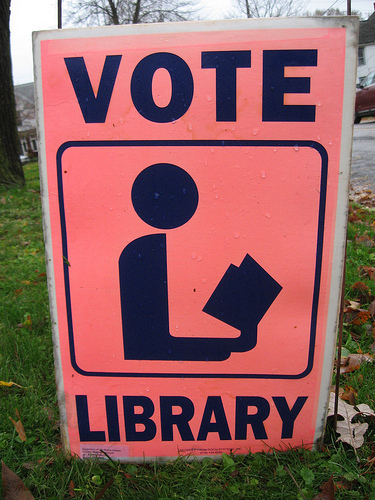
I'm in Ohio this week* visiting family, and couldn't help but notice all the bright pink VOTE LIBRARY signs dotting the lawns in Huron, Ohio:
It got me curious, so I looked into what the library was asking for. Funding increases are certainly nothing new to the library world, but I thought the Huron Library has put together a good levy campaign. They've got info on their website as well as a dedicated website for the issue. Both have a nice embedded video explaining how the library will use the money to benefit the community - and my favorite part is that they break it down to the personal level:
The owner of a home with a market value of $100,000 currently pays $25 per year for library services. The 1.25 mills will cost that same homeowner approximately $39 per year - a total increase of $14 per year. For less than the cost of two hardcover books, or two DVDs, per year, quality library service to the community can be preserved. [emphasis added]
Because there are so many people right now who are against any tax increases at all ever no matter what ever ever, it's important to focus on the value of tax money - and do it in easily digestible language. For people in a community with a strong library, $14 is not much of an increase - and it's certainly easier to understand on a personal level than an increase of .45 mill.
Judging from the number of signs I saw around town, the Huron Library has a lot of community support for this levy - good luck, HPL!
*I had planned to just stay for an extended weekend, but Hurricane Sandy conveniently cut off any return route from Ohio to Massachusetts, so my five day stay became eight days of playing with nieces and nephews and helping my parents (besides, my library was without power for a couple days so they never missed me anyway). I hope everyone else affected by the storm fared well.
Tags: budget, funding, hpl, huron, increase, levy, libraries, Library, oh, ohio, public, sign, vote, voting
Posted under Uncategorized | 3 Comments »
October 27th, 2012 Brian Herzog
You know serendipity can be a subtle but major influence on how people find things in libraries? Here's a situation where serendipity backfired.
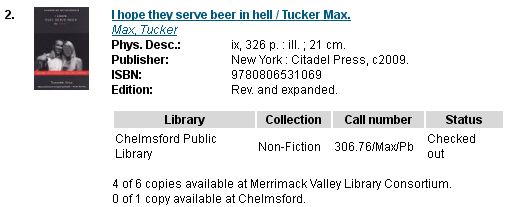
A patron came up to the desk and asked if we had any books on how family members can cope with someone who has a drug and alcohol addiction. I brought her to a catalog workstation and did a simple book search for "alcohol addiction" - the second result was:
Oops.
The patron didn't comment on it, and I quickly pressed on to find useful resources for her. I have no idea what her situation was, but still, I felt like an ass. Oh well.
Posted under Uncategorized | 5 Comments »
October 24th, 2012 Brian Herzog
 Have you ever heard about something, liked the idea, and just accepted as fact that because you've heard about it, everyone else must have too, and then a couple years later happened to mention it in a room full of people like it's common knowledge only to have everyone look at you with blank stares? I get this a lot.
Most recently, it happened with the Human Library Project - you know, the idea in the news a couple years ago where libraries had collections of people you could check out - police officer, politician, Buddhist, lesbian, etc - and sit and talk with them to learn about their life experience.
I personally loved this idea, because it's a way to meet types of people you may never meet in your life's normal routine. Of course, I don't think the project every took itself to be grander than it was - I mean, you're only talking to one person, so of course you can't automatically generalize to everyone of that person's "type." The human books aren't stereotypes, so it's not like you're learning what life is like for all black men, but you do find out what life is like for this black man - which might be more than you knew before, and that's a good thing.
Anyway, like I said, I loved this idea when I first heard about it, and tucked it away. I happened to mention it during a meeting a couple weeks ago, and everyone in the room thought I was making it up. So I started asking around over the course of that week, and no one I talked to had heard of it. So, here you go, world - consider yourself officially informed. You are welcome.
I thought I'd also take this opportunity to mention a few other non-traditional things you can check out of libraries. Earlier this year, there was a PLA session on non-traditional collections, such as circulating ereaders, guitars, and running a seed library.
The iLibrarian blog is also a great resource for these types of ideas. Recent posts there include:
Seeing things like this makes me happy I work in libraries, but sad that I can't work in all the libraries. I mean, I've always thought it was cool that some libraries circulate cooking pans and artwork, and just last week we referred a patron to the Library of Congress' Talking Books program. But how much fun would it be to check out farmland or to offer a Maker Station?
Pretty fun, is my answer. I get excited by potential, which is why I never despair over the future of libraries - we've got potential coming out of our buns.
Posted under Uncategorized | 5 Comments »
October 20th, 2012 Brian Herzog
 This was the entirety of a call that came in Wednesday afternoon this week:
[ring ring]
Me: Reference desk, can I help you?
Patron: Yeah can can...can you tell me what...what's on green tonight Green Lantern...Lantern...I mean Green...you know...the other one...Green Lantern...Green...Arrow...Arrow Green...Green Arrow yeah Green Arrow no... Lantern Green...Green...um...it's not Green Lantern, it's not Green Arrow...um...HORNET Green Hornet can you tell me what's on Green Hornet tonight oh wait it's Wednesday nevermind [click]
We have a patron who frequently calls to find out which episodes of his shows are going to be on that day. He usually ends up watching them all anyway, regardless of the episode, but he just wants to know in advance.
In this case, I think he had just woken up from a nap, and only eventually realized his show wasn't on that night.
In general, my favorite "what's on TV" resource is Zap2It.com, because it usually provides better descriptions of "local programming" than TVGuide.com. Although for some of this patron's shows, we have to go right to the MeTV Channel's website for schedule and descriptions.
This patron calls with this question so much that I've bookmarked both of these websites at all the reference computers. It kind of makes me laugh that we have ready reference resources devoted to just one patron, but it certainly is worth it.
Tags: green hornet, guide, libraries, Library, public, Random, Reference Question, schedule, show, shows, television, tv
Posted under Uncategorized | 5 Comments »
October 17th, 2012 Brian Herzog
 I spent the first part of this week at the New England Library Association 2012 annual conference, which I found I enjoyed more than others in recent memory. Partly it was due to talking with way more people than I usually do, but the guys from ByWater Solutions, Koha developers, also picked up my lunch tab one day, which is awesome - thanks Nate.
Anyway, I mostly stuck to the technology track this time, which seemed like it was all ebooks all the time. Often, that turned into Overdrive-bashing (for past practices), but there was also a lot of looking to the future of what-could-be. Here are a few notes I wrote down from the various sessions over the three days:
- Followup on Kirtsaeng v. John Wiley & Sons, Inc.
Last week I posted about this case now before the Supreme Court, and mentioned that Alan Wexelblat of Copyfight would be speaking at NELA. This was probably the hands-down absolute best session I attended, and if you ever get the chance to see Alan speak, jump at it.
He offered more insight on the speculating I did last week - for one thing, this case will be limited to items imported from overseas, and only items that have (or can be) copyrighted. So, things like iPhones (which are patented, not copyrighted) and clothes (which are not copyrighted at all) will not be affected (so no "Garage Sale Police: SVU" any time soon).
Alan also said he expected the Supreme Court to rule in Wiley's favor, albeit with a very narrow ruling. Arguments between October 29th, so keep an eye on it.
- The (not so bright) future of ereaders
In more than one session, I heard people say that 2012 was the peak for dedicated ereaders. They will start to decline in 2013, and from here on out, ebooks will be read on smartphones and tablets, because ebooks will cease to be something special or unusual and just part of peoples' normal lives. As people get more and more used to doing everything on one device, dedicated devices - like ereaders - will be left behind.
Dedicated ereaders have the advantage with cheaper prices and better eink displays, but hardware prices are always falling, and the more people use smartphones and tablets, the more they become accustomed to those displays. Besides, Betamax was better quality than VHS, and it still lost out.
Except maybe in libraries, since the libraries that circulate hardware will only want patrons using them for ebooks. But the death of ereaders was still an interesting observation (and again, a widely-held one, it seemed).
- But if you are buying ereaders...
A few speakers gave kind of best-practices reviews of ereader lending programs in their libraries. One recommendation was that, if you are buying ereaders to lend to patrons, definitely get the extended warranty.
Another model for ereader/ebook lending was to give patrons a gift card in addition to loaning them an ereader. That way, patrons do your ebook collection development for you. And, since the books are being purchased, patrons aren't limited to just what is available through Overdrive, and instead they get to read whatever bestseller they want, right now. A couple libraries in Massachusetts are doing this, and they have not had any problems - the gift card is tied to the library's Amazon account, and patrons are told not to buy more than three ebooks.
However, again, there was the recommendation to buy tablets, not dedicated ereaders at all - they will have a longer useful life.
- The (ever brightening) future of ebooks
Another common opinion was that ebooks really are a major revolution in publishing, whether we like it or not. And by revolution, we're really talking evolution along the lines of cave walls > clay tablets > papyrus scrolls > bound books > ebooks. However, ebooks won't necessarily totally supersede print in our lifetime - more likely, they will be viewed as different experiences, not as mutually-exclusive.
A great example of this was keynote speaker T. Scott Plutchak's story of reading picture books to his granddaughter. She has one favorite book, which they have both in print and on his iPad. She always wants him to read it to her, but sometimes she wants the interactive play of the iPad, and sometimes she wants the traditional page-turning of the print book. I like the view that it's not all or nothing - print and ebooks can coexist. And kids don't see them as competitors, just different. I think I've said this before, but I still use both pencils and pens, and I also still listen to the radio every day. Pencils and the radio are good for certain applications, pens and keyboards and television and internet good for others.
Another analogy I liked was that ebooks are a total revolution in technology, along the lines of sheet music > phonograph recordings. Before Edison, music was distributed as sheet music - people bought it and then played the piano themselves in their own parlors. But after the phonograph, people could buy and listen to a recording. This is a fundamental change in how people interacted with music - it removed the personal experience of playing it, and standardized what version of the song people heard. This isn't a direct ebook correlation, but the basic "this is a fundamental shift in how people interact with stories" is worth considering.
However, one of the funniest lines at the conference came up when a speaker was trying to make the point that new technology does often replace old technology: "yes, people still raise horses, but how many of you rode a horse here today?" Ha.
- DRM is the problem.
Universally, the cause of all ebook-related problems right now is DRM. Not copyright, not technology, not piracy - just DRM. So, the recommendations were always: buy DRM-free ebooks - publishers like TOR and HumbleBundle are leading the way and need to be supported.
- Create your own electronic content
For libraries in Massachusetts, contact the Boston Public Library to get on board with BPL's local resource digitization program. For free, libraries, historical societies, town offices, etc. can have their annual reports, yearbooks, special collections, whatevers digitized by BPL and Internet Archive staff. The items will become part of the Digital Commonwealth and Internet Archive collections, and will be freely available online. This is definitely worth checking out - send a message to [email protected] for more information.
Good quotes relating to this were, "copyright is like a speed limit - it's flexible, so going a little over is okay." And, "copyright is often a gray area - and to us, gray means GO!"
- Training - it's what we do
Lastly, lots of talk about training and tech support - library staff training patrons to use ebooks, the reference desk evolving into a community technology help desk, etc. These ideas are not new, but they bear repeating, because I do think this is the future for libraries.
I did hear one new idea though: one speaker found he was having trouble training senior citizens to use their brand new ereaders, because they had no computer experience whatsoever. No matter how patient and repetitive he was, he could just not communicate with them in the way they needed. So, he got the idea to train one of their peers - a senior woman who volunteered at the library - and then had her show other seniors how to use technology. He said results were instant and fantastic, because she, being from their generation, was naturally more attuned to speaking at their level. Great idea, up until he told us what he called it: "The Old Lady Support Group."
In all, it was a great conference. My only complaint is that I couldn't get to all the sessions I wanted to see. Presentations are being posted online, so please check them out for more information.
Posted under Uncategorized | 2 Comments »