October 6th, 2012 Brian Herzog
 This might be one of the strangest questions I've ever been asked.
A patron called to ask what information we could find out about the business her husband worked for in Chelmsford in the 1990's. She gave me the name and address of their office from that time, and just said that she had recently been contacted by the IRS concerning his pay and benefits from his time there.
Whew. I told her it might take me some time to research it, and she gave me her name and phone number to contact her when I found something. Interestingly (to me), the phone number she gave me had a California area code.
So anyway, the first step was just to search online for "Financial Applications Consulting Services, Inc." (the name of the company, which unfortunately is also a common description of this type of business) to see if they were still around. I also checked local phone directories and ReferenceUSA, but from what I could tell, they were no longer in business. If that's the case, I'm not sure what I could possibly find to offer this woman, but now it became a personal challenge to find anything at all.
I thought the Town Clerk would have information on businesses in town, when they filed for permits or paid taxes or whatever. However, when I called over there, the Clerk said they had no record of this business - which, she said, isn't unusual, because only certain kinds of businesses need to be on record with them.
Next, since I had the business' old address, I thought I'd try to track down the owner of that building (since it was sort of a strip mall of office suites). I hoped the business would have left some kind of forwarding address when they moved, or at least I'd get the date they closed. I called the current tenants of the same address and explained that I was looking for the building owner to find a previous tenant, and they were happy to give me his name and number. However, they also cautioned that he's difficult to get a hold of because he travels a lot.
So I noted this to pass on the patron, but didn't try contact him myself.
Instead, I went back to web searching, looking more for information about the company than the company itself. This turned up an interesting history:
From Bizjournals.com:
...Financial Applications Consulting Services Inc., which does business under the name Fastech. It is based in Livonia, Mich. ...
From Businesswire.com:
...On July 25, 2003, FASTECH filed for Chapter 11 bankruptcy protection in the U.S. Bankruptcy Court. On Nov. 18, 2003, the court ordered the granting of FASTECH's motion to sell certain assets, including its customer base, to Kronos....
Kronos happens to be one of the larger companies based in Chelmsford*, but I don't know if it's a coincidence that a Michigan-based company had a small office here, or if there had been some connection to Kronos all along.
Regardless, I think this gave me the information I was looking for - since Kronos was involved with taking ownership of the company the patron where the patron's husband worked, their legal or human resources department is probably the best resource to answer her questions regarding whatever questions the IRS is asking her.
So I gathered contact information for Kronos, Fastech, the building landlord, and also the URLs for the articles I had found online, and called the patron back. No answer - bummer. I left a message, saying that I had made some progress and asked her to call me back.
A couple days later, the patron's daughter called. She explained that after her father retired, her parents left Chelmsford and moved to California. Recently, her father had died, and in the course of finalizing his estate, the IRS contacted them about outstanding benefits from the time he was employed at this company in Chelmsford. She didn't know what it was about, but really appreciated the information I was able to provide.
That's great, and I was happy to help - but this is one of those questions that still feels opened-ended, because I have no idea how it was ultimately resolved. Of course, it's not about me - I hope the family was able to accomplish whatever they needed to do.
*Kronos has been extremely generous to the Chelmsford Library, donating laptops and other equipment - thank you very much!
Posted under Uncategorized | Comments Off on Reference Question of the Week – 9/20/12
October 3rd, 2012 Brian Herzog
 I think I'm a little behind the curve on this, but since there were so many great comments on how to improve the Overdrive interface, I thought this would be worth talking about.
It looks like the new Overdrive interface really is coming, scheduled to hit libraries during the holidays - perhaps the worst time for staff to be learning a new interface, but if it's progress, it's worth it.
I haven't seen Overdrive's Webinar on the new interface, but I do plan to watch it as soon as I find a spare 60 minutes.
However, other librarians in my consortium have watched it, and it looks like there's some good stuff in there. Most interesting to me is the "one-click download" requiring no software installation or activation. That's huge. Apparently that component isn't quite ready yet, but should make our patrons lives (and therefore our lives) much, much, much easier.
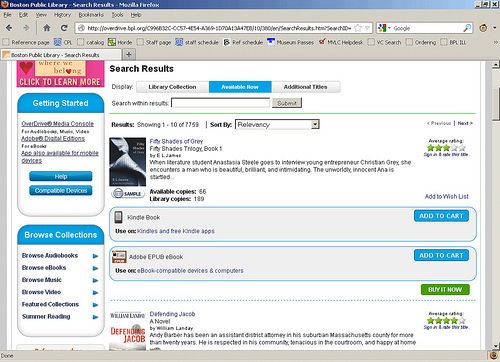
But one of the new features did bother me. The new interface apparently includes a "Buy It Now" button, which will be located directly under the "Add to Cart" button. The Boston Public Library has been demo'ing the new interface for most of this year, and here's what it looks like (click for bigger):
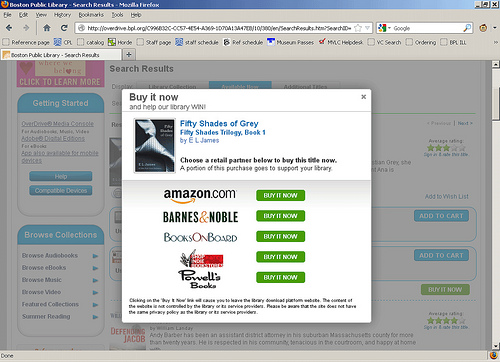
When someone clicks that green "Buy It Now," a windows pops up with a list of stores (click for bigger):
Pardon my French, but I fucking hate this. There's been conflicting reports about whether this "Buy It Now" button is optional or not, but I sincerely hope it can be turned off.
Certainly there's an argument to be made for it: if publishers know libraries are going to directly be driving customers to them, they might be more inclined to actually deal with libraries. There's also the convenience to the patrons who don't want to wait for the library's copy to be returned, and can afford to just go buy it themselves.
This seems wrong to me. It makes libraries Overdrive's bitches, because now we're drumming up retail business by preying on immediate gratification. Which is absolutely idiotic, because technologically there is no reason anyone should ever have to wait for an ebook. Implementing this feature just encourages the backward-thinking currently gripping the ebook world as they try to cling to past revenue models.
What would be awesome is if the patrons were given the option of buying a copy for the library. They get it first, then they can donate it to the library for others to use, if they want.
There's also the line that libraries will be getting a kickback from such sales, in the form of Overdrive credit. This is a complete non-starter for me, so I won't even address the idea of libraries profiting from our shortcomings.
But speaking of revenue streams, it looks like the new Overdrive interface also prominently features banner ads - here's the BPL's advanced search page (click for bigger):
Notice the two "Advertisement" right under the black menu bar? Sigh.
But I don't want to be all doom and gloom. In all fairness, I haven't seen the webinar and don't know a lot of the facts - this is just all from using BPL's site. When I called BPL, they were much more positive than I felt. The "Buy It Now" button was initially a little jarring for them, but they've had no problems or complaints, and do see credits quarterly, which shows patrons have no qualms about using it.
I am also not sure what other new features are included in the new interface, but since Mike Lovett of Overdrive was so encouraging in his comments last time, I'm hopeful the good outweighs the bad (or better yet, all of the "bad" is opt-in).
So, I encourage everyone to check out the Overdrive Next Generation Digital Library webinar. And as always, keep a running list of "how to make this better" to send to Overdrive to incorporate into the next iteration.
And for further reading on ebook topics, here's a few recent things to check out:
Posted under Uncategorized | 9 Comments »
September 29th, 2012 Brian Herzog
Wednesday is my night to close the library, so I work until 9pm. Usually the 8-9pm hour can be slow, allowing me to get off-desk-type work done. However, one particular patron made the last hour of this past Wednesday more interesting than usual.
The phone rings, and when I answer it, she opens with this question:
Do you have that very famous book about Lincoln and World War Two?
I had no idea how to take that. She had a very gravelly voice, and at first I wasn't even sure if was a real call or a prank of some kind.
But to be on the safe side, I said I didn't know the book, and asked if she knew the author. She replied that he was a famous poet, and after a minute or so, came up with Carl Sandburg.
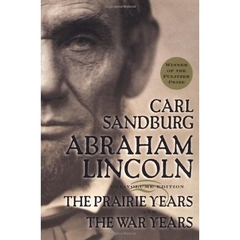 Searching for keyword:Abraham Lincoln author:Carl Sandburg brought up Abraham Lincoln: the prairie years and the war years, and when I read the title to the patron, she said it was the right book. I put it on hold for her and we hung up.
I didn't immediately see the WWII connection, so I did a web search for "Abraham Lincoln" "carl sandburg" +wwii and found an article from the Journal of the Abraham Lincoln Association stating:
Maybe enough time has passed for us to see The Prairie Years and The War Years in historical perspective, to historicize it against the background of American history between the world wars. Sand-burg began writing The Prairie Years in 1922, less than five years after the World War I Armistice, and he completed The War Years in 1939 as the world was sliding inexorably into the holocaust of World War II; the ambiguity of his title did not escape him. Read as a timeless masterpiece, Sandburg's Lincoln does not hold up; read as a timely response to a series of national crises that recalled the Civil War, the book still carries much of its original power.
Okay, I can see why the patron conflated Lincoln and WWII. About two minutes after I found this, the same patron called back and asked:
Can you tell me who designed the Greek army uniforms?
Are you kidding me?
She went on to say she didn't mean the regular uniforms - what she was interested in where the clown uniforms, the ones with balloon pants that they blow air into. Oh, well, then in that case, no problem.
I told her I'd have to research this and I would call her back.
 A quickie search for Greek army uniforms actually lead to a Wikipedia article devoted to them, which was handy. It didn't talk about balloon pants, but one of the images was of some Evzones, whose uniforms, while not including balloon pants, were nonetheless remarkable.
But while I was searching for that, it occurred to me that she might actually mean the Swiss Guard at the Vatican. I looked up their uniform too (and the designer), and their pants are more balloonish than the Greek's leggings.
I called the patron back with what I found, and she was very interested. She agreed that she must have been thinking of the Swiss Guard, but that only slowed her down for a second. She immediately followed-up with,
So then who designed the Beafeaters' uniforms?
A quick web search found two websites talking about uniform origin, which basically date, unchanged, to Tudor times in 1552.
These were all quick and superficial answers. I then searched our catalog to see if we had a book about military uniforms, but none of ours included these types of historical dress uniforms. Other libraries in our consortium appeared to have more historical books, but then the patron changed her mind - she was just curious, so the websites were good enough and she didn't need to read more about it.
So we hung up, and for the rest of the night I kept waiting for her to call back asking for the number of fry cooks on Venus or something - but she never did.
Posted under Uncategorized | 7 Comments »
September 26th, 2012 Brian Herzog
A few months ago, my library conducted a survey of our patrons. We wanted it to be short+useful, so we called it the "60 Second Survey" and limited it to five questions, on things like which services people liked/used, best way to contact them about programs and events, etc.
Of course, the last question was the open-ended "Tell us what you think" question. 255 people provided comments, which made for very interesting reading.
Last week while a coworker was talking about the Wordle cover letter cloud, we got the idea to do a cloud based on the survey comments. Here it is (larger version to see smaller words):
We had read the comments so we knew it was generally positive, but the visual impact of seeing things like this made us feel pretty good. A cloud is so much more concise than 255 individual comments, and we were very happy to see things like "friendly" and "helpful" rise to the top since those are areas we strive to emphasize.
Anyway, I don't mean this as a "We're #1" gloaty post - I just wanted to share because it was so positive. And, it's also a great visual, so we're going to include it in the Town Annual Report, as well as create a poster to display in the library, post on Facebook, etc. A t-shirt might be going too far, but we'll see. I like t-shirts.
I know I'm late to the Wordle game, but now I can't help trying to come up with other things to convert to clouds.
Tags: chelmsford, cloud, comments, libraries, Library, patron, public, Random, Service, survey, wordle
Posted under Uncategorized | 2 Comments »
September 22nd, 2012 Brian Herzog
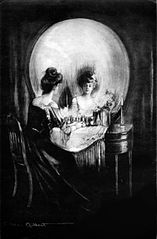 This question... well, this question is one of those that I dread. All too easy to answer, but the easy answer comes with a moral dilemma for librarians.
One afternoon my director came out to the Reference Desk to talk to me about something. While she was out there, a patron walked up and with this question:
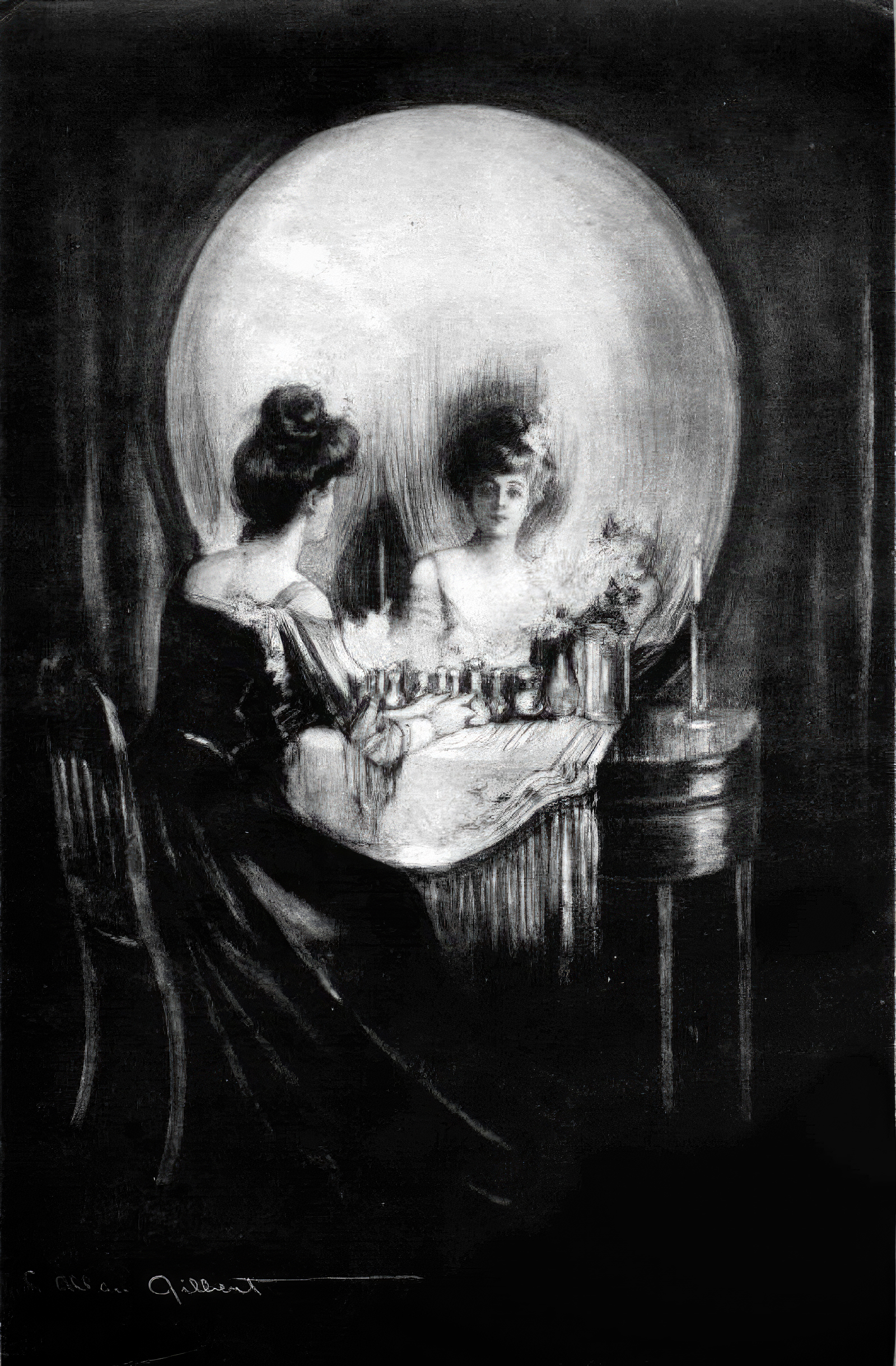
Patron: There's a famous painting by an artist named C. A. Gilbert - it's of a women looking in a mirror, but it's an optical illusion that looks like a skull. Do you have a book with it in it?
Me: I don't know, but let's check.
Patron: It's a great painting - I want to photocopy it so I can put it on a t-shirt.
Okay, that last comment is what caused the warning bells to go off. I don't like giving patrons the "COPYRIGHT! DON'T STEAL!" talk, but I respect intellectual property enough to always work it in somehow. Each patron, and each potential copyright violation, is different, so I usual wait and try to either casually mention it in the course of the search, or make a very blatant parting statement after we find whatever we're looking for. But it's something no one ever wants to hear, most people don't care about, and makes me feel like a dork and a prude for pointing out. But I am a librarian, and I wear my dorkishness and prudishness on my sleeve.
My director, for her part, knew exactly what I was thinking (and dreading) copyright-wise, so she just kind of laughed and walked away, leaving me to it.
In this case, the patron was really excited about how neat this painting was, so we got right into the search. The first thing I did was search for "c a gilbert woman skull" online, to make sure we got the right painting and the artist's full name.
The first result was a Wikipedia entry for Charles Allan Gilbert, and when we clicked into it, the painting he was looking for was right at the top of the page. Great. Also great is that Wikipedia provided the name of the painting, All is Vanity.
Unfortunately, searches in our catalog for his name or the name of the painting were unsuccessful. There's always the option of going to our general books of American artwork and flipping through the tables of contents and indexes looking for these entries, but I could tell this patron wouldn't be happy with that.
So, I showed him how you could click the image on Wikipedia to see a larger version, and also how to use Google to search for high-resolution images (there weren't a lot of high-res versions, but tons of low-res images on all sorts of websites). That way, I said, he could just print from the computer right onto iron-on paper, to make his t-shirt.
He readily agreed, and it seemed like the time was right for The Copyright Talk (coincidentally, my director happened to choose just this moment to make her way back over to the desk).
Me: Oh and remember, not everything on the internet is always free to use. Some things are still under copyright, and you usually need to get permission before you use them or make things out of them.
I thought that was kind of smooth. But the patron turn to me straight on and just looked at me.
Patron (kind of offended): That painting is a hundred years old and the artist is probably dead, so it's not copyrighted any more. Besides, I'm not going to sell t-shirts, I'm just making one for myself.
I didn't want this to turn confrontational, accusatory, or preachy, but I wanted to persevere too (especially with my boss within earshot), so I just wrapped it up with,
Me: I think copyright can extend beyond the artist's life, depending on how the estate handles it. And even making a shirt for yourself might be a violation, because making one means you're not buying an officially-licensed one, which could impact their revenue. In this case you're probably all right because there were so many other copies of this painting on all sorts of websites, but it's a good thing to check into if you really want to be safe.
The patron agreed, but I think it was more to shut me up than because he was going to look into copyright.
Regardless, he thanked me, especially for showing how to find the high resolution image online, because that was something he hadn't tried. This was actually a couple weeks ago, and I haven't seen the patron around town wearing a new t-shirt, so hopefully he did the right thing.
Posted under Uncategorized | 9 Comments »
September 19th, 2012 Brian Herzog
This week we started the first round of interviews for my library's Head of Reader Services position. Which means, I've been reading a lot of resumes and cover letters lately.
Since we advertised for someone who is really into books and reading, many of the cover letters included more colorful adjectives than usual: passionate, voluminous, enthusiastic, voracious.
That got me thinking about mean cover letter word distribution, so I ran the text from the 26 leading cover letters we received through Wordle. I removed any identifying information (current/previous employers, phone numbers, emails, urls, etc), and Wordle also removes some words, and the resulting cloud is interesting:
View the large size to see some of the smaller words, but overall, a lot of the most common words were what we were hoping to see ("love" ranked well).
Here's something else in this process I found interesting: This is the first time (for me) that every single resume was submitted electronically. They were all sent to the Library Director, who then forwarded them to those of us doing the interviewing.
To keep them organized, I created a "Jobs" folder in my inbox:
The red boxes cover peoples name, but looking at the contents of this folder really shows how alike and "just part of the crowd" applicants can seem. From now on, I will always include my name in the subject line when I submit a resume.
Posted under Uncategorized | 4 Comments »