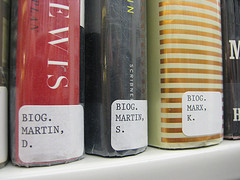
My library's ever-shrinking book budget has made me be more discerning when it comes to selection. However, one area that is always difficult for me is biographies.
It seems like every troubled athlete, aging celebrity, recovering musician, reality television personality, unfaithful politician (and their wives), have all signed book deals. I don't pay much attention to pop culture personalities, so it's hard for me to tell if the person is someone significant.
So I was joking with a coworker about a new selection criteria for all of these celebrity memoirs. Since the importance of many of these people is based on social zeitgeist, I thought I could use Google to help me decide. I figure that if a person is important, a Google search for that person's name should return at least one million webpages. If they're above that (arbitrary) threshold, I'll buy their biography - if not, then I'll check again when the paperback comes out.
Granted, not all my ideas are practical, but here's how some current biographies fare with this "hive mind" selection criteria:
Obviously, not flawless, but this Google criteria might help tell me who I should pay attention to. And in addition to traditional reviews and ratings, another one of my tactics is to wait until requests for a book reach a certain number before ordering it, but that method only addresses demand after the fact, and leaves out the patrons who didn't think to request it.
Selection is a fine art, but when it comes to biographies, most my crayons are dull.
I feel a little sheepish whenever I talk about a product on here, because I don't want to come off sounding like a commercial. But I thought this Book Due Date Calendar was a good idea.
It's available on Etsy from a seller called Aunt June, and it's a fun and creative way for patrons to keep track of when their library books are due.
Paper for our receipt printers is expensive, so we ask people if they need a receipt instead of printing one automatically - which means many people leave the library without any tangible reminder of when their books are due back. I've seen libraries use due date bookmarks, which are also a good idea, but this calendar was colorful and definitely eye-catching enough to be a great reminder (especially for kids) - kind of like a real-world Library Elf.
Here's what it looks like in action:
It looks like you download a pdf, which is nice because you can print out extras if you're a heavy library user. I wonder if you could print it onto some kind of glossy paper that might work like a dry erase board. I also wonder if the seller would be willing to work out some deal with libraries to let them sell these as fundraisers.
Anytime you go to a conference, like Computers in Libraries, you learn about all sorts of neat things, hear great ideas, and get excited about taking these ideas home. The trouble (for me, anyway) can be in connecting those exciting ideas to the real world outside of the conference.
In his Experience Design Makeover talk, David Lee King mentioned the idea of "Touch Points" - the times a person comes in contact with an organization's product or services. While riding the DC Metro system, I realized a group could achieve their primary goal while still failing at many touch points (and I apologize for this long rant, but I tie it back to libraries at the end).
Here's what I mean: the Metro's primary goal is to move people around the city quickly and safely. They do this very well. Once you're on the Metro, it's easy to get to where you want to go, and there were maps of the colored routes everywhere I needed one.
However, I still think they failed at many of the touch points. First of all, actually getting onto the Metro was very difficult. There are big vending machines from which you need to buy a ticket - which is fair enough. However, they sell three different kinds of tickets, charge different prices depending on where you're going, and the fares also change depending on the time of day.
DC is a tourist city, so these vending machines were always swamped with people squinting at the tiny text on the machines trying to figure out what they needed to do. And even though there would be a bank of six or seven almost identical-looking vending machines, they each would offer different kinds of tickets.
So the complicated and confusing fees and policies is a touch point failure. So too is spelling it all out on a big sign with small print that no one could hope to read and understand.
I'm usually forgiving when it comes to technological breakdowns, because I know software hiccups and machines wear out. But I experienced an overabundance of this in the Metro. I saw broken escalators in at least half of the stations I went through. More than once when buying a fare card, one machine wouldn't take my dollar bills but another would. The machines all had coin slots, but all but one I tried just rejected all coins. This meant that for a $1.35 fare, I had to put in $2.00, and the machines don't give change.
In the Metro, you have to swipe your fare card to get into the system, and then again when you leave. Twice upon leaving my fare card was rejected, even though it had enough money on it, and I had to ask the station manager to let me out.
Something that I did like was that inside the Metro they promoted their DCMetroOpenDoors.com website as a way to find out the status of stations and trains. But when I visited it, it does nothing but points to back to the main transit website, and even that link is hard to see. So working hard to promote a website that isn't helpful is a double-fail.
So what does this have to do with libraries?
I'm a dork and often relate daily experiences back to my job. In this way, the DC Metro reminded me of an unfriendly library. A library could have a great collection, anything a person could want, and yet still fail at every patron touch point:
Signage unreadable and unhelpful
Catalog and shelves difficult to navigate
Building facilities (elevator, catalog stations, etc) out of order
Policies complex and restrictive
Fees appear arbitrary and take people by surprise
Staff required even for simple tasks
So don't overlook your library's touch points - your patrons certainly don't. Just being open and having books and other materials on the shelves shouldn't be the main goal - the patron's experience in getting their items is what should be most important.
I haven't done a good, old fashioned, "look it up on the internet" type reference question in awhile, so this was kind of fun. A patron asked,
What was the name of the song they played at the end of Castle this week?
I actually like Castle*, but hadn't seen the episode yet because I watch it online instead of on television. So, the first step was to get the name of the episode by looking up Castle on Hulu.com ("Wrapped up in Death" aired on 4/5).
Next we searched the internet for "Wrapped up in Death" castle song to see if anyone else was talking about this song. One of the results, heardontv.com, was exactly what we needed - it even described the scene when the song was played. According to that website, the song was "Love Is Endless" by Mozella.
The final step was to search for this song on YouTube just to make sure it was the right one. It was, so the patron was happy.
A video of the song is below, but I warn you: it's catchy, and will likely get stuck in your head. I noticed the patron was humming it when he left twenty minutes later.
*And it humors me to no end that my library actually shelves Richard Castle books.
 At first this struck me as funny, but then I found it sad. In the end, I decided to file it under "good decision."