I only got involved with this towards the end, but in plenty of time for the punch line. A woman called in to reserve a meeting room for later that day, and during the process, apparently she asked:
Can the ceilings of any of your meeting rooms be raised?
I didn't hear about this until the next day, but it should have been a tip-off that trouble lay ahead. However, she was told there was an available room, and she would need to fill out our online reservation form to reserve it.
That night the woman came in with her group, which is when I got involved. It turns out she never did actually reserve a room, but just showed up expecting one. All our rooms were in use by then, so after much scrambling around trying to find an available space, I ended up dividing our large meeting room with the movable wall - then I went back downstairs to the Reference Desk feeling satisfied about accommodating a patron's request.
About ten minutes later, the Children's Librarian came down to see me. Our Children's Room is right next to the meeting room, so she can often hear what's going on in there, even at moderate noise levels. I thought she was going to commiserate about our online room booking system or not having enough meeting space to meet community demand, but instead she asked:
Did you tell that group they could use a catapult?
Ha. Apparently, this group was a school group, and for a science project they built and are experimenting with a catapult. It wasn't quiet as large as the one in the picture, but still it was too big, too loud, and too dangerous for us to let them use it in the library. I'm actually a little bit in awe of them for apparently thinking it would be perfectly okay.
Now, you know I like medieval siege weapons, but perhaps this is a good rule of thumb: if the library's ceiling is too low to do something, then that is something you cannot do in the library.
Ever had one of those moments where, in a second, some random bit of information unexpectedly clicks and your world makes so much more sense?
Being a librarian, my most recent example came reading the title of Bobbi Newman's recent post, For Digital Natives There Is No Web 2.0. Yes, of course. For kids growing up with the internet of today, this is their Web 1.0 - because they've never known anything else.
This is a total (probably long overdue) mindshift for me. My library is currently trying to figure out how to use Web 2.0 tools to reach kids in our community, and this one title changed the way I think about the task. We talk about tools kids may or may not use in their daily life, but for many kids, these tools are their daily lives.
This realization actually makes our task easier, but it certainly raises the bar for how good a job we need to do.
I'm sure libraries across the country are asking this same question.
My library purchased Last Train from Hiroshima, but haven't put it out yet because we're divided over how to handle it. Based on revelations in the New York Times and Washington Post, I'm opposed to just shelving this book in non-fiction. There are a lot of requests for it, so I do want to make it available for people to read, but I would like to include a note of some kind stating there are significant known inaccuracies in the book.
One argument is that it's not a library's place to censor books, and if people want to read it we should provide access. However, we do censor resources and information simply by the act of selection, and by choosing which websites to link to based on their factual accuracy and reliability.
Mainly I want to protect school kids and other unknowing people from taking portions of this book as fact - which is what the library is confirming by shelving it in non-fiction. But so far, neither the Charles Pellegrino (author) nor the Henry Holt (publisher) has issued an easy-to-print statement to include in the book. As of today, the book is still being promoted on the publisher's homepage, but the author has addressed the issue in a forum posting linked to from his website.
So, what are libraries doing with this book? Shelving it as usual? Not shelving it at all? Including a note inside or on the cover? Putting it in fiction? We still have Million Little Pieces in non-fiction, but I think there's a difference between a memoir and a book about World War II.
Once again, heavy winds and rain has been knocking out power to most of the area (especially yesterday), so this question of the week is a repeat:
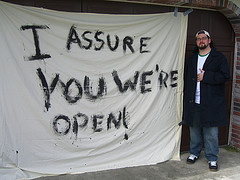
Hey, are you open?
My library had power all day, but most of the town and other nearby libraries did not. The library was packed, and more than a few times I was asked if I knew when power would be back on at a patron's house.
I think the power companies learned a public relations lesson last year, and have been more proactive in providing information. In searching the internet, I found some helpful National Grid storm resources:
Chelmsford's Town Offices were also in contact with National Grid, and created their own concise and useful Storm Update page
When I asked my Director if we'd be staying open late to serve as a shelter for people without power, she said we officially cannot do that. Apparently there are strict certifications necessary for a Town building to function as an emergency shelter, and the library is not certified (neither is our Senior Center, which did stay open last year, but was closed when someone noticed the lack of certification). Granted, this week's outage (and weather) is certainly not as bad as last year's ice storm, but I really don't know how involved certification would need to be. We wouldn't be providing food or aid or beds for people, just heat and power and chairs and internet, which we already do every day. Of course, we'd have to pay staff to stay open, and that is tough with our budget situation.
So, not a very inspiring reference question, but it's been that kind of week. For a real Reference Question this week, check out a great transaction from The Surly Librarian.
Given the changes in the economy and the re-organization/downsizing of many public library systems these days, public librarian jobs are few and far between. So, if you could no longer work as a librarian, what work would you do?
Read the rest of the question (including the parameters), and other peoples' answers, and give it some thought.
I posted my answer (too wordy as usual), but who knows what I'd end up doing in this situation - paperboy? volunteer fireman? park ranger? fry cook on Venus? I'm really not sure.
I like to think I'm the kind of person open to the opinions of others, and I certainly don't expect myself to be right all the time. However, it's still rare for me to advertise when I think I am wrong, yet today is one of those days.
Last week my director received the following email from a patron and forwarded it to all the department heads to see what we thought about it:
Ms. Herrmann,
I just heard about Red Box doing a trial with Libraries across the country. This is a fantastic idea, there currently is no Red Box in Chelmsford Center. Attached is a link for you to look at.
In case you've never heard of Red Box, they are dvd vending machines which rent new movies at $1 per night. The machines are located outdoors and are available to the consumer 24/7. Red Box pays the library and also allows the library to free up cash from having to purchase current films.
It would be great if Chelmsford could get in on this trial!!
I had heard of libraries using both Redbox and Netflix, but never really gave it too much though. So I was kind of surprised at my response to my director:
Maybe this is just a reaction based on the kind of day this has been, but I have mostly negative feelings about this. Based on http://tametheweb.com/2009/07/01/red-box-rentals-at-princeton-public-library/ is seems any money we get is minimal, and I'm always reluctant to give
businesses a green light to target library patrons.
If we did put one of these in, I sincerely hope it wouldn't mean we'd be buying fewer DVDs and rely on this as a crutch, because just like Rosetta Stone, they can pull out at any time and we'd be left
scrambling to fill the holes in our collection.
Its biggest benefit would be providing patrons access to DVDs 24 hours a day, but it also means patrons have a reason to be at the front door 24 hours a day, doing who knows what - the police department might not like that idea. Then there's also the patrons who return the RedBox
DVDs in our dropbox, those who put ours into the RedBox, patrons demanding refunds and tech support from the circ desk, blah blah blah.
I know Conway makes money off our printers and the FaxVend people do too, but RedBox feels way more commercial - like letting a dealership put used cars in our parking lot to make it easier for patrons to shop for cars. Or letting a bookstore set up a table of bestsellers in the lobby and sell books so patrons don't have to wait on a long reserve list.
I don't know exactly why I don't like it, but right now I'm leaning against it - but again, it might just my mood. Blah.
So my question is this: why I am wrong?
I don't feel like I'm right, because I can see positive aspects to a Redbox being in front of the library (especially for libraries that already charge $1/DVD), and it's unusual for me to be this negative. I don't think that every new idea or technology has a place in every library, but still, my answer on this surprised me.
So I thought I'd ask the wider library world for your opinions on Redboxes and libraries. Lots of good comments were posted on Tame the Web when Michael talked about this last year, but I'm still not entirely convinced. What do you think?
 I only got involved with this towards the end, but in plenty of time for the punch line. A woman called in to reserve a meeting room for later that day, and during the process, apparently she asked: