February 23rd, 2013 Brian Herzog
 This isn't a reference question, but I think it is by far the most interesting email the library received this week. The message below was sent to my Director, and was then forwarded to our cataloger and me to look into:
Subject: former(?) Rare Chelmsford Library Book 1743 MASSACHUSETTS Bay COLONIAL Laws
Hello, I noticed this rare book for sale on ebay and an image shows an ownership label of your library. I'm not interested in buying it, just wanted to bring it to your attention in case this rare item had been removed from your collection. No response needed to me.
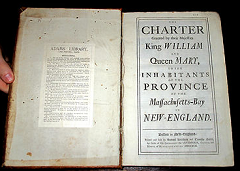
Wow. We checked out the ebay listing for this book, and sure enough, the inside cover has a old Chelmsford Library bookplate:
None of us ever recalled seeing this book in the collection, or even anything remotely like it. We have lots of old historical and vital records, but none leather-bound or particularly valuable.
There was no record in the catalog for this item at our library (although a nearby library does have it) - which means this item could have been weeded and discarded, sold as a fundraiser, or stolen by fiends any time in the last 100+ years.
Since we have no way to know, there's nothing we can do. I do occasionally hear about stolen library books being sold at auction (or worse, maps or color plates cut out of library books), but in this case I'm willing to give the benefit of the doubt. It is an interesting situation though. If anyone would like to purchase it and donate it to the library, please let me know.
Tags: antique, book, Books, ebay, libraries, Library, public, Random, Reference Question, sale, valuable
Posted under Uncategorized | 1 Comment »
February 16th, 2013 Brian Herzog
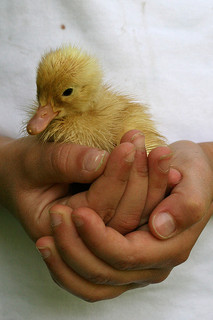 One common question at the reference desk is a patron asking for a specific book by describing the cover - they don't remember the title or author, but know it was "kind of red, with an airplane or a submarine, and maybe something like a roundish square type thing."
Being librarians, we take whatever information the patron can provide and do our best. I know many people dread this type of question (because it's often just impossible), but I sort of enjoy them. Since the expectation of success is so low to begin with, it's a fun challenge, and finding the right book is all the better for it.
In this case, the patron was actually a coworker of mine - she had taken her niece to a different library, and was trying to re-locate a book her niece had picked out and loved, to see if the author had any others. But all she could remember was that it was a newish kids book with a girl holding a duck on the cover.
I first went to Amazon's advanced search with this question. My keyword search was for "girl duck," limit to Condition=New, Format=Printed Books, Pub date after November 2012, and then submitted individual searches for each of the different kid ages one at a time. None of the searches has a likely-looking cover, so I decided to just use "duck" as my keyword (thinking that if a duck is on the cover it must be the important part of the story). I also dropped the idea of using the age limiter in favor of the Subject option limited to Children's Books.
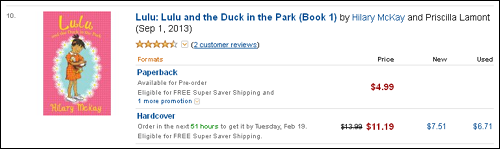
In that search, result #10 looked promising. I called my coworker over to check, and she was excited - the book she'd seen with her niece was indeed Lulu: Lulu and the Duck in the Park (Book 1), by Hilary McKay and Priscilla Lamont*.
Awesome. But then I started to wonder - was Amazon the best tool for this question? There is no really good "look up a book by cover" resource out there, although I would love there to be. LibraryThing started down this road with CoverGuess. The genius of their approach was to gamify the data entry part of tagging cover art, but I don't think a searchable interface has ever been created.
Anyway, out of curiosity I decided to run the same search process in Novelist and the library catalog, to see if I could have successfully located the book with those tools.
Novelist's advanced search is more complex than Amazon's - I used "girl duck" as a keyword, limited to Audience = 0-8 Years, and Publication Date from = November 2012:
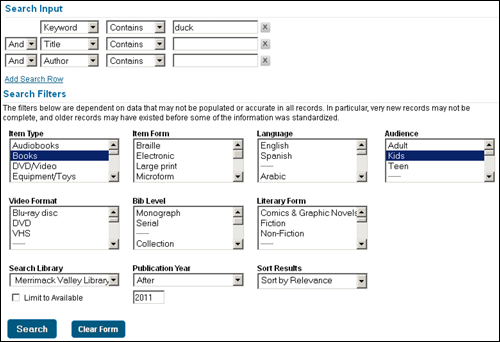
In my library's catalog's advanced search, I used "duck" as the keyword, limited to Format = Books, Audience = Kids, and Publication Year after 2011:
And now the results - each one has the number next to it indicating how far down this book was in the search results:
Amazon:
Novelist:
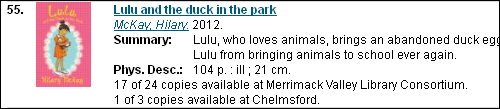
Library Catalog:
In all cases it was findable, but Novelist ranked it the highest with the fewest search limiters. However, since Novelist is a subscription database, getting to the search interface is a much more cumbersome process than using Amazon. The library catalog is easy to get to and the search interface is reasonable, but burying the book at #55 is bad because many people give up log before the sixth page of search results (thanks for that, Google).
Something else I noticed, and what I think is another strike against the library catalog, was the various sizes of the cover images. Comparatively, the library catalog's cover thumbnail is tiny, and because of this it's not really evident that the girl is holding a duck. Since that's all I had to go on with this search, if I had started with the library catalog, I probably would have missed this book entirely. I don't know why the thumbnails are as small as they are, but it seems the catalog would be improved by making them almost twice the size they are now.
So there you go, my curiosity was sated. Anyone else have a favorite method for finding books by cover descriptions?
*I don't know why Amazon has the publication date as September 2013, since the other library apparently had it cataloged and on their shelf. Ah, sweet mysteries of life.
Tags: amazon, Books, catalog, cover, covers, libraries, Library, novelist, public, Reference Question, search, Technology
Posted under Uncategorized | 8 Comments »
February 13th, 2013 Brian Herzog
 Over the last couple years, there's been a trend in my library to move some of the work traditionally done by Technical Services out to the service desks.
It hasn't been deliberate, and it hasn't been too major, but desk staff now routinely:
- change status of items in the catalog, moving them into and out of "Display," "New Books," or the regular stacks
- add identification labels, such as "Teen" or "Documentary," to items that are already circulating
- use a barcode duplicator to add barcodes to the front cover of items
- change call numbers in the catalog (or more often, correct them if the spine label doesn't match the catalog)
- replace faded spine labels (courtesy of having a spine label printer at the Circulation Desk, and soon-to-be one at the Reference Desk too)
For the most part, it has improved customer service by decreasing the amount of time it takes to do these tasks. It keeps items in circulation longer (instead of being routed to Tech Services where they might be unavailable for a week or so while the update is made), and also keeps our catalog and shelves more accurate by fixing problems or improving findability on the spot.
 However, we have noticed mistakes being made, too - which isn't unexpected. When the work was done only by Tech Services, it is by staff trained to do this type of work, usually in the back office where they work at their own pace. Desk staff, on the other hand, only get minimal training, and can only do this work in between helping patrons. So, with many more staff working on it, details are bound to be missed or forgotten as different people develop their own workflow over time. But no matter how small these mistakes were, they are still glaring when they cause a problem.
I bring all this up, not just because I find it an interesting trend in and of itself, but because of something our cataloger pointed out about the whole process.
Recently, our Director relayed a story to the entire staff about a distraught patron coming in looking for a book, and the first staff person she spoke to was able to identify the book, look it up in the catalog, take the patron to the shelf, and put the book in the patron's hand. The Director praised this success and efficiency, referring to the library as a "well-oiled machine."
Our cataloger used this success story to highlight why it is so important for the desk staff to do these traditionally-Tech Services tasks correctly. Her point was that these little processing details - making sure spine labels are printed correctly and consistently, making sure the barcode is in the right place, etc - is the oil that allows our "well-oiled machine" to run smoothly. Their importance cannot be taken for granted.
Too many mistakes, and suddenly we can't find books on the shelf because they're not where they're supposed to be or their catalog record is inaccurate.
It's helpful to share the workload, but quality control cannot be overlooked in the process. Libraries are funny in that the smallest details upstream - which many people don't even think twice about - seem to have the biggest impact downstream if something goes wrong.
So, yay for catalogers and their persnickety attention to detail - without them, libraries certainly would grind to a halt.
Tags: cataloging, detail, labels, libraries, Library, oil, process, public, Service, tech serv, tech services
Posted under Uncategorized | 9 Comments »
February 9th, 2013 Brian Herzog
 Earlier this week I mentioned something I really like about working in libraries. For the reference question this week, I'm going to talk about something I don't like about my job:ambiguity.
And, fair warning: the next few paragraphs are just me whining, so feel free to skip to the question at the end.
This week was kind of a perfect storm of annoyances for me, if you'll pardon the pun. First, it's tax season. Second, I don't know if this made the news outside of New England, but we got a bit of a storm Friday and Saturday. Most of the questions this week dealt with one of these topics.
First, the tax stuff
Tax forms were late this year, which always brings out the worst in people. When we finally started getting the ones people wanted and put them out for the public, people were happy - until they noticed we didn't have all the forms and instructions they wanted.
Now, libraries don't create the tax forms, and we have no input into the publication schedule - we just help distribute them. We put out what we can, and for the ones we know we're missing, like the 1040 Instructions, we put up a sign saying something like "1040 Instructions have not arrived yet."
Of course this prompts people to ask when they'll arrive. We have no idea. They don't know we don't know, but also rarely seem to take "we don't know" for an answer. It's a no-win situation, and one I hate to be in - I hate it when "I don't know" is really the best thing I can tell someone. It has been especially bad this year.
Second, the snow storm
This storm was predicted to be a big one, starting early on Friday and lasting into Saturday night. It was supposed to be so big, in fact, that about noon on Friday, Massachusetts Governor Deval Patrick issued an executive order closing all the roads in the state at 4pm, with a $500 fine if you were caught out after that. So, yeah, serious.
All schools in the area were closed on Friday, and most libraries closed at noon - but not us. The way things work in my town is that it's the Town Manager's call, and his philosophy is to keep public facilities open as long as conditions allow. When we do close early, we usually only get an hour or two notice.
This can cause a bit of a problem, because while most libraries announced their early closing on Thursday, Friday at noon we were still telling patrons, "sorry, we don't know how long we'll be open." It was frustrating, because the phone was ringing constantly with people asking, "hey, are you open?" and, "are you closing early?" and, again, the best we could tell them was "we don't know."
This demoralized staff, but was also frustrating for patrons - road conditions were deteriorating, and they had to weigh if it was worth it to drive to the library to get books and DVDs for the upcoming snow-bound weekend. But then not even knowing if we'd be open once they got here was understandably irritating.
Now the question
One question I dread every winter is the "how much snow fell on X date?" We get similar weather-related questions throughout the year, but snowfall is always the toughest. The problem is there is no good local resource that provides the data the patrons want, so the best we can do is cobble together what we can find and let them draw their own conclusions.
This time, someone asked me how much snow fell on two different days in January, because the plow guy she uses billed her for $60 for plowing 4" on January 16th and $40 for 1" on the 29th. Something seemed off to her, so she wanted to double-check to make sure that's how much snow was on her driveway on those days.
Now that is hyper-local, and it's just tough. My favorite historical weather resource, which I've talked about before, is NOAA's snow data files, and they have snowfall and snow depth by month. The closest NOAA monitoring station is only the next town over, which is pretty good, but it's still far enough away to not be able to conclusively say what happened in her driveway on those days.
The other resource I've found that's good for this type of question is Accuweather's past weather table. This is great because it easily lets you scroll backward in time, and shows snowfall in addition to precipitation (most weather resources just show precipitation, which is why snowfall is more difficult than rainfall).
But a problem with consulting multiple resources is when, as in this case, the numbers don't match up. Accuweather's amounts different from NOAA's, which are themselves different from the plow guy's amounts. Not enough to dispute the bill, which I think is all this patron is looking for really. But I include this on my list of "ambiguity annoyances" because I don't like it when I can't find a solid answer for someone. I know it's the nature of research, but still - frustrating.
Anyway, in this particular case, the patron also slightly annoyed that the plow guy charged her for plowing an inch of snow - but, wisely, she decided she wasn't going to say anything to him until after the major storm this weekend.
Tags: closing, complain, early, forms, grouch, libraries, Library, Personal, public, Reference Question, snow, storm, tax, taxes
Posted under Uncategorized | 13 Comments »
February 6th, 2013 Brian Herzog
My library's One Book Chelmsford selection this year is Townie, by Andre Dubus, and the kick-off event was last weekend.
To promote the book with patrons, we decided to hang up a punching bag right next to the circulation desk, so it's the first thing people see when coming into the library. Pretty neat, huh? Plus, since we didn't want to permanently attach it to the wall or ceiling, they let me build a stand for it:
It's nothing fancy, but I like woodworking and carpentry, and any excuse to use power tools is a good one. The wood and hardware cost about $30, and we bought the bag itself on Craigslist for $15, so it's not too much money for a pretty eye-catching display. And in how many other jobs would I get to do something like this?
Patrons seem to really like it too - especially kids. We encourage people to try it, and I'm pretty sure it won't fall over (we tested it). We still haven't decided what to do with it afterwards, but we've got a few months. Who knows - maybe we'll just catalog it and add it to the circulating collection for people to check out.
Tags: andre dubus, Books, chelmsford, display, libraries, Library, One Book, Programs, public, punching bag, townie
Posted under Uncategorized | 10 Comments »