June 19th, 2012 Brian Herzog
Salem Press released the results of the 2012 Library Blog Awards this morning - congratulations to all the nominees and winners!
Since I was a winner last year, I was asked to be a judge this year - and it was tough. I keep hearing that blogs are old-fashioned, but obviously the format is still going strong.
Thanks to all the writers and editors who put time into sharing information, experiences, and news with the rest of us - and to Salem Press for annually recognizing the standouts.
Posted under Uncategorized | Comments Off on 2012 Library Blog Award Winners Announced
June 16th, 2012 Brian Herzog
 I was sitting at the reference desk one day this week, when my coworker answered the phone. After speaking to the patron for a little while, she turned to me and said:
Brian, this patron wants to know if it's okay for her daughter and another student to meet at the library to work on a project - and they need to use a hot glue gun.
The first two things that popped into my head were "mess" and "burned kids," but really I didn't see any reason to say no. I suggested they at least reserve a study room, to contain any potential mess and also prevent anyone else from accidentally bumping into it.
My coworker relayed my permission to the patron, talked for a little while longer, and hung up. Then she turned to me, smiling, and told me the punch line:
The patron's daughter is working on this project with a boy in her class. It's the boy's glue gun, but the patron didn't want her daughter and the boy alone at his house, so she said they had to come to the library.
Ha - a totally legitimate concern, I know, but yet another reminder why ebooks will not destroy libraries.
Anyway, the good news is that the kids showed up later that day, stayed for a few hours working on their project, and left. I checked the room after they were done, and it was in perfect shape (although it smelled a little funny). But yay for another library success.
Posted under Uncategorized | 1 Comment »
June 9th, 2012 Brian Herzog
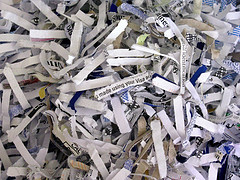 One afternoon, an older female patron called the reference desk and asked:
Do you have a shredder there that I can use?
This has always been kind of a gray area for us. Yes, we do have a shredder in the office for library staff. We have no official policy on the public using it, other than our general yes-based policy. And in the past, if a patron had just a few sheets that needed to be shredded, I would take the pages and do the shredding for the patron. So, I asked:
Me: How many pages do you have to shred?
Patron: Oh, I'd say hundreds.
Arrgh - "hundreds" sounded like more than we could accommodate* (besides, we have just a standard office shredder, not a heavy-duty one). So, reluctantly, all I could suggest to this patron is to contact her bank, as I know a few local banks will shred their customers' documents for free.
I get asked this a few times a year, but the more I thought about it this time, the more I thought this is a perfect service for libraries to offer. A heavy-duty shredder is something not everyone can afford, but something the community could purchase and share (just like other library materials). Plus, with libraries' strong commitment to protecting patron privacy, this seems like a nice way to promote "privacy literacy."
There are questions though - in fact, to find out if there are already best-practices for public shredding, I posted this question on the library stack exchange:
- how heavy-duty of a shredder is necessary?
- should it be a free-access shredder in a public area, or staff-mediated behind a desk or in an office?
- would noise or safety a factor?
- should patrons need to sign a waiver since they're probably leaving personal/private data behind? (shredded, but still, there's always potential)
- should there be a limit on how much patrons can shred? (since it all becomes waste the library needs to pay to remove)
If you've got any suggestions, please feel free to answer on stack exchange or in the comments below - thanks.
*There are a few off-the-books things in the library people can do, if they don't it too much. Shredding is one, using a desk phone to make a call is another.
The most common is probably bringing in magazines - we have a basket into which we put our weeded magazines for people to take (and keep), and patrons always ask if they can bring in their own magazines to leave there for others. Officially the basket is just for library magazines (because we don't want to deal with someone dumping a load of junk there for us to deal with), but we routinely tell patrons that if they just have a few magazines, it's okay.
So far, everyone has been totally fine with this, and no one abuses it. I like these sort of open-ended practices, where you trust people not to be idiots, and it works.
Posted under Uncategorized | 8 Comments »
June 6th, 2012 Brian Herzog
Aaron highlighted a great tool on Walking Paper - a single serving script that shows whether the library is open or not:
Great job Durham County Library for coming up with it, and thank you very much for making the code freely available.
This is definitely going on my library's website (when I get a chance) - but of course, with 24/7 Library Anytime, the answer is always YES!
Posted under Uncategorized | 1 Comment »
June 5th, 2012 Brian Herzog
Today is the last day to nominate your favorite library blog for an award! Read all about this year's contest in Salem's Library Blog Center or simply make a nomination by emailing them at [email protected].
Use Salem's Library Blog Directory to search for or browse library blogs by focus, type, or audience.
2012 nominees will be announced on Friday, June 8th. Also be sure to check out last year's winners (full disclosure, I won in the public library category).
Posted under Uncategorized | 3 Comments »
June 2nd, 2012 Brian Herzog
 This was one of those questions that was was only of throw-away curiosity to the patron, but made me wish we could have spent more time on it.
One day about lunchtime, a patron walks up to the desk and said:
I just stopped in on my lunch hour to pick up some things I had on hold, but while I was here I thought I'd ask: is there a measurement for smell? Someone in my office uses our microwave to cook his lunch and usually it smells bad. Is there a way to measure how bad it smells, so we can tell him he can't cook things that smell worse than X?
Let me tell you right now, I love this question.
And honestly, I had no idea. I know sound is measured in decibels and light is measured in candlepower or lumens, but I've never heard of a measurement for smells (or for taste, for that matter. Touch I suppose is PSI).
My favorite go-to source for questions like this (definitions in search of a word) is the Descriptionary, but it turns out our copy is missing. So, being pressed for time with the patron on his lunch break, I just searched the internet for unit of measurement for smell, which brought us to the Wikipedia article for Odor, which has a "Measurement" section.
Our quick skim indicated two aspects involved in measurement - concentration and intensity - and that it appears there is no easy way to measure smells (nothing like a convenient light meter, for example). Measurement seems to be done in labs by professionals, using carefully controlled sample. We did learn, however, that there is a 0-6 scale for smell intensity, and that the unit of measurement for smell concentration is the European Odor Unit, (OUE).
We were both kind of disappointed at this point - I think we were hoping for a little handheld device that you could stick in a room and it would give a quantitative reading like "42 stinks" or something. The patron had to go, so I took his name and email address, and told him I'd send him anything else I found.
And I did find more, but nothing that would really help. Here are some of the highlights:
- Devices that measures smells are an olfactometer and an electronic nose
- Glossary of scent and smell terminology
- From a different glossary:
- Olf: an empirical unit of indoor odor intensity introduced by the Danish environmental scientist P.O. Fanger in 1988. One olf is defined as the odor intensity produced by one 'standard' person (a standard person is also defined). The name comes from the Latin olfacere, to smell. Ventilation reduces pollution, and the resulting pollution in ventilated, enclosed spaces is measured in decipols.
- Decipol: an empirical unit of indoor odor intensity introduced by the Danish environmental scientist P.O. Fanger in 1988. One olf is defined as the indoor odor intensity produced by one "standard person", and one decipol is the perceived odor intensity level in a space having an odor source of strength one olf and ventilation at the rate of 10 liters/second with unpolluted air. Measurements are recorded by human observers using protocols laid out by Fanger and his colleagues.
- Popular Science article on two Cornell students who created a machine to quantify farts
- Further reading:
That was the academic information I found. For non-academic information, I also found:
- Hobo Power: Coined by Adam Carolla and Dr. Drew on the radio show Loveline as a measure of how bad something smells. Ranging from 0-100, anything near 100 hobo would smell bad enough to cause death by asphyxiation.
Although more colloquial than OUE, I don't like this, because ever since I was little I wanted to be a hobo. But not everyone must share my romanticized view. A quick breakdown of the Hobo Power scale can be found here, and it's also listed in the Urban Dictionary.
I liked the "Olf" the best, but without any way to really measure it in the field, it's still not very helpful to the patron. I sent him what I found, with a note that I'll keep looking, but unfortunately I don't have much hope for finding something that will prevent his office lunchtime odors.
Tags: libraries, Library, measure, measurement, odor, public, Random, Reference Question, scent, smell, unit
Posted under Uncategorized | 2 Comments »