June 21st, 2011 Brian Herzog
It's not too uncommon for me to receive ideas or suggestions for posts through my contact form. Sometimes they can be pretty sketchy, but this one looks legitimate - and interesting.
Oxford University Press recently release a survey of census data detailing Librarians in the U.S. from 1880-2009. Even if you just skim the graphs, I think you'll be hooked.
While I wouldn't call most of the findings exactly shocking, I was surprised to learn a few things:
- The number of librarians in 2009 (212,742) is roughly the same as 1974 (the year I was born) - and down almost 100,000 since the peak in 1990

- My home state of Ohio, which always seems like a hotbed of library activity, isn't one of the states with the most librarians nor the most librarians-per-capita
- Today, only 17% of librarians are male - by my math, that works out to 36,166 of us. In other words, if we average 6' tall and were laid end to end, we would stretch for about 41 miles
Librarian Gender
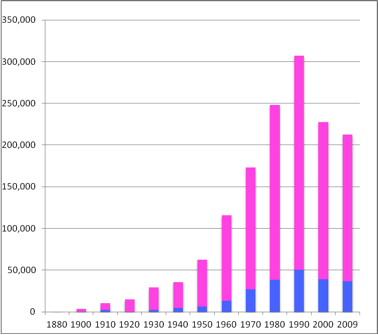
This part of the conclusion also stood out to me:
[T]he internet seems to be having an effect on the field, as it has faced a significant decline since 1990. That decline seems to have slowed substantially since 2000, as librarians adjust to and find new roles in the internet age and the extensive increase in information that it has brought about.
That's interesting - I had chalked up fewer librarians to wave after wave of budget cuts and hiring freezes. I know people sometimes ask, "we have the internet now, why do we need librarians?" but aside from factual reference questions, my library is still as busy as ever. Our Town Hall has never said, "your stats are down, so you don't need as many employees" - instead, they've said, "every town department is being cut 5%, and probably more next year." Maybe that is why I hadn't drawn a direct correlation between the loss of jobs and the rise of the internet - nor that the decrease in jobs would stabilize once we find our information age niche.
If anything, I could hire more staff specifically to serve as a information technology help desk, to support all our patrons who end up with devices and online services they don't know how to use. Maybe that is the new role we are looking for. Really, I don't think the decline in librarians can be as simple as that, but it is an interesting correlation.
Thanks to OUP for mining and compiling this data - and to Lauren for the heads-up.
Posted under Uncategorized | 7 Comments »
June 18th, 2011 Brian Herzog
 One afternoon, three high school kids came up to the desk and asked if they could use one of the study rooms. I set them up, and then about a half hour later they came back with this question:
Do you have a book with SAT scores by town for all of Massachusetts?
I didn't think we would have anything in print with scores down to the town level, so I told them I'd search online. They said they had been and couldn't find anything - I told them I'd try anyway, and I'd come get them if I found something (said the librarian, with confidence).
The first place I went was the MA Department of Education website, but a search for SAT scores didn't provide statistics, just news articles about trends.
Next I tried a general web search for SAT scores by town Massachusetts, which did produce a Boston Globe article with scores by schools from 2006. Since this proved such data was available, I thought surely the DOE website must have something.
So I searched again limiting to site:doe.mass.edu (actually, at first I just typed in .gov, but it turns out the DOE website is a .edu - huh), and found the exact same Boston Globe data on the DOE website - plus data from previous years.
It always bugs me when Google's site: limiter search works better than a website's own native search, but at least I found something.
And finally, I searched around CollegeBoard.com to see if they had breakdowns of SAT scores. All I could find there were national percentile tables, but that seems like it might be useful, too.
I went to the study room to tell the kids what I found, and they were pretty happy. Of course, since everything I found was online, the only real way to get it to them was to get the email address of one of the girls in the group and email her the URLs - which seems a little awkward to me, but it worked well enough in this case.
This was the email I sent them...
From the Department of Education's website:
http://profiles.doe.mass.edu/state_report/sat.aspx
The same table a little easier to read from Boston.com:
http://www.boston.com/news/education/k_12/articles/2006/08/29/2006_sat_scores_for_massachusetts/
And if you need general statistics on SAT test takers overall, that's
on the SAT website:
http://professionals.collegeboard.com/data-reports-research/sat/data-tables
Let me know if you guys need anything else.
They stayed in the room for an hour or so more, and stopped by the desk to thank me on the way out. How nice.
Posted under Uncategorized | 7 Comments »
May 31st, 2011 Brian Herzog
Our brand new Evergreen catalog went live last night about 7:00 PM, and today is the first day staff and patrons are seeing the new catalog. Each MVLC library has its own search interface, and here's ours:
The consortium network staff in charge of the migration chose Memorial Day weekend so they'd have an extra day to work on everything, since libraries would be closed anyway. Although you always plan for the worst with major changes like this, it seems like everything is more or less going according to plan.
My library chose to open late today (1:00 PM instead of 9:30 AM) to give staff time to get caught up on checking everything in from the weekend (since the catalog was totally off-line during the migration), and to also give us time to get familiar with the new interface before we started using it to serve patrons.
The last couple month have felt like a mad scramble to test what we could, suggesting as many changes as possible to make the catalog more staff- and patron-friendly. The great thing about open source software like Evergreen is that new features can constantly be developed, but nothing happens instantly, and everything needs to be prioritized.
We're not launching with the perfectly ideal catalog, but we have been trying to reframe our patrons mindsets to the new "perpetual beta" approach to feature development in our catalog. I also expect a stream of training and how-to blog posts and maybe videos, but that should be par for the course for any migration. If you feel so inclined, please try it out and I'd love to hear feedback and suggestions.
 Oh yeah...
A colleague at another MVLC library pointed out that today, May 31st, is also the 100th anniversary of the launching of the Titanic. That is not foreboding at all.
Now, time for vacation
Although I know it's bad timing, I'm going to be traveling this week and next for a family wedding and niece- and nephew-seeing. I'll have a couple days with the new system before I leave, but I'll post again in a couple weeks with an update on how things are going.
Posted under Uncategorized | 6 Comments »
May 28th, 2011 Brian Herzog
I was all proud of myself for ultimately finding the answer to this question - but afterward I discovered the answer wasn't nearly as hard to find as I had thought. Oh well.
A patron came up to the desk and pushed this newspaper clipping towards me (click to read it):
As she did this she said,
This from the Wall Street Journal page A12, but I can't remember date. I looked through all the issues you have, but it's not in any of them. You need to find out when is this article from because I want to read the rest of it. I'll leave this with you and go back to my computer, so just bring it over when you find it.
We keep the last three months of the WSJ in print, and since she said she looked at every issue, that ruled out anything between now and March 2011. I asked her if she had any idea when she photocopied it, and she said she thought it was in March, but it could have been a little earlier, so I decided to focus my search between January and March 2011.
Unfortunately, we don't have subscription database access to the WSJ, so I went to their website to see what kind of archive search they had. Their search did allow limiting to a date range, so I combined that with what seemed like the most important keywords from the article (Victim Funds, Columbine High School, Virginia Tech, Von Mour, etc) - and came up empty.
I usually don't have much luck with newspaper searches, so I quickly switched to Google - sometimes their cached results contain a better record of what has been published (or at least a temporary view through paywalls), and I'd be happy if I could even just get a citation. I searched on various iterations of those same keywords, and included the "site:wsj.com" limiter, but still had no luck.
I thought I was on the right track, but just using the wrong keywords, so I reread what I could of the article, looking for something unique. Towards the top of the page is a photo caption listing peoples' names, so I tried another Google search for "victim funds" "dan smolnik" site:wsj.com and got exactly one hit.
Clicking into the article and skimming it, I saw the same "Victim Funds" table, and also did a Ctrl+F for the phrase "As many as 4.62 points," which appears at the bottom of the clipping, so I knew this was the right article.
So yay, that made me happy. I scrolled back up to the top to find the date: March 28, 2010. Wow, the patron had the right month, but the wrong year.
I went over to the patron's computer and pulled up the article for her. At first she was skeptical because of the year, but when I showed her the table and the same paragraphs from the clipping, she agreed it must be the same one.
After getting back to the desk, I felt pretty proud of myself for being able to unearth this based on such a fragment of a clipping - no title, no author, no date. But I was curious if the search on the WSJ website would have found the man's name. I tried it, and it didn't - until I remembered to expand the time frame to 2 years, and then it did.
I also found success searching on the phrases "As many as 4.62 points" and "token of support from the community" which were in the article. At this point, my pride dissipated, as I realized I had just picked all the wrong keywords from the start - making what should have been a 1-2 minute search unnecessarily long. Luckily it didn't matter in this case, as the patron was still around - but next time I'll just start with random phrases as keywords and see how it works.
Posted under Uncategorized | 6 Comments »
May 21st, 2011 Brian Herzog
 One of our regulars is a patron with special needs who is in all the time - so much so that I think he considers library staff some of his closest friends.
As a result, he is totally comfortable telling us things that many of us would rather not hear - and in this case, he told me something I wasn't sure what to do with.
Just before closing one night, he comes in and walks right up to the desk, happy as can be. He pulls out a crumpled and dirty check, shows it to me, and asks me if I think the bank will cash it.
It's made out in his name, for $300, and when I ask him where he got it (occasionally he'll get checks for his birthday or things, and always tells us about how much money he has), he says:
I found it blank in the street, so I put my name on it and $300. Do you think the bank will give me the money? If not it's okay, I just want to see if they will*.
I fairly emphatically told him he should absolutely not try to cash that check, that it's illegal, it's stealing, and if he tries it, the bank won't just tell him no, they will call the police and he'll go to jail.
With this negative response, he quickly puts the check away (I also noticed it was already endorsed), and said he wasn't trying to steal, he just wanted to see if they'd cash it. And he didn't care about the police or going to jail, because he's been to jail before, and anyway his apartment was messy and he was out of food (which actually made me laugh, even though I was trying to be serious).
He went to the computers until we closed, and as he was leaving I again told him not to take it to the bank, and he said it was okay if they didn't give him the money, he just wanted to try and see if they would.
All of this happened between 8:50-9:00 PM, so there wasn't much I could do. But when I thought about it on my way home, what could I do? Call the police? The bank? Which bank? His case worker? His mom?
Instead, I emailed my Director, knowing that she has a good relationship with the Police Chief, and I had no idea what legal requirements town employees have when it comes to knowledge of intent to break a law. The next morning, she did call his case worker, who I think has some legal responsibility for him. We also have worked with this case worker in the past, on other issues relating to this patron, so it wasn't exactly a call out of the blue.
I opened that next morning, and within about fifteen minutes of opening the doors, this special needs patron came in to use the computers. I asked him if he had gone to the bank, and he said,
Yeah, they took my check away and tore it up and told me never to come back.
So, good on the bank for that reaction. I know this patron understands that what he was doing was wrong, but I think ending things by just ripping up the check was the right response, given the circumstances. I'm still not sure there is a clear role for the library in a precrime situation like this, but I am happy it resolved more or less correctly - and at least the poor guy who lost the check in the first place isn't out $300.
*Also keep in mind that this patron never speaks softly, so when he said this, very loudly in a quiet library, the other ten patrons in the area heard him.
Tags: crime, legal, libraries, Library, precrime, privacy, public, Reference Question, responsibility, special needs, theft
Posted under Uncategorized | 4 Comments »
May 19th, 2011 Brian Herzog
 My last post and peoples' comments got me thinking about displaying the circulation history of items, and how it might make items more interesting.
I don't know how many library patrons consider the fact that other people have used an item before them (unless, of course, they find some evidence of that use). But if we started showing the cost-per-circ, it might prompt some people to wonder about the X number of people who also were interested in the same thing as them.
Obviously, libraries couldn't cross any privacy lines, but I do think there are ways to highlight the "shared resources" aspect of the library, and to emphasize a sense of community among our patrons.
Some ideas for what could be shown:
- Detailed stats on cost-per-circ (including a breakdown on the library's cost for that item - price we paid for it, processing cost, etc) - and, as Walt said, this would be particularly interesting for databases
- Number of local checkouts vs. ILLs and network transfers (along with current number of holds)
- Along with number of checkouts, calculate the popularity ranking vs. total library items checkouts
- Date the item was added to the collection, and date of last checkout (and check-in)
- Some catalogs by default have an opt-in reading history for patrons; they should also have an opt-in way to make their checkout history public, on an item-by-item basis
- Some catalogs, and some third-party plugins (like ChiliFresh and LibraryThing for Libraries), allow patrons to include their review and rating for items right in the catalog record
- Ebook readers should be able to leave comments and notes in the ebook, which subsequent patrons could either turn on or off depending on if they wanted to see them
Some of this information is available in our staff view, and I use it all the time - why not make it available to the public, too?
One drawback to making this kind of item information available is that we might get a lot more "weeding suggestions" from patrons, on items they don't feel have provided enough value to the library (or that have been used too much). Of course, I get this to some degree already, so it's just a matter of having - and employing - a good collection development policy.
Does anyone's catalog include features like these? How do patrons like them?
Tags: catalog, circ, circulation, comment, comments, data, display, history, information, interactive, item, libraries, Library, patron, patrons, public, Random, review, reviews
Posted under Uncategorized | 12 Comments »