May 24th, 2011 Brian Herzog
Today I'd like to gather peoples' opinions about something.
This coming weekend my consortium is migrating to the Evergreen ILS - so we're down to the wire to decide which features to launch with and which to turn on later, or not at all. One feature libraries are divided over is including a link to Google Books.
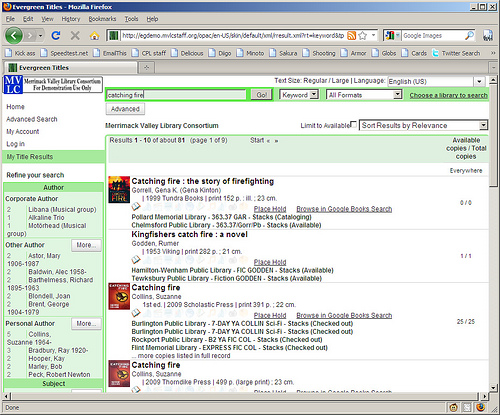
The link shows up in two places (below are some screenshots, but you can also test it live on our demo server). First and foremost, it displays for almost every book on the search results page:
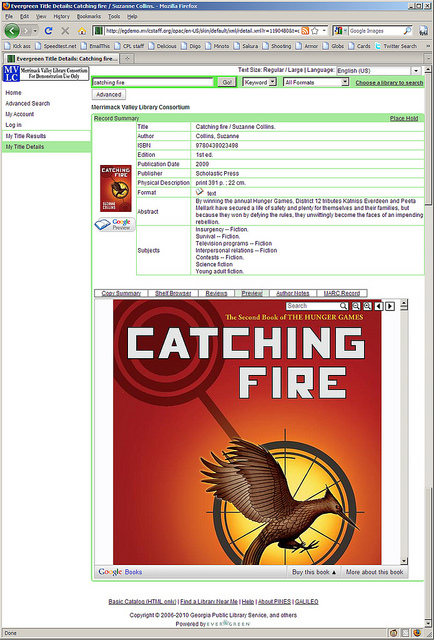
Secondly, for some records (although not all), there are additional links to Google on the item details page - sometimes the "Google Preview" icon appears under the book cover, and sometimes the "Preview" tab occurs at the bottom. When patrons click that tab, the book's preview is embedded right in the catalog. I haven't figured out the rhyme or reason behind the Preview tab appearing - not all books have it, even books that are available free online.
I'd really like to know what other people think about including these links in the catalog. For me, I knew instantly how I felt, but have been struggling to put my reasoning into words. Here goes:
- Google Books "Preview" tab on item details page
- should stay
- it is clearly adding value to the catalog and providing a service for patrons, to see into the book online
- should be improved to include all books that have preview or full text online
- "Browse in Google Books Search" link on the search results page
- should be removed
- I don't like how prominent it is - more noticeable than our "Place Hold" link
- from my testing, about 90% of the books with this link do not have any kind of "view online" option - which means this is nothing but a "buy it online somewhere" link
- as far as I can tell, even though we're essentially linking to a bookstore, we're not getting any kind of kickback from driving sales to them (and away from our collection)
- should we be linking to a bookseller at all? If so, why not the local bookstore instead?
- when there is no online preview, all the Google Books page offers is reviews, similar books, and some other information - all of which we already have in the catalog
- doesn't the link imply endorsement and approval of Google Books?
- isn't the Google Books project still tied up in courts to determine how legal it is?
So this is basically where I am - what do you think?
Posted under Uncategorized | 14 Comments »
May 21st, 2011 Brian Herzog
 One of our regulars is a patron with special needs who is in all the time - so much so that I think he considers library staff some of his closest friends.
As a result, he is totally comfortable telling us things that many of us would rather not hear - and in this case, he told me something I wasn't sure what to do with.
Just before closing one night, he comes in and walks right up to the desk, happy as can be. He pulls out a crumpled and dirty check, shows it to me, and asks me if I think the bank will cash it.
It's made out in his name, for $300, and when I ask him where he got it (occasionally he'll get checks for his birthday or things, and always tells us about how much money he has), he says:
I found it blank in the street, so I put my name on it and $300. Do you think the bank will give me the money? If not it's okay, I just want to see if they will*.
I fairly emphatically told him he should absolutely not try to cash that check, that it's illegal, it's stealing, and if he tries it, the bank won't just tell him no, they will call the police and he'll go to jail.
With this negative response, he quickly puts the check away (I also noticed it was already endorsed), and said he wasn't trying to steal, he just wanted to see if they'd cash it. And he didn't care about the police or going to jail, because he's been to jail before, and anyway his apartment was messy and he was out of food (which actually made me laugh, even though I was trying to be serious).
He went to the computers until we closed, and as he was leaving I again told him not to take it to the bank, and he said it was okay if they didn't give him the money, he just wanted to try and see if they would.
All of this happened between 8:50-9:00 PM, so there wasn't much I could do. But when I thought about it on my way home, what could I do? Call the police? The bank? Which bank? His case worker? His mom?
Instead, I emailed my Director, knowing that she has a good relationship with the Police Chief, and I had no idea what legal requirements town employees have when it comes to knowledge of intent to break a law. The next morning, she did call his case worker, who I think has some legal responsibility for him. We also have worked with this case worker in the past, on other issues relating to this patron, so it wasn't exactly a call out of the blue.
I opened that next morning, and within about fifteen minutes of opening the doors, this special needs patron came in to use the computers. I asked him if he had gone to the bank, and he said,
Yeah, they took my check away and tore it up and told me never to come back.
So, good on the bank for that reaction. I know this patron understands that what he was doing was wrong, but I think ending things by just ripping up the check was the right response, given the circumstances. I'm still not sure there is a clear role for the library in a precrime situation like this, but I am happy it resolved more or less correctly - and at least the poor guy who lost the check in the first place isn't out $300.
*Also keep in mind that this patron never speaks softly, so when he said this, very loudly in a quiet library, the other ten patrons in the area heard him.
Tags: crime, legal, libraries, Library, precrime, privacy, public, Reference Question, responsibility, special needs, theft
Posted under Uncategorized | 4 Comments »
May 19th, 2011 Brian Herzog
 My last post and peoples' comments got me thinking about displaying the circulation history of items, and how it might make items more interesting.
I don't know how many library patrons consider the fact that other people have used an item before them (unless, of course, they find some evidence of that use). But if we started showing the cost-per-circ, it might prompt some people to wonder about the X number of people who also were interested in the same thing as them.
Obviously, libraries couldn't cross any privacy lines, but I do think there are ways to highlight the "shared resources" aspect of the library, and to emphasize a sense of community among our patrons.
Some ideas for what could be shown:
- Detailed stats on cost-per-circ (including a breakdown on the library's cost for that item - price we paid for it, processing cost, etc) - and, as Walt said, this would be particularly interesting for databases
- Number of local checkouts vs. ILLs and network transfers (along with current number of holds)
- Along with number of checkouts, calculate the popularity ranking vs. total library items checkouts
- Date the item was added to the collection, and date of last checkout (and check-in)
- Some catalogs by default have an opt-in reading history for patrons; they should also have an opt-in way to make their checkout history public, on an item-by-item basis
- Some catalogs, and some third-party plugins (like ChiliFresh and LibraryThing for Libraries), allow patrons to include their review and rating for items right in the catalog record
- Ebook readers should be able to leave comments and notes in the ebook, which subsequent patrons could either turn on or off depending on if they wanted to see them
Some of this information is available in our staff view, and I use it all the time - why not make it available to the public, too?
One drawback to making this kind of item information available is that we might get a lot more "weeding suggestions" from patrons, on items they don't feel have provided enough value to the library (or that have been used too much). Of course, I get this to some degree already, so it's just a matter of having - and employing - a good collection development policy.
Does anyone's catalog include features like these? How do patrons like them?
Tags: catalog, circ, circulation, comment, comments, data, display, history, information, interactive, item, libraries, Library, patron, patrons, public, Random, review, reviews
Posted under Uncategorized | 12 Comments »
May 17th, 2011 Brian Herzog
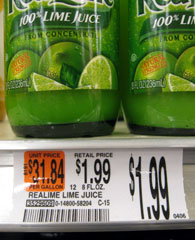 You know how stores display the "unit price" along with the retail price for items? I like this mandate, and often use that unit price to decide whether or not to buy something (or at least, which size to buy).
I was talking with some colleagues recently about bringing this practice into the library world. We decided the data we'd like to display is the cost of the book, with the "unit price" being the cost of the book spread out over the number of times the book has circulated.
Since it would constantly be changing, it'd be hard to show this on shelf (or spine) labels. But, it should be a pretty easy thing to add to the catalog's item display.
Item cost is generally not something shown in the record, but I thought if you made it somewhat interactive and interesting, people might be curious about "cost per circ." But what we couldn't decide was this:
- would patrons be more likely to check out a item with a low unit price, because it's a better "value" to the community, or
- would patrons be more likely to check out item with a high unit price, because it's a better "value" to them (as the item hasn't been used very much and is therefore of higher perceived quality)
I couldn't decide, or really even decide if it would influence my check out decision one way or another. But I do know that I would definitely be curious to look at this number every time I checked an item out.
Posted under Uncategorized | 10 Comments »
May 14th, 2011 Brian Herzog
 I'm using this question because, well, it's not funny, but I did find it remarkable.
One afternoon, a high school girl walked up to the desk and said she has to do a report on the girl that started the Amber Alert.
She wasn't sure what that Amber's full name was, and I didn't know either, but a quick internet search for just amber alert led to the Wikipedia article that gave the little girl's full name: Amber Hagerman.
I searched our catalog for her name, but got no results. Before I took the girl to our biography encyclopedias to just start flipping through the indexes, I wanted to check our Gale biography database. I logged in from our website, searched for her name, and saw this:
Occupation: Victim? Really? I'm sure that's just the name of the field, and they had to put something in there, and for 99% of the biographies, the person's occupation is why they are famous. But my gosh, how sad.
It didn't phase my patron one bit, but the articles from the database didn't actually help much. We checked a couple other databases, and between that and resources and references on the Wikipedia articles, she felt we found enough. She left happy, but that "Victim" listing really bothered me.
Posted under Uncategorized | 5 Comments »
May 10th, 2011 Brian Herzog
 You only have a few more days to submit your nomination for the 2011 Salem Press Library Blog Awards - nominations close May 13th.
Last year's inaugural awards went to some very deserving blogs, so be sure to support your favorite - new and old - again this year.
Read about the judges and full details on Salem Press' website, but here's a bit about awards, nominations, and judging process:
2011 Nominations
Please share your favorite blogs with us. Doing so will enter your beloved online reading in our 2011 Awards process. We'll be accepting suggestions through May 13, 2011. To send us nominations (including a working link to the blog), email [email protected].
Bigger & Better
This year, Library Blog Awards returns with the same goal—to recognize blogging excellence across the library spectrum—but with a new structure. We have increased the number of volunteer judges (from four to 15) and blog categories (from five to eight) and added a new dimension to the process: the public vote.
After our judges complete the first round of eliminations and finalists are announced on May 18th, we will ask readers and interested parties to cast their votes online. The list of winners (one per category) will follow in mid-June.
Last year I was awarded gold star recognition, which is great. But what I like most about these awards is how they work as a discovery tool in finding new bloggers and resources.
If you are so inclined, send in your nomination before May 13th.
Update 5/17/11: Public voting is now open until June 1st - cast your vote for your favorite blogs (and thanks everyone for nominating me for Public Library blog!)
Posted under Uncategorized | Comments Off on Last Call for 2011 Salem Press Library Blog Awards Nominations